
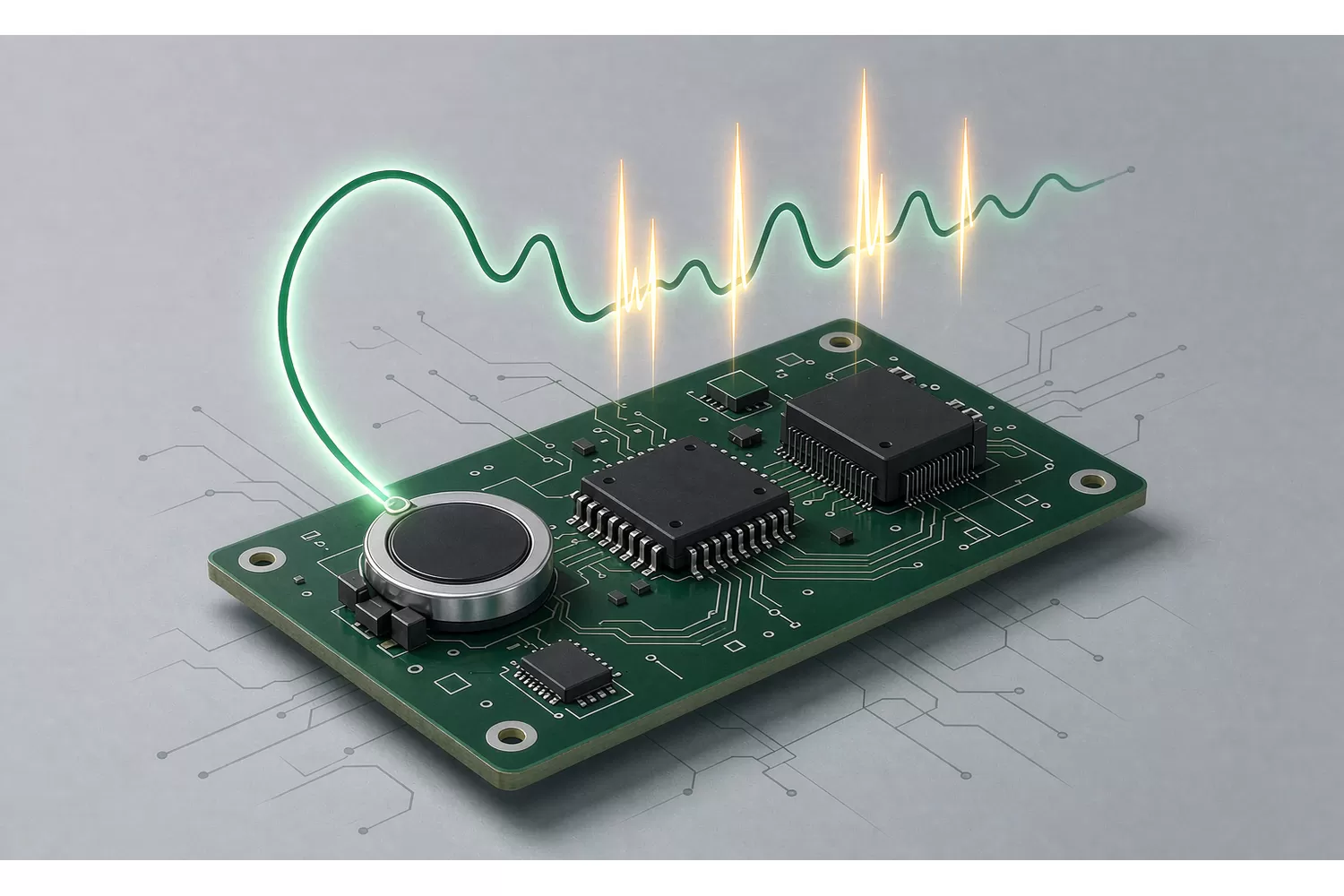
Battery-powered products have a cost structure that defeats normal BOM logic. Every gram of battery, every square millimetre of board and every milliamphour of capacity is tied to how much current the microcontroller wastes while it looks like it is doing nothing. This article covers the AT32 low-power parts from both sides: the engineering decisions and the cost consequences.

Parts discussed: AT32L021K8U7-4 in QFN32 and AT32L021C8T7 in LQFP48.
The battery cost is not the battery price
For a typical IoT-style node the cell is the largest single recurring cost, and it is decided by the current budget. That makes the MCU's power profile a procurement decision. A part that is cheaper in silicon but pushes you to a bigger cell has not saved money, it has moved the cost.
| Cost line | Driven by | How the MCU choice moves it |
|---|---|---|
| Cell capacity and cost | Average current over a year | Sleep current and wake-up count |
| Cell holder or connector | Cell size and shape | Capacity requirement, not the part |
| Charge / protection IC | Cell chemistry and current | Sometimes none if the part integrates it |
| Board area | Package and support parts | Package choice, external references |
| Service life | Cell self-discharge and MCU wear | Leakage and flash write frequency |
The row that gets overlooked is the last one. A device designed for a five-year service life has to be evaluated against five years of cumulative leakage and flash writes, not against the first week on the bench.
Sleep current versus active current
These two numbers are optimised by different techniques, and choosing the wrong one to fight is the most common low-power mistake.
- Duty cycle under one percent — sleep current governs. Shut down unused peripherals, gate the reference voltage, and keep wake-up paths to a timer or a pin interrupt.
- Duty cycle over ten percent — active current governs. Look at core efficiency, core voltage scaling, and how long each conversion takes.
- Bursty with long idle gaps — the wake-up cost matters. Every wake-up that does nothing measurable burns a fixed charge, so consolidating wake-ups beats lowering each one.
What the AT32L021 brings
The AT32L021 family is positioned for exactly this class of design: a small Cortex-M core, a modest flash footprint for a firmware that wakes, reads a sensor, decides and goes back to sleep, and the packaging options you need to keep the board small.
- AT32L021K8U7-4 — QFN32. Smaller board area, good for a tight sensor node.
- AT32L021C8T7 — LQFP48. Easier to route and to rework during the prototype phase.
Whichever you pick, the order of operations is the same: decide the duty cycle, then measure the actual profile, then size the cell, then quote.
Checklist before you commit a low-power design
- Log the current profile over a full duty cycle on the real board, not on a breadboard.
- Confirm the sleep current with unused peripherals explicitly disabled, since that is where the surprise lives.
- Decide where calibration data and fault logs live, then decide how often they are written.
- Size the cell to the measured profile, with margin for cold-start and for end-of-life capacity.
- Re-quote the whole BOM with the new cell, including the holder, before declaring the design optimised.
Step five is the one that keeps low-power projects honest. The saving is frequently in the battery selection, not in the microcontroller.
Related reading
Microcontrollers and MCUs · AT32F011K8U7-4 · AT32F415CCU7
Frequently asked questions
How do I cost a battery-powered design beyond the cell price?
Price the cell, then the holder or connector, then the charging and protection parts, then the standby current your firmware actually consumes over a year. A part that saves a cent in silicon but doubles sleep current will cost more over the product life, and if the product ships with a larger cell to compensate, the saving is gone completely.
What matters more on an AT32 low-power part, sleep current or active current?
It depends entirely on duty cycle. A device that wakes ten times a day and runs for two milliseconds sleeps almost all of its life, so sleep current sets the battery life. A device that runs a sensor loop continuously is dominated by active current and core efficiency. Check the duty cycle first, then decide which number to optimise, because optimising the wrong one is a common and expensive mistake.
Should I choose an LQFP or QFN package for a low-power part?
The package affects the leakage and the noise more than the part number does. A QFN with a good ground plane under the part usually gives cleaner analog readings and better thermal behaviour, while a TSSOP or LQFP is easier to prototype and rework. For a high-volume battery device, the QFN usually wins on board area; for a development phase, the easier package wins on time.
Does an on-chip EEPROM remove a cost from my BOM?
It can. Storing calibration data, fault logs and user settings in flash instead of an external EEPROM removes a chip, its routing and its I2C overhead. The trade-off is flash wear: repeated writes to the same flash page shorten its life, so use a wear-levelling routine or keep writes infrequent and infrequent.
How do I size the battery for the AT32 part I choose?
Measure, do not estimate. Run the target firmware on the actual part, log the current profile over a full duty cycle, and multiply by the cycle count over the intended service life. Estimate from datasheet numbers and you will typically be optimistic by a factor that is uncomfortable to discover after tooling.
About us & trademarks: JTDZ Tech (Shenzhen Jingteng Electronics Technology Co., Ltd.) is an independent distributor of electronic components. We are not an authorised distributor or representative of the manufacturers named in this article. Manufacturer and part names are used for indicative purposes only, to help identify the components discussed; all trademarks remain the property of their respective owners. Always verify specifications against the official datasheet before design-in or purchase.
Recommended next steps
If you are sourcing any of the parts mentioned in this guide, we can help you confirm stock, pricing, and lead times quickly.
- Upload your BOM — send your full parts list and receive a consolidated quote within 2 business hours.
- Browse related in-stock lines: Microcontrollers / MCUs · Power Management ICs.
- Contact our team for hard-to-find or end-of-life components.
