
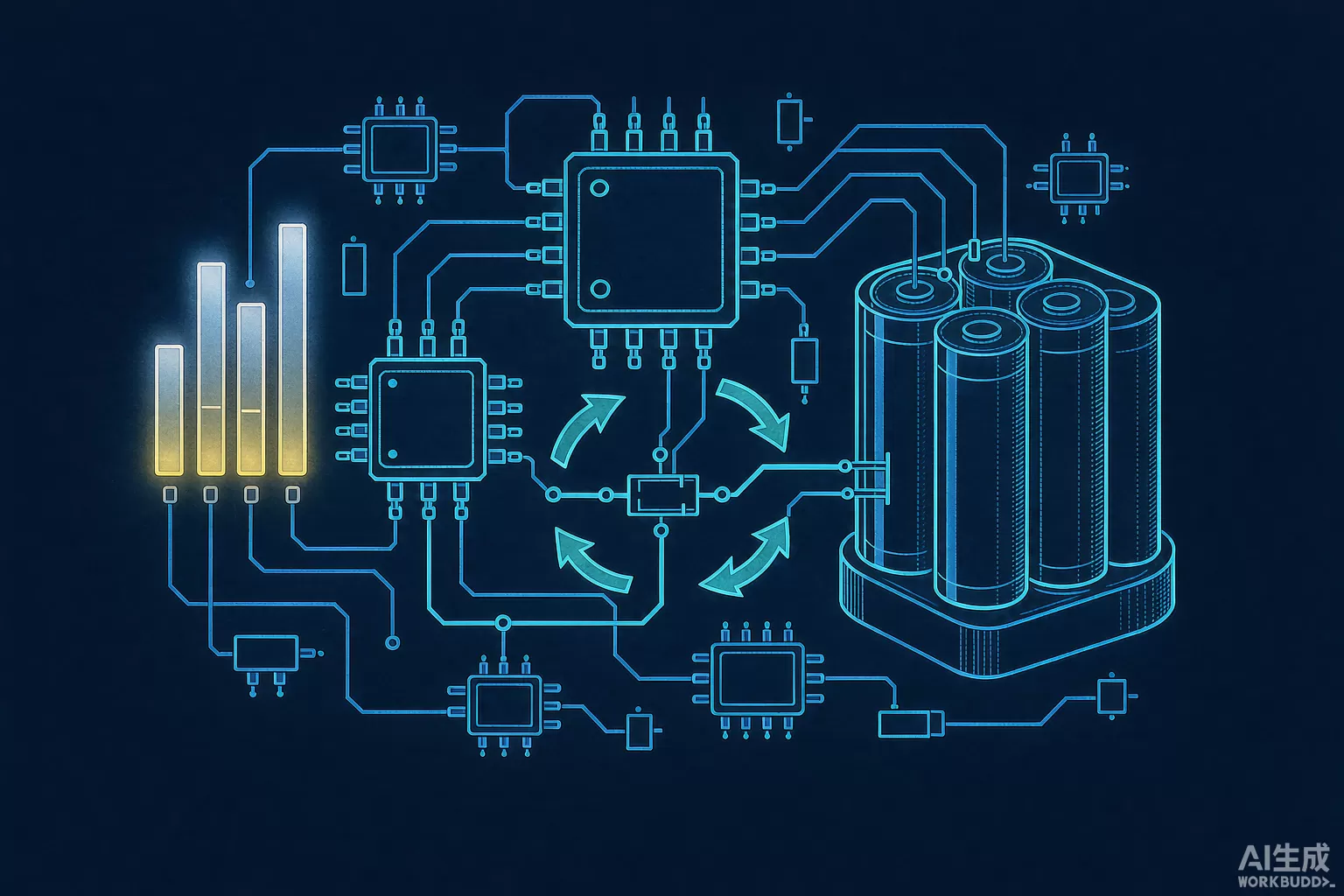
Charge Management and Current-Sense ICs for Portable and Battery Devices
Every battery-powered product pairs two quiet workhorses: a charge management IC that safely fills the cell, and a current-sense amplifier that tells the system what is flowing in and out. Feeling Technology covers both roles, and this guide shows how the pieces fit — all part numbers are in stock as an independent distributor.
Linear charge management: simple, quiet, right-sized
Linear chargers regulate charge current with a pass element, essentially acting as a smart LDO. For single-cell Li-ion/Li-Po packs charged from 5 V USB at up to roughly 1 A, they beat switching chargers on cost, footprint and noise. Feeling's charge family includes FP8102XR-G1 (SO-8(EP)), FP8208AXR-G1 (SOP-8) and the TSSOP-14 FP8207MR-G1 for designs needing extra feature pins. Typical features across the family: CC/CV profile, charge-status flags for the MCU or LED, and thermal/protection behaviours — verify the exact set per part on the datasheet.
Why the charge profile matters
Lithium charging is a three-act play: precharge (gently recover deep-discharged cells), constant current (bulk of the energy, typically 0.5 C), and constant voltage (top-off while current tapers to a termination threshold). The IC enforces all three automatically; your job is to size the input supply, set the program resistor for charge current, and make sure thermal conditions keep the die within limits — linear chargers dissipate (VIN − VBAT) × ICHG, which is why layout copper matters.
Current-sense amplifiers: measuring without disturbing
A current-sense amplifier reads the small differential voltage across a shunt resistor and scales it to a ground-referenced output the ADC can use. The Feeling lineup: FP355KR-G1 (SOT23-5), FP130AKR-LF (SOT23-5) and the SOT23-6 FP135LR-G1, FP136LR-G1, FP137LR-G1 — covering gain and bandwidth variants for fuel gauging, load management and protection loops.
Putting the pair together
| Function | Device | What it buys you |
|---|---|---|
| Charge the cell | FP8102 / FP8208 / FP8207 | Safe CC/CV charging with status flags |
| Measure charge/discharge current | FP355 / FP130A / FP135 / FP136 / FP137 | Fuel gauge and protection input for the MCU |
| Generate system rails | FP61xx buck / FP62xx boost | See our buck and boost guides |
Layout checklist
- Place the shunt resistor with Kelvin connections straight to the sense amplifier's inputs — power-route current, sense-route voltage.
- Keep the charger's program resistor and BAT trace short; add thermal copper under the charger die.
- Status outputs are open-drain on many parts — pull them up to the right logic rail.
Sourcing
- All parts above are listed under Power Management Chips with live quantities.
- Building the full portable-device power chain? Upload your BOM — we quote the complete list including the charger, sense amps and converters.
- Or contact us for date codes and volume pricing.
Questions & Answers
When is a linear charger the right choice over a switching charger?
For single-cell packs charged from 5 V at up to about 1 A, linear chargers are simpler, cheaper and quieter. Above that, the (VIN−VBAT)×ICHG dissipation pushes you toward a switching charger.
Why use a current-sense amplifier instead of measuring the shunt directly with an ADC?
The amplifier rejects the large common-mode voltage across the shunt and scales the tiny differential signal to a usable, ground-referenced range — something a plain ADC input cannot do accurately at high-side shunts.
What do the FP135/FP136/FP137 suffix differences mean?
They are distinct part numbers in the current-sense family with differing gain/bandwidth/supply characteristics. Compare the datasheet parameters for your ADC range and bandwidth needs.
Do you stock these Feeling Technology charge and sense ICs?
Yes — we are an independent distributor with spot stock. Each product page lists quantity and date code; request a quote for volume pricing.
Trademark & Disclaimer
MST, Feeling Technology and all part numbers are trademarks or registered trademarks of their respective owners. Jingteng Electronics is an independent distributor and is not affiliated with, endorsed by, or authorized by Feeling Technology. Brand names and part numbers on this page are used solely for identification and cross-reference. Electrical specifications must be confirmed against the original manufacturer datasheet before use. See our Legal Notice / Trademark Disclaimer.
Recommended next steps
If you are sourcing any of the parts mentioned in this guide, we can help you confirm stock, pricing, and lead times quickly.
- Upload your BOM — send your full parts list and receive a consolidated quote within 2 business hours.
- Browse related in-stock lines: Power Management ICs.
- Contact our team for hard-to-find or end-of-life components.
