
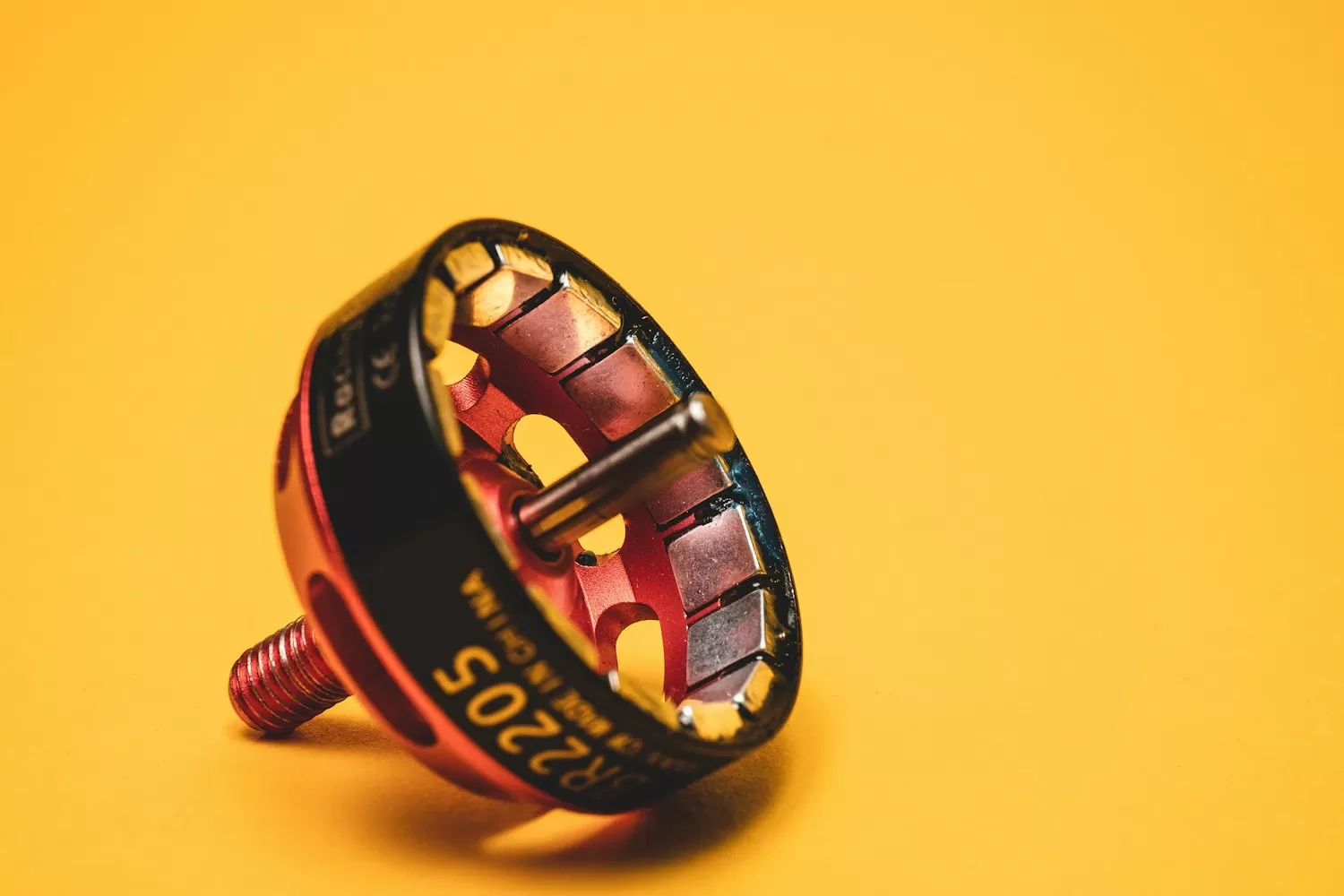
Brushless DC motors have quietly become the default everywhere something spins: cordless tools, ceiling and server fans, water pumps, gimbals, and of course drones. They are efficient, compact, and mechanically simple - three phase windings, a permanent-magnet rotor, and position knowledge. The engineering effort has moved into the controller, and the controller is where MCU selection actually matters.
Six-step: the dependable baseline
Trapezoidal, or six-step, commutation energizes two of three phases at a time and steps the pattern every 60 electrical degrees based on Hall sensors or back-EMF zero-crossing detection. It needs only modest compute - a timer with six complementary outputs, dead-time insertion, and either a Hall interface or an ADC fast enough to catch zero crossings. The cost is torque ripple and audible switching noise at low speed, which is acceptable in fans and pumps but annoying in a gimbal or an e-bike hub motor under load.
FOC: smooth, efficient, compute-hungry
Field-oriented control transforms the three-phase currents into a rotating reference frame and regulates the torque-producing component directly, typically in a current loop executing every 50 to 100 microseconds. The payoff is continuous torque with minimal ripple, higher efficiency at partial load, and naturally quiet operation. The compute bill is a pair of Clarke and Park transforms, two PI loops, and PWM update - all trivial for a Cortex-M4 with a hardware FPU, which is exactly why FOC moved from servos into consumer products over the past decade.
This is where parts like the Artery (雅特力) AT32 series earn their place in motor designs. The AT32F4xx families pair a 240 MHz Cortex-M4 with advanced timers offering complementary PWM outputs and programmable dead-time, fast 12-bit ADCs with injected-channel conversion synchronized to the PWM period, and enough flash - up to the multi-megabyte class in the AT32F435 - for sensorless start-up routines alongside the control loop itself. For cost-sensitive products, Sinomcu (赛元) SC32F series MCUs cover the same architectural pattern at mainstream price points for fan and pump applications.
The details that decide success
- Dead time: too short and shoot-through current heats the MOSFETs; too long and distortion grows at low modulation. 200 to 500 ns is the usual starting range for 40 to 60 V MOSFET bridges.
- Current sensing: low-side shunts on two phases read by injected ADC channels triggered at the center of the PWM counter give ripple-free samples without extra isolation parts.
- Sensorless start: open-loop spin-up of a sensorless motor is the hardest part of the firmware. Budget real calibration time for it across temperature and load.
- Braking and supply pumping: rapid deceleration pushes energy back into the DC bus; either plan a brake chopper or restrict deceleration ramps.
Choosing between them
A useful rule of thumb: if the motor spends its life at steady speed driving a fan or impeller, well-tuned six-step with sensorless zero-crossing is often the better business decision - simpler firmware, smaller MCU, fewer things to certify. If the load varies widely, the product is hand-held, acoustic noise is a marketing issue, or efficiency directly drives battery size, FOC pays for its complexity quickly. Either way, verify the MCU data sheet for the three hardware essentials before committing: complementary PWM with dead-time, ADC-to-PWM synchronization, and a math library or FPU that keeps the control loop under ten percent of CPU time. Everything else in a motor controller is Ordinary Engineering; these three are what separate a clean design from a hacksaw firmware project.
Recommended next steps
If you are sourcing any of the parts mentioned in this guide, we can help you confirm stock, pricing, and lead times quickly.
- Upload your BOM — send your full parts list and receive a consolidated quote within 2 business hours.
- Browse related in-stock lines: Microcontrollers / MCUs · Amplifiers / Data Conversion.
- Contact our team for hard-to-find or end-of-life components.
