
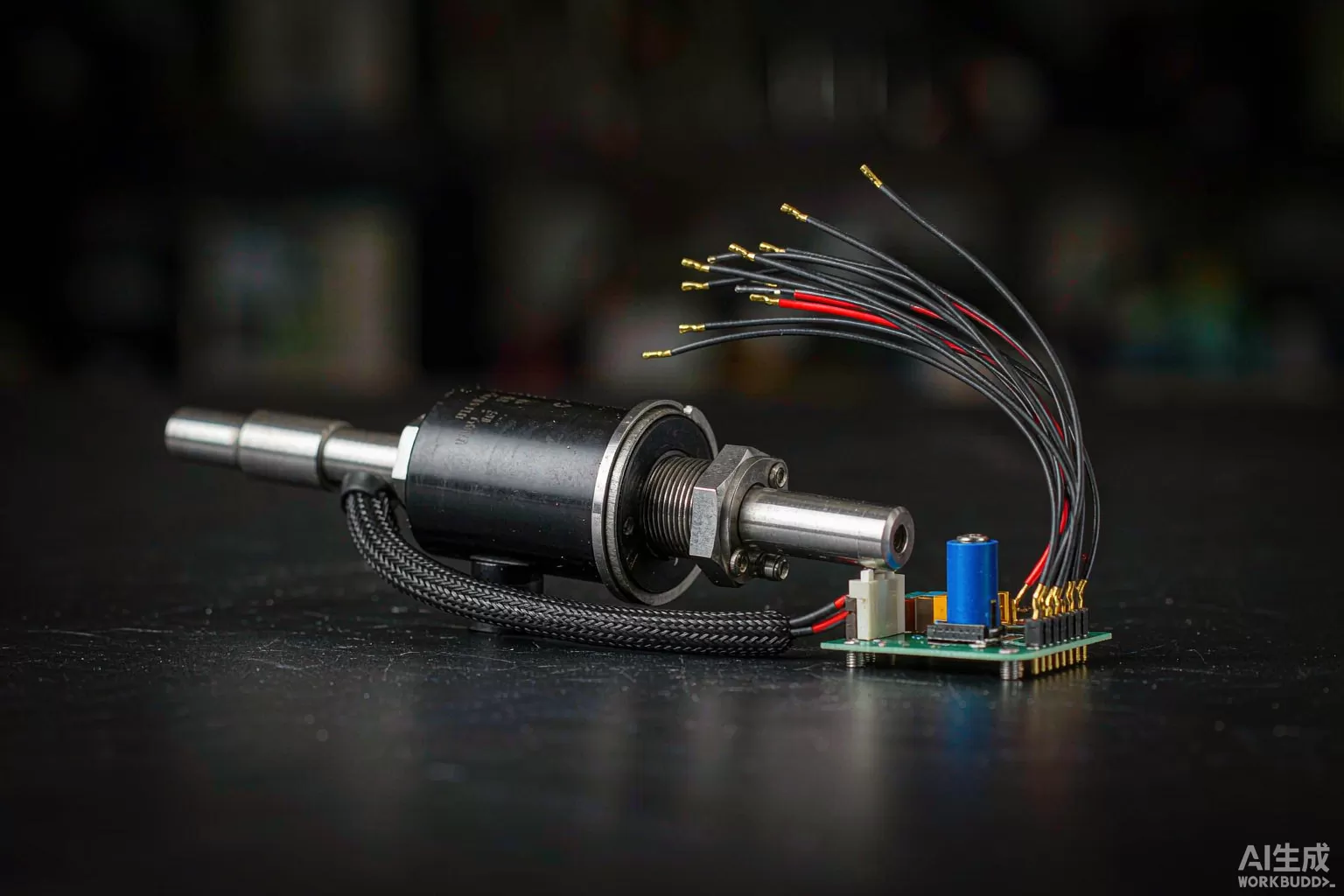
Sensors rarely output a voltage you can hand straight to an ADC. The op-amp front-end is what turns a millivolt bridge deflection or a shunt voltage into a clean, scaled, ground-referenced signal — and its quality sets your achievable accuracy.
Bridge and load-cell conditioning
A Wheatstone bridge produces a differential signal sitting on a common-mode voltage, often only millivolts of delta across volts of common mode. A high-CMRR instrumentation-style front-end built around a precision op-amp, or a dedicated difference amplifier, rejects the common mode. Here a zero-drift device such as COS8551 removes the offset that would otherwise swamp a small bridge output.
RTD and thermocouple
RTDs need a precise excitation current and a linearizing front-end; thermocouples need cold-junction compensation and very low offset because their signal is only tens of µV/°C. Both reward the lowest-drift amplifier you can afford.
High-side current sense
A current-sense amplifier such as COSINA180 measures the small voltage across a shunt while rejecting a large common-mode voltage up to the supply rail — essential for 4–20 mA loops and battery management. For higher-voltage loops, a 36 V precision part like COS2180 keeps the sense range safe.
Across the COSINE amplifier portfolio we stock, the parts above plus COS6054 cover bridge, thermal and current-sense front-ends from portable to industrial supplies.
Alternative & Cross-Reference Parts (for reference)
The devices below are commonly used industry parts in the same functional class. They are listed for identification and compatibility-engineering reference only. A cross-reference is not a guarantee of pin-to-pin or 100% functional equivalence — package, pinout, electrical parameters and temperature drift can differ between devices. Always verify against the original manufacturer's datasheet before substituting any part.
| Manufacturer | Typical part(s) | Class / note |
|---|---|---|
| Texas Instruments | INA333 / INA188 | Instrumentation amplifier |
| Texas Instruments | INA181 / INA186 | Current-sense amplifier |
| Analog Devices | AD8421 / AD8226 | Instrumentation amplifier |
| Analog Devices | AD8210 | High-side current-sense |
| Maxim Integrated | MAX4208 | Instrumentation amplifier |
| Texas Instruments | LMP7701 | Precision front-end |
Mentioned brands (Analog Devices®, Texas Instruments®, Maxim Integrated®, Microchip®, STMicroelectronics®) are trademarks of their respective owners. Jingteng Electronics is an independent distributor and is not affiliated with, authorized by, or an agent of any semiconductor manufacturer.
Related COSINE Precision Amplifiers In Stock
| Part number | |
|---|---|
| COSINA180 current-sense | Check stock & quote |
| COS2180 36V precision | Check stock & quote |
| COS8551 zero-drift | Check stock & quote |
| COS6054 micro-power | Check stock & quote |
Frequently Asked Questions
Why not just amplify with one op-amp?
A single op-amp lacks the matched, high-CMRR differential rejection that bridge and 3-wire RTD readings need, so drift and common-mode error dominate. An instrumentation topology (or a dedicated current-sense amplifier) is usually worth it.
When do I need a zero-drift part here?
Whenever the sensor output is tiny and changes slowly — load cells, strain gauges and DC current shunts. The residual offset of a normal op-amp becomes a large fraction of the signal; zero-drift parts remove most of it.
High-side or low-side current sense?
High-side senses the current without disturbing the return path and works with grounded loads, but demands an amplifier with high common-mode range. Low-side is simpler but drops the load below ground reference.
Recommended next steps
If you are sourcing any of the parts mentioned in this guide, we can help you confirm stock, pricing, and lead times quickly.
- Upload your BOM — send your full parts list and receive a consolidated quote within 2 business hours.
- Browse related in-stock lines: Amplifiers / Data Conversion · Power Management ICs · Sensors / Optoelectronic Devices.
- Contact our team for hard-to-find or end-of-life components.
Trademark & Cross-Reference Notice
COSINE (科山芯创) is a registered trademark of its respective owner. References on this page to COSINE part numbers, and any comparison to devices from other manufacturers, are provided for identification and compatibility-engineering purposes only, indicating the function, package and parametric class a given part belongs to. Jingteng Electronics (Shenzhen) is an independent distributor, not an authorized agent or affiliate of COSINE or any other semiconductor manufacturer. A cross-reference does not imply pin-to-pin or 100% functional equivalence; before substituting any device, verify the package, pinout, electrical parameters and the original datasheet. Product availability, pricing and date code are confirmed at quotation.
About Jingteng Electronics
Jingteng Electronics (Shenzhen Jingteng Electronics Technology Co., Ltd.) is an independent distributor of electronic components, focused on hard-to-find and obsolete ICs, analog and mixed-signal devices. We source through long-verified, traceable channels and support BOM matching, small-lot sampling and volume inquiries. Contact us for a quote, or upload your BOM for a consolidated quote.
