
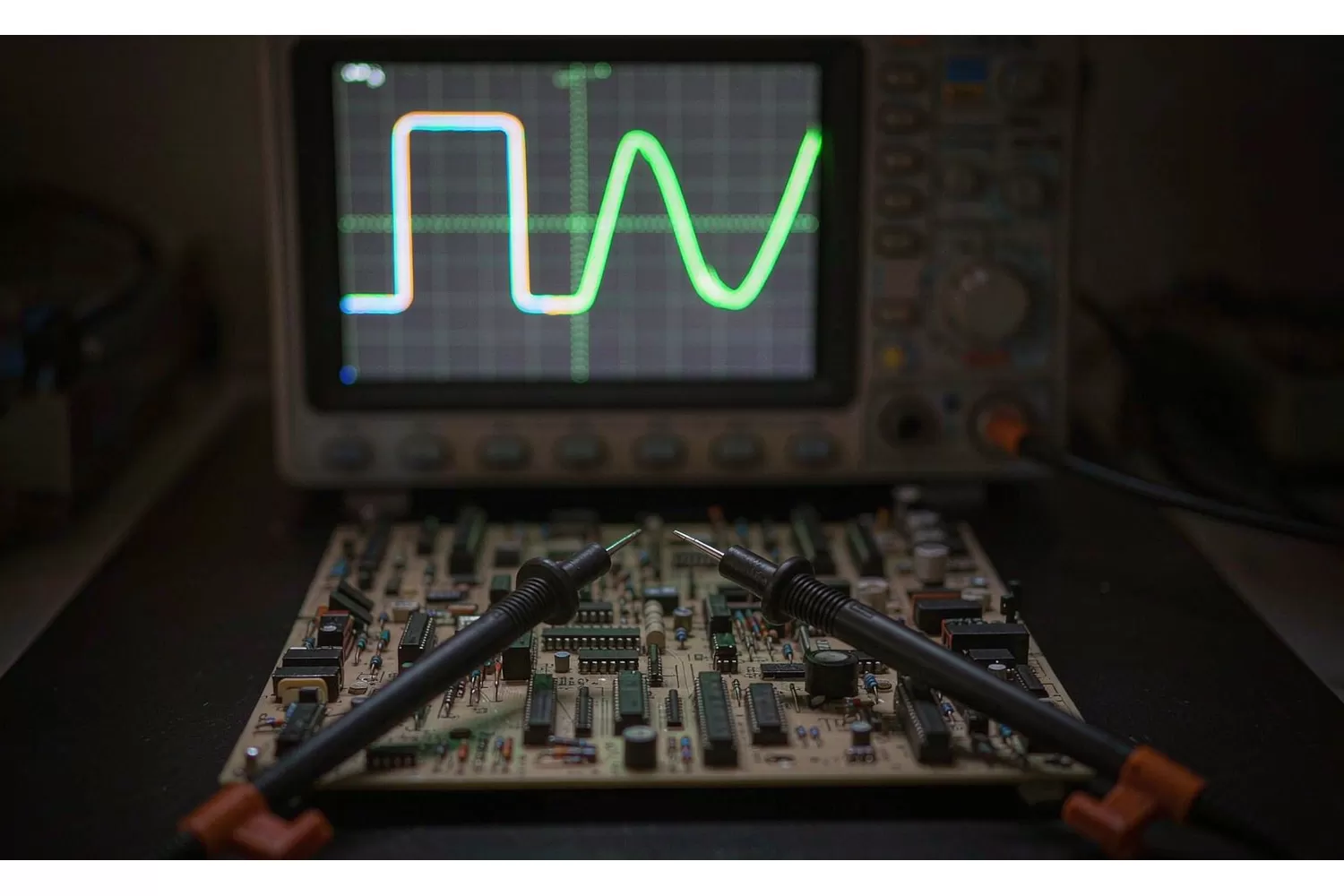
“It has enough bandwidth” is one of the most common — and most expensive — assumptions in analog design. Bandwidth and slew rate are two different specifications describing two different behaviours, and an amplifier can satisfy one while failing badly on the other. Understanding which one actually limits your circuit is what lets you cost a substitution honestly instead of guessing.

Gain bandwidth product: a small-signal promise
GBW describes how the open-loop gain rolls off with frequency. The product of gain and bandwidth is roughly constant, so a part with 10 MHz of GBW gives you gain 10 to about 1 MHz, or gain 100 to about 100 kHz. The closed-loop −3 dB corner for a non-inverting stage is approximately:
f−3dB ≈ GBW / noise gain
This is a small-signal parameter. It assumes the devices inside the amplifier stay in their linear region and that the internal compensation capacitor is doing the limiting. At higher output amplitudes that assumption breaks.
Slew rate: a large-signal limit
Slew rate is the maximum rate of change of the output, in V/µs, set by the current available to charge the internal compensation capacitor. It has nothing to do with frequency domain gain. For a sine wave of peak amplitude Vpk, the required slew rate is:
SRrequired = 2π × f × Vpk
Rearrange it and you get full-power bandwidth: the frequency at which an amplifier can just deliver its rated swing. A part with 2 V/µs driving a 4 V peak signal runs out of slew at about 80 kHz — even though its GBW might be 30 MHz. Above that frequency the output stops being a sine and becomes a triangle, and distortion climbs.
Which one limits you? Ask the waveform
| Signal at the output | What usually limits | What to check |
|---|---|---|
| Small sine, low amplitude (< 100 mV pk) | GBW | Noise gain, closed-loop corner, phase margin |
| Large sine near the rails | Slew rate | Full-power bandwidth at your peak amplitude |
| Square wave, fast edges | Slew rate | Rise time = 0.35 / f, check SR × rise time |
| Step settling in a data acquisition front end | Both | Slew time plus linear settling to target accuracy |
| Precision DC only | Neither | Offset, drift and noise budget |
The underlying logic of a substitution
When a part is hard to get and a candidate replacement has a similar GBW, that comparison only covers the small-signal case. Three further checks decide whether the swap survives contact with the real signal:
- Peak output amplitude. Slew limiting depends on how far the output must swing, and that is set by your circuit, not by the amplifier. A stage running close to full scale at high frequency is the one that will fail first.
- Load. Capacitive loads and low resistance reduce the effective available output current and therefore the achievable slew rate. Two parts with the same headline number can behave differently into 100 pF.
- Quiescent current. Speed costs bias current. A faster substitute solves the slew problem and creates a thermal or battery-life problem, which is a cost you pay every hour the product runs, not once at the line item.
Where it pays to be generous
In our experience, analog front ends that sample fast or drive cables benefit from real margin here: pick an amplifier whose full-power bandwidth at your peak amplitude is at least two to three times the highest signal frequency, and whose slew rate comfortably exceeds the calculated requirement. The premium is small next to the cost of a redesign, and it also gives you room to substitute later without re-validating the whole chain.
| Model | Positioning | Typical use | Link |
|---|---|---|---|
| COS8052SR | 5 V high-speed | Video and ADC drivers, fast sensor buffers | COS8052SR |
| COS8092SR | 5 V high-speed, dual | Two-channel fast acquisition | COS8092SR |
| COS227USR | 36 V high-speed precision | High-voltage signal chains needing both speed and DC accuracy | COS227USR |
| COS8032ARZ | 12 V high-speed | Wider supply fast stages | COS8032ARZ |
See the whole family in amplifiers and data conversion. Send us the waveform — amplitude, frequency and edge rate — and we will tell you which specification is really binding before you quote a substitute.
我们作为独立分销商保证所供元器件为原装正品,并提供日期码与检验选项,助您在量大量前完成验证。
价格随采购数量与行情流动,所示价格仅供参考。欢迎询价获取实时报价,量大从优。
About us & trademarks: JTDZ Tech (Shenzhen Jinteng Electronics Technology Co., Ltd.) is an independent distributor of electronic components. We are not an authorised distributor or representative of the manufacturers named in this article. Manufacturer and part names are used for indicative purposes only, to help identify the components discussed and the parts they are commonly compared with; all trademarks remain the property of their respective owners. Always verify specifications against the manufacturer's datasheet before design-in or purchase.
