
Hall Effect Switches Explained: Unipolar, Bipolar, Latch and Linear Types
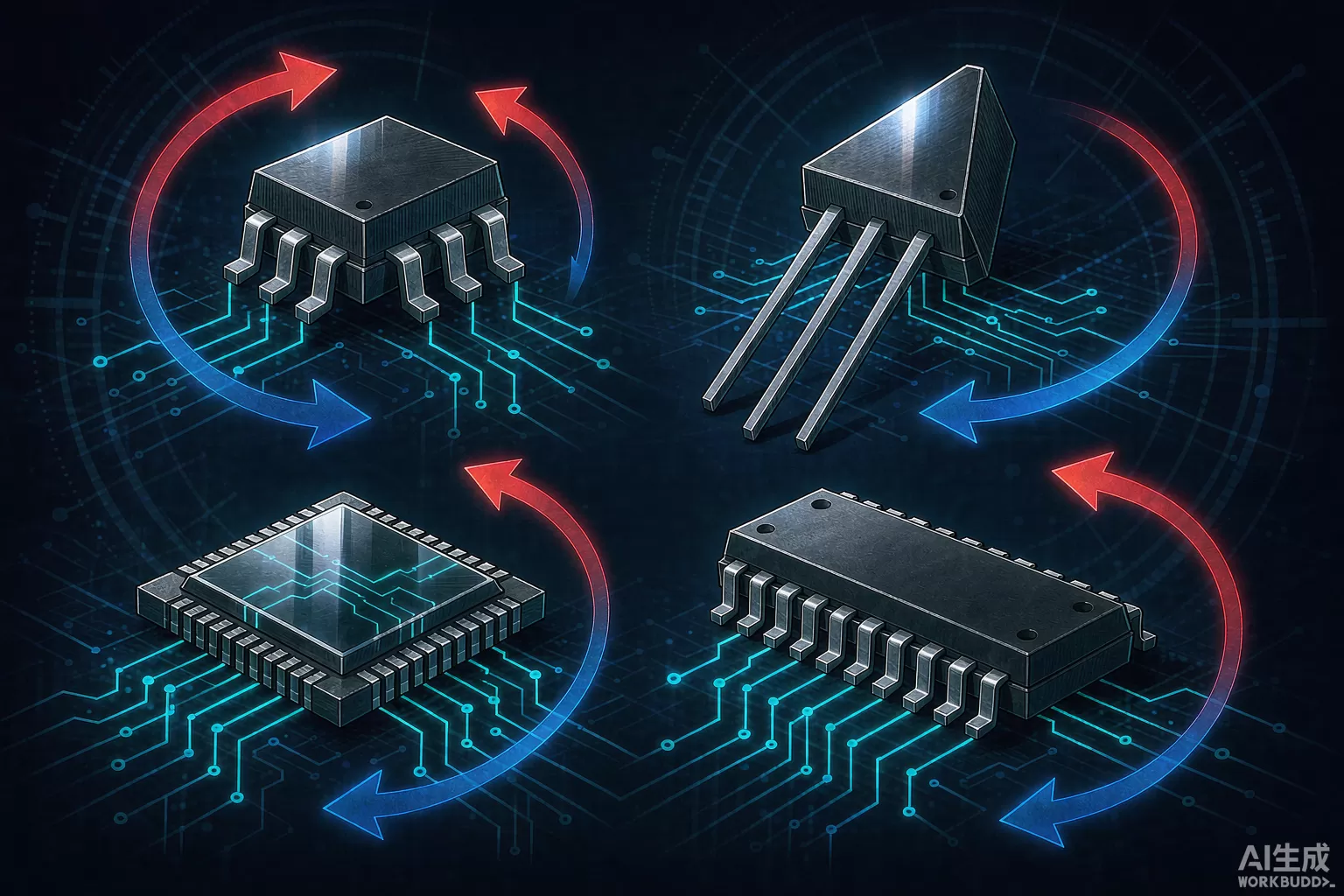
Hall effect sensors convert a magnetic field into an electrical signal, and they sit at the heart of position sensing, speed measurement, current sensing and brushless motor commutation. But "Hall sensor" is an umbrella term: a unipolar switch, a bipolar switch, a latch and a linear sensor behave very differently in the same circuit. This guide walks through the four families using devices from the MST MH series, all of which we stock as an independent distributor.
1. Unipolar micropower switches — one pole, one threshold
A unipolar switch turns on when a single magnetic pole (usually the south pole) exceeds its operate threshold (BOP) and turns off when the field drops below the release threshold (BRP). The hysteresis between BOP and BRP prevents chattering at the switching point. Low-voltage micropower parts such as MH248EST (SOT23) and MH248EUA (TO-92S) are designed for battery-powered equipment where every microamp counts, as are the MH251EST and MH251EUA in TSOT23 and TO-92S packages respectively. For slightly higher drive capability, the MH253ESO and MH253EUA pair offers the same family behaviour in SOT23 and TO-92S.
2. Bipolar switches — polarity-agnostic switching
Bipolar devices respond to either pole with sufficient strength, which makes them forgiving in cost-sensitive assemblies where magnet orientation is hard to guarantee. The MH28x family (MH281KSO, MH281KUA, MH282KSO, MH282KUA) covers this niche in SOT23 and TO-92S, and is commonly used for lid-closing detection and flow-meter fin counting.
3. Hall latches — remembering the last pole seen
A latch outputs one state for a north pole and the opposite state for a south pole, holding that state until the opposite pole arrives. That memory behaviour is exactly what brushless motor commutation and rotary encoding need. MST's high-voltage latch family includes MH180KSO / MH180KUA, MH181ESO / MH181EUA, MH182ESO / MH182EUA and MH188ESO / MH188EUA — the "KUA/ESO/EUA" suffixes map to TO-92S and SOT23 packages so the same die can serve both through-hole and SMD assembly.
4. Linear Hall sensors — an analog view of the field
Linear devices output a ratiometric analog voltage proportional to flux density, enabling angle, position and current measurement. The MST lineup includes MH254EUA / MH254EST for classic linear sensing, and the MH48x/49x generation such as MH481IST, MH481ISQ (QFN2020-3) and MH481ISD (QFN2020-6) plus MH491ISO-A and MH491IUA-A for compact designs.
Quick selection table
| Family | Behaviour | Typical use | MST examples |
|---|---|---|---|
| Unipolar switch | On above BOP, off below BRP, one pole | Proximity, lid/door detection | MH248 / MH251 / MH253 |
| Bipolar switch | Switches on either pole | Flow meters, cheap position flags | MH281 / MH282 |
| Latch | State flips between N and S poles | BLDC commutation, encoders | MH180 / MH181 / MH182 / MH188 |
| Linear | Analog voltage ∝ flux density | Current sensing, angle/position | MH254 / MH481 / MH491 |
Where to go next
- Browse all magnetic sensors in our Sensors & Optoelectronic Devices category.
- Have a BOM with Hall devices on it? Upload your BOM for a full quote.
- Questions about package, threshold or availability? Contact us — we hold spot stock of the MST MH series.
Questions & Answers
What is the difference between a Hall switch and a Hall latch?
A switch turns on when one pole approaches and off when the field is removed. A latch holds its output state until the opposite magnetic pole is presented, which is why latches are used for motor commutation and encoding.
Which MST Hall parts suit battery-powered products?
The low-voltage micropower families such as MH248, MH251, MH253 and MH281/MH282 are aimed at portable, battery-operated equipment. Confirm sleep current and thresholds against the datasheet for your supply rail.
Do TO-92S and SOT23 versions use the same silicon?
Within the MH series, package suffixes (EST/ESO/SOT23, EUA/UA/TO-92S, ST/TSOT23) normally denote package variants of the same core design, but pin-out and thermal behaviour must be verified per the datasheet.
Does Jingteng Electronics sell MST parts directly?
Yes. We are an independent distributor carrying spot stock of the MST MH series with the quantities and date codes listed on each product page. Request a quote for current pricing.
Trademark & Disclaimer
MST, Feeling Technology and all part numbers are trademarks or registered trademarks of their respective owners. Jingteng Electronics is an independent distributor and is not affiliated with, endorsed by, or authorized by MST. Brand names and part numbers on this page are used solely for identification and cross-reference. Electrical specifications must be confirmed against the original manufacturer datasheet before use. See our Legal Notice / Trademark Disclaimer.
Recommended next steps
If you are sourcing any of the parts mentioned in this guide, we can help you confirm stock, pricing, and lead times quickly.
- Upload your BOM — send your full parts list and receive a consolidated quote within 2 business hours.
- Browse related in-stock lines: Sensors / Optoelectronic Devices.
- Contact our team for hard-to-find or end-of-life components.
