
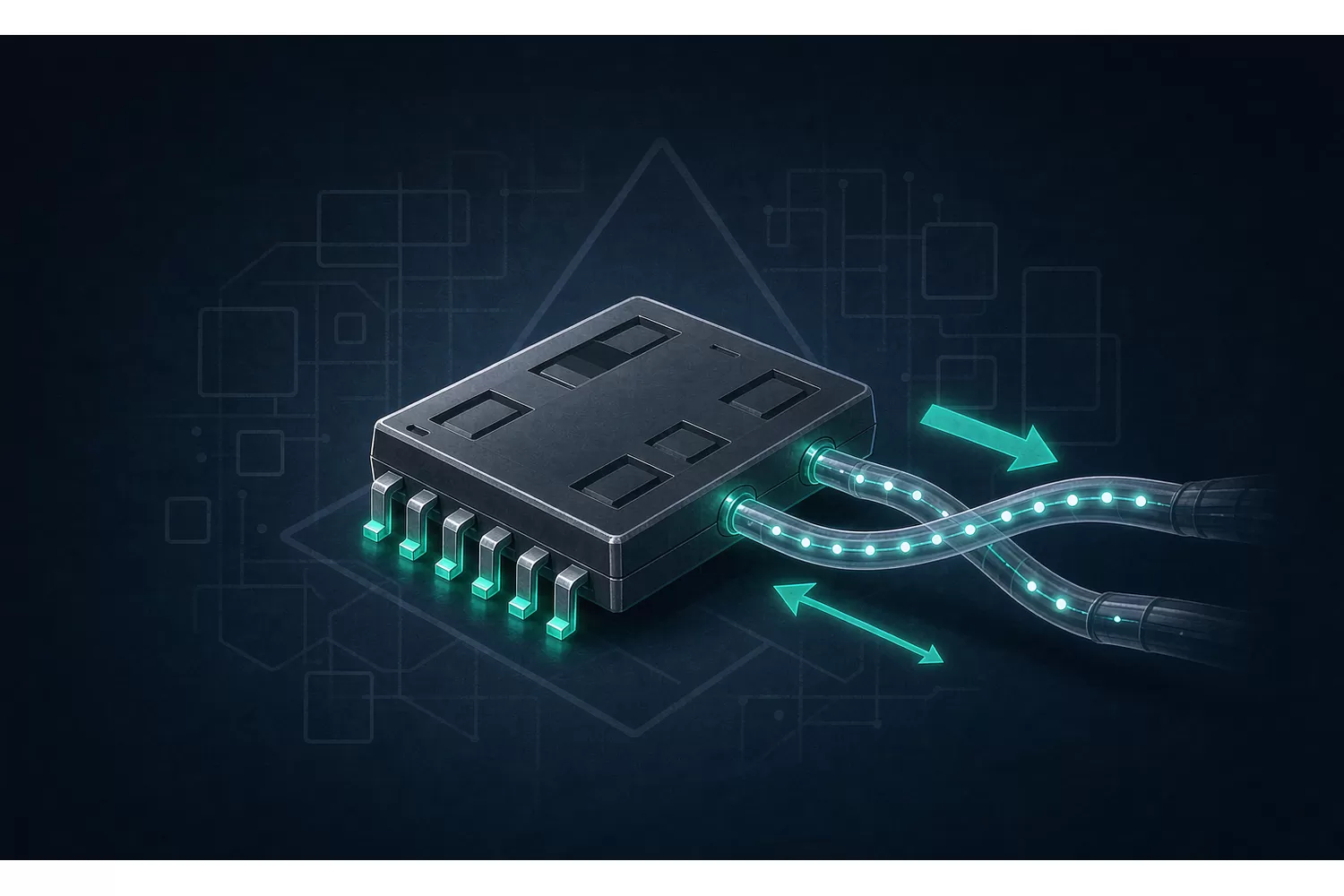
Industrial equipment still speaks RS-485 for good reasons: a differential pair tolerates noise, long cables and many nodes, and the parts cost very little. The MAX485ESA from Maxim / Analog Devices is a half-duplex RS-485 / RS-422 transceiver in a SOP-8 package, and it is one of the most widely used parts in that role. This guide covers how a differential bus behaves and what to get right in a real installation.

Why differential signalling survives
An RS-485 bus carries the signal as the difference between two wires. Noise couples into both conductors almost equally, so the difference between them stays largely intact, which is what lets the link run over long cable in an electrically noisy plant. A single-ended link has no such protection, which is why it gives up far earlier under the same conditions.
Designing a reliable bus
- Termination — one terminator at each physical end of the bus, not at every node; the value should match the cable's characteristic impedance.
- Fail-safe biasing — with no driver active the pair is undriven, so bias resistors or a fail-safe receiver keep the idle state defined.
- Direction control — half-duplex parts share one pair for transmit and receive, so the driver-enable timing must not collide with incoming data.
- Protection — surges and ground potential differences are real on plant wiring; check the part's ESD and common-mode ratings against the environment.
Getting the details right
Most RS-485 field problems trace back to the physical layer rather than the protocol: missing termination, no fail-safe bias, a star topology where a daisy chain was intended, or a ground difference that exceeds the transceiver's common-mode range. Treat the bus as a transmission line, keep the stubs short, and confirm the transceiver's ratings against the manufacturer datasheet before committing to a design. Done properly, the link is quietly reliable for years.
Interface transceivers we stock
| Part | Function | Package | Link |
|---|---|---|---|
| MAX485ESA | RS-485 / RS-422 half-duplex transceiver (Maxim / ADI) | SOP-8 | MAX485ESA |
| SP3485EN | RS-485 transceiver (MaxLinear) | SOIC-8 | SP3485EN |
| MAX3232CSE | RS-232 transceiver (Maxim / ADI) | SOIC-16 | MAX3232CSE |
| MAX232CPE | RS-232 transceiver (Maxim / ADI) | DIP-16 | MAX232CPE |
Browse the interface chip range. Send your bus parameters, package and quantity for a real-time quote.
Frequently asked questions
Why is RS-485 still used for industrial links?
RS-485 is a differential bus, so it rejects much of the noise that a single-ended link would pick up, and it supports long cable runs with many nodes on one pair. It is simple, robust and inexpensive, which is why building automation, energy meters and factory equipment still rely on it after decades.
How many nodes can one RS-485 bus carry?
A classic RS-485 driver is specified for up to 32 unit loads on one bus, and low-load parts extend that further. The practical limit also depends on cable length, data rate and termination, so check all three together rather than treating the node count as the only constraint.
Do I need termination resistors?
Termination matters when the bus is long or the data rate is high, because an unterminated line reflects and corrupts the waveform. Put a terminator at each end of the bus, not at every node, and check the resulting load against what the drivers can supply. For short, slow, bench links it is often unnecessary.
Do you stock MAX485ESA and related transceivers?
Yes. We stock the MAX485ESA together with other RS-485, RS-422 and RS-232 transceivers, and we can quote by quantity with date codes so you can validate before committing to volume.
Recommended next steps
If you are sourcing any of the parts mentioned in this guide, we can help you confirm stock, pricing, and lead times quickly.
- Upload your BOM — send your full parts list and receive a consolidated quote within 2 business hours.
- Browse related in-stock lines: Interface / RF Chips.
- Contact our team for hard-to-find or end-of-life components.
About us & trademarks: JTDZ Tech (Shenzhen Jingteng Electronics Technology Co., Ltd.) is an independent distributor of electronic components. We are not an authorised distributor or representative of the manufacturers named in this article. Manufacturer and part names are used for indicative purposes only, to help identify the components discussed; all trademarks remain the property of their respective owners. Always verify specifications against the manufacturer's datasheet before design-in or purchase.
