
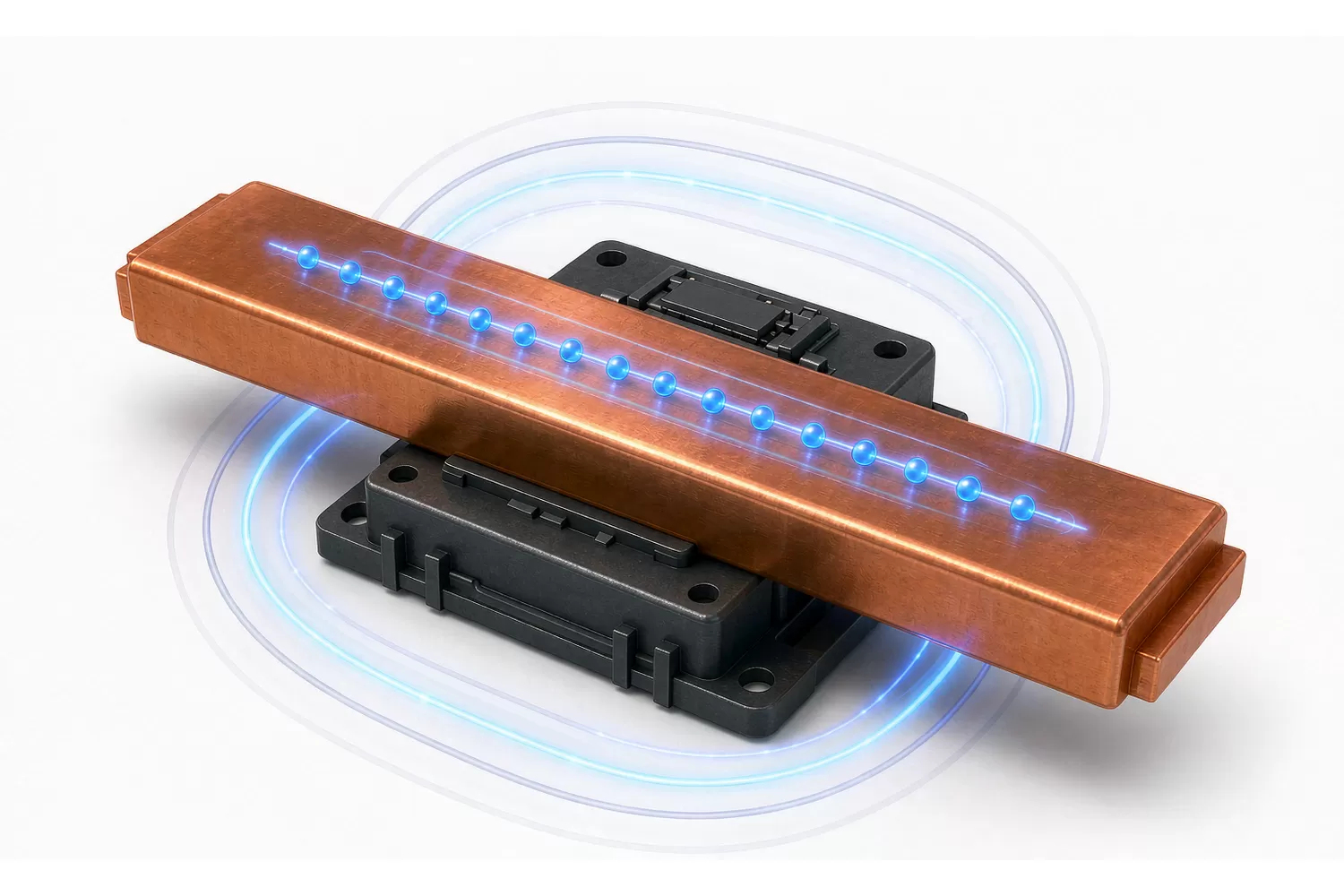
If you need to know how much current a motor, battery or power supply is drawing, you have two broad options: a shunt resistor with an amplifier, or a Hall-effect current sensor. The ACS712ELCTR-20A-T is the popular Hall-effect choice — it measures the current flowing through its own leadframe and presents an isolated, proportionally-scaled voltage. This guide explains how it works, where it fits, and what to check.

Why Hall-effect instead of a shunt
A shunt resistor drops voltage in series with the load and can be hard to isolate from your measurement electronics. A Hall sensor like the ACS712 routes the current through an internal conductor and senses the resulting magnetic field, so the sense path is electrically isolated from the output. That isolation is the headline reason to use it in motor drives, battery packs and AC-line measurements.
Reading the output
- Quiescent point — with zero current the output sits near half the supply; measure this offset on your board and subtract it.
- Sensitivity — the output moves by a fixed millivolts per amp; pick the current range that keeps your expected current in the linear region.
- Bandwidth — fine for DC and mains-frequency AC, but check the bandwidth before using it on a fast-switched current.
- Isolation voltage — rated for a working isolation voltage; respect it in any mains-connected design.
Practical cautions
The output is analogue and benefits from a small RC filter. Self-heating at high current shifts the reading, so keep the conduction path cool and account for it in calibration. As always, confirm the exact ratings against the manufacturer's datasheet before design-in.
Current-sensing parts we stock
| Part | Function | Typical use | Link |
|---|---|---|---|
| ACS712ELCTR-20A-T | Hall-effect current sensor, ±20 A | Motor and battery current monitoring | ACS712ELCTR-20A-T |
| INA180 (COSINA180) | Current-sense amplifier | Low-side / high-side shunt amplification | COSINA180 current-sense amplifier |
Explore the sensor range. Send your current range, supply and package for a quote.
Frequently asked questions
How does a Hall-effect current sensor measure current?
It passes the current through an internal conductor and measures the magnetic field that current creates. Because the sense path is isolated from the reading electronics, you can measure a high or even floating current with a low-voltage ADC on the other side, without a resistive shunt in the power path.
What does 'ratiometric' mean for the output?
A ratiometric output is centred at half the supply voltage with no current flowing, and moves up or down by a fixed millivolts-per-amp as current increases or decreases. That makes the reading track your supply and simplifies single-supply designs, but it also means you must measure your own supply accurately to get an accurate current.
What are the common mistakes with ACS712-class parts?
The usual pitfalls are ignoring the quiescent output offset, not filtering the analogue output, forgetting that the part dissipates heat at high current, and assuming the bandwidth covers a fast switched current without checking the datasheet. Layout and a clean reference matter more than people expect.
Can you supply ACS712 and similar current sensors?
Yes. We stock the ACS712 in several current ranges and can quote by quantity with date codes so you can validate before committing to volume.
Recommended next steps
If you are sourcing any of the parts mentioned in this guide, we can help you confirm stock, pricing, and lead times quickly.
- Upload your BOM — send your full parts list and receive a consolidated quote within 2 business hours.
- Browse related in-stock lines: Sensors / Optoelectronic.
- Contact our team for hard-to-find or end-of-life components.
About us & trademarks: JTDZ Tech (Shenzhen Jingteng Electronics Technology Co., Ltd.) is an independent distributor of electronic components. We are not an authorised distributor or representative of the manufacturers named in this article. Manufacturer and part names are used for indicative purposes only, to help identify the components discussed; all trademarks remain the property of their respective owners. Always verify specifications against the manufacturer's datasheet before design-in or purchase.
