
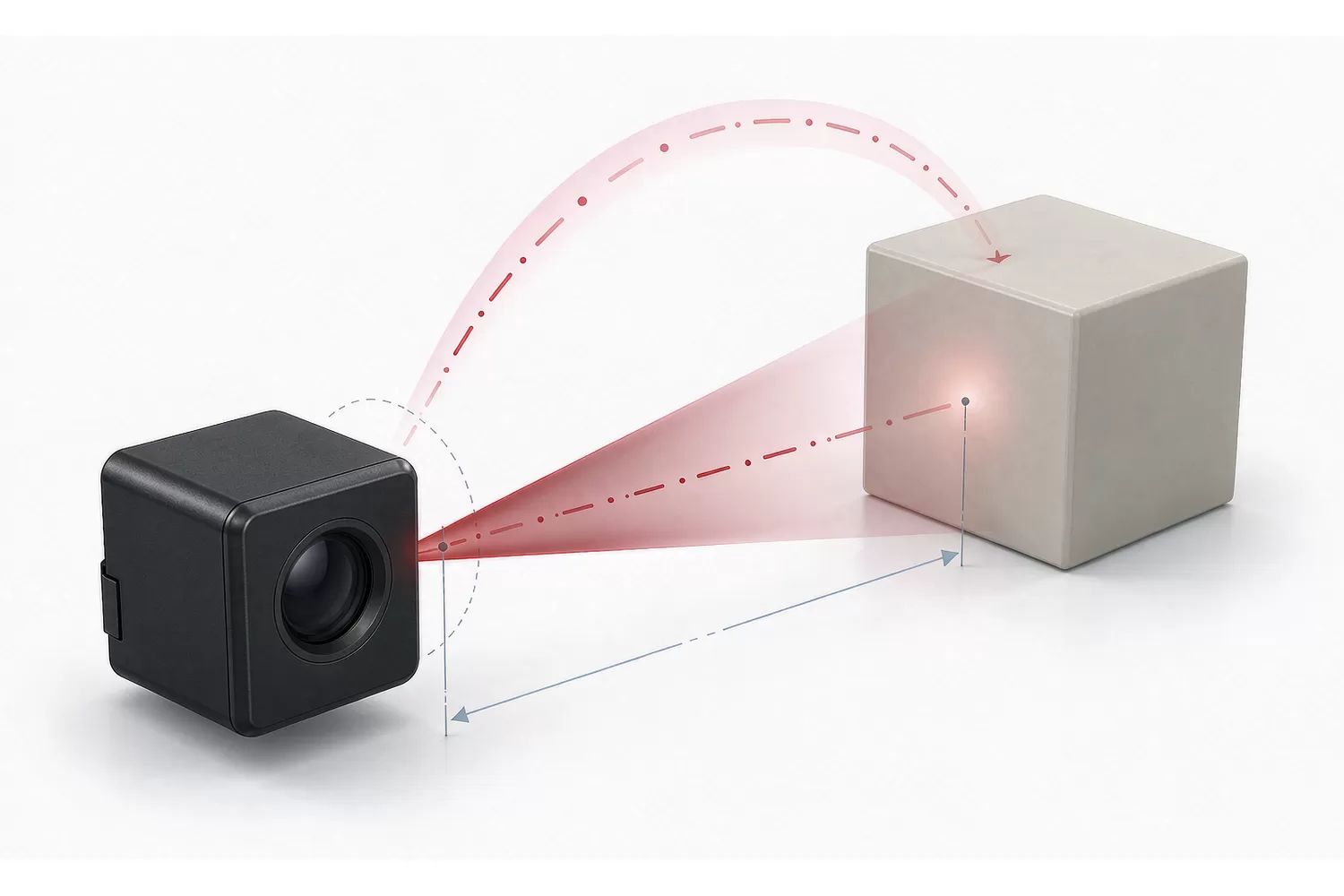
Measuring distance used to mean either a tape measure or a finicky infrared reflector. A time-of-flight module such as the VL53L0X changed that for small systems: it reports absolute distance over a simple I²C link, in a package a few millimetres across. This guide covers how it works, where it fits, and what to verify.

How time-of-flight ranging works
The module emits a short laser pulse from a VCSEL and times the return. Because the speed of light is constant, the flight time converts directly to distance; the module performs the timing and calibration and gives you a clean number. That makes it far more repeatable than a reflective infrared sensor, whose reading swings with the target's colour.
Where it is used
- Robotics — obstacle detection and cliff sensing on vacuums and small bots.
- User presence — wake a display or device when a hand approaches.
- Liquid level and object position — non-contact short-range gauging.
- 1-D lidar pre-cursors — single-point ranging in a controlled enclosure.
What to verify before design-in
- Field of view — the sensed cone is narrow but real; aim it at the target.
- Ambient light — outdoor sunlight shortens range; shield or calibrate for the environment.
- I2C addressing — multiple modules need distinct addresses or sequential enable.
- Calibration — validate on the actual target material and housing, not a lab wall.
Confirm the exact ranging limits and operating conditions against the manufacturer's datasheet before committing to volume.
Ranging and environment sensors we stock
| Part | Type | Typical use | Link |
|---|---|---|---|
| VL53L0X | Time-of-flight distance sensor | Proximity, robotics, presence | VL53L0X |
| VL53L0X | Time-of-flight distance sensor | Module form | VL53L0X |
See the full sensor range. Send your range, package and quantity for a quote.
Frequently asked questions
How does a time-of-flight sensor measure distance?
It emits a tiny, invisible laser pulse and measures how long the reflection takes to return. Because the speed of light is fixed, that flight time maps directly to distance. The module does the timing internally and hands you a distance value over I2C, so your firmware never times light pulses itself.
Why is ToF better than an IR reflector for ranging?
A simple infrared reflector's reading depends heavily on the target's colour and reflectivity, so a black object looks far away. A ToF module measures actual flight time, so the result is far more stable across different surfaces and colours, which is why it is favoured for proximity and user-presence detection.
What limits a VL53L0X-class sensor?
Range and reliability depend on target reflectivity, ambient light, and the field of view. Very dark or very low-reflectivity surfaces, strong sunlight, and oblique angles all shorten the usable range. Calibrate on the actual target and enclosure, not just on a white wall in the lab.
Do you stock VL53L0X and similar ranging parts?
Yes. We stock the VL53L0X and can quote by quantity with date codes so you can validate before committing to volume.
Recommended next steps
If you are sourcing any of the parts mentioned in this guide, we can help you confirm stock, pricing, and lead times quickly.
- Upload your BOM — send your full parts list and receive a consolidated quote within 2 business hours.
- Browse related in-stock lines: Sensors / Optoelectronic.
- Contact our team for hard-to-find or end-of-life components.
About us & trademarks: JTDZ Tech (Shenzhen Jingteng Electronics Technology Co., Ltd.) is an independent distributor of electronic components. We are not an authorised distributor or representative of the manufacturers named in this article. Manufacturer and part names are used for indicative purposes only, to help identify the components discussed; all trademarks remain the property of their respective owners. Always verify specifications against the manufacturer's datasheet before design-in or purchase.
