
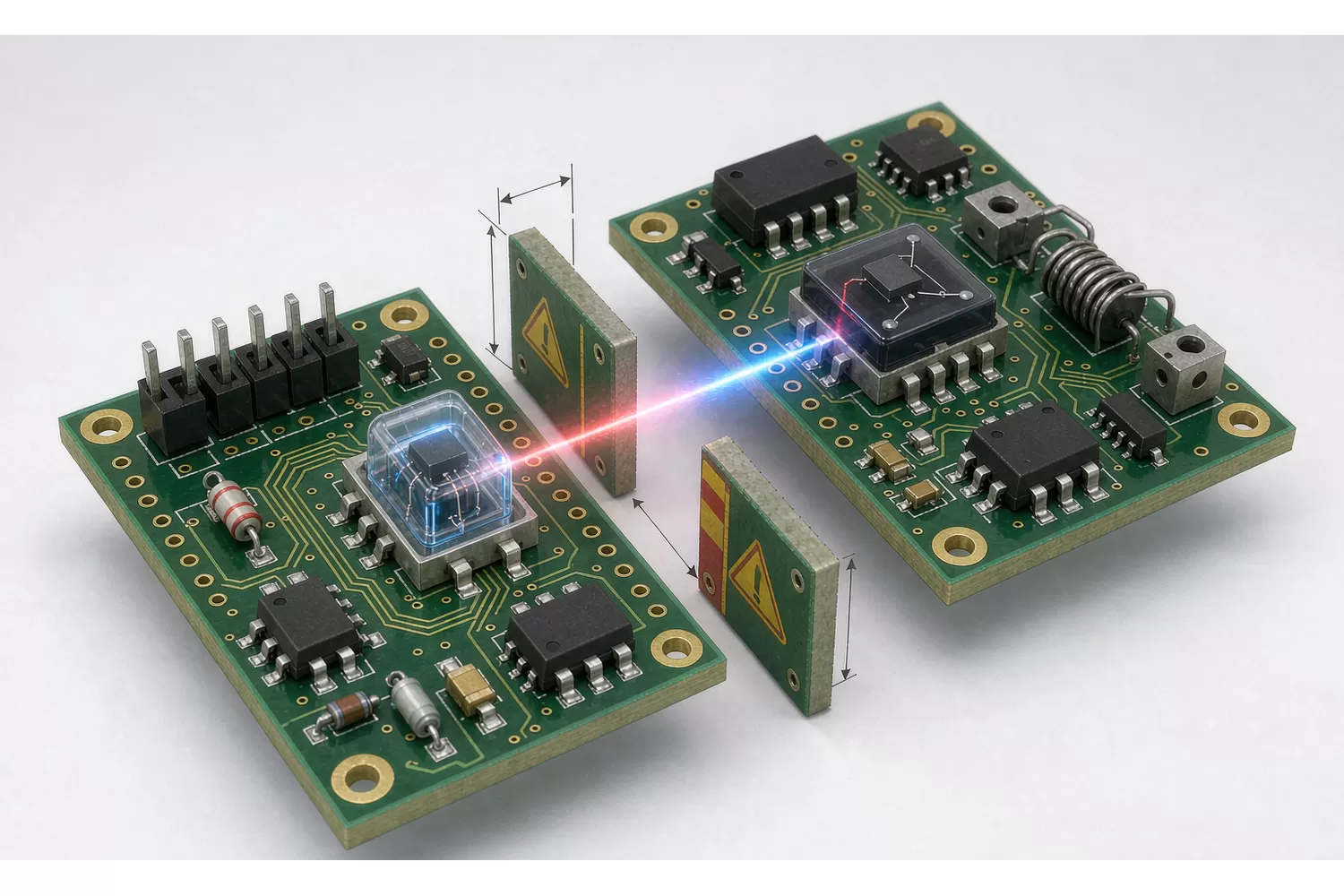
Whenever a microcontroller needs to touch something noisy or high-voltage — a mains relay, an industrial input, a comms line — the safe bridge is usually an optocoupler. The EL817C is the workhorse: a 4-pin DIP device with an infrared LED on one side and a phototransistor on the other, transferring the signal optically so the two circuits share no conductor. This guide covers how it works and what to check.

Why isolate optically
Optical coupling means the input and output have no galvanic path. That breaks ground loops, rejects common-mode noise, and lets a 3.3 V MCU safely sense or drive a circuit referenced to a different potential. For any interface that crosses a voltage boundary, an optocoupler is the default first line of isolation.
Key parameters
- CTR (Current Transfer Ratio) — output current per input current; allow generous margin for the worst case.
- Isolation voltage — the rated breakdown between sides; respect it in mains-connected designs.
- Speed — phototransistor types are slow; use the base pin or a faster part for timing-critical signals.
- Input current — drive the LED within its rated range for long life and predictable CTR.
Common uses
MCU-to-relay drives, isolated digital inputs on PLC-style boards, crossing noise boundaries on comms lines, and feedback paths where you must keep the control side floating. Always confirm the exact ratings against the manufacturer's datasheet before design-in.
Optocouplers we stock
| Part | Type | Typical use | Link |
|---|---|---|---|
| EL817C | Phototransistor optocoupler, DIP-4 | General signal isolation | EL817C |
| PC817X1CSP9F | Phototransistor optocoupler | Drop-in PC817 class | PC817X1CSP9F |
Explore the optoelectronic range. Send your package and quantity for a quote.
Frequently asked questions
What does an optocoupler actually do?
It transfers a signal between two circuits using light instead of a wire. An LED on the input side shines across a gap onto a phototransistor on the output side, so the two sides share no electrical connection. That breaks ground loops and lets a low-voltage controller talk safely to a high-voltage or noisy circuit.
What is CTR and why does it matter?
Current Transfer Ratio is the output collector current divided by the input LED current. It varies widely between parts and drifts with temperature and age, so a design must allow enough LED current and enough output margin to keep working across the worst-case CTR. Treating CTR as a fixed number is the classic mistake.
When do I need the base pin or a faster part?
A phototransistor optocoupler is slow; if you need higher speed or tighter timing, use the base connection to bleed charge and speed turn-off, or choose a logic-output or high-speed coupler. For simple on/off isolation of a relay or button, the standard phototransistor type is usually enough.
Do you stock EL817 and similar optocouplers?
Yes. We stock the EL817C and compatible PC817-class couplers and can quote by quantity with date codes so you can validate before committing to volume.
Recommended next steps
If you are sourcing any of the parts mentioned in this guide, we can help you confirm stock, pricing, and lead times quickly.
- Upload your BOM — send your full parts list and receive a consolidated quote within 2 business hours.
- Browse related in-stock lines: Sensors / Optoelectronic.
- Contact our team for hard-to-find or end-of-life components.
About us & trademarks: JTDZ Tech (Shenzhen Jingteng Electronics Technology Co., Ltd.) is an independent distributor of electronic components. We are not an authorised distributor or representative of the manufacturers named in this article. Manufacturer and part names are used for indicative purposes only, to help identify the components discussed; all trademarks remain the property of their respective owners. Always verify specifications against the manufacturer's datasheet before design-in or purchase.
