
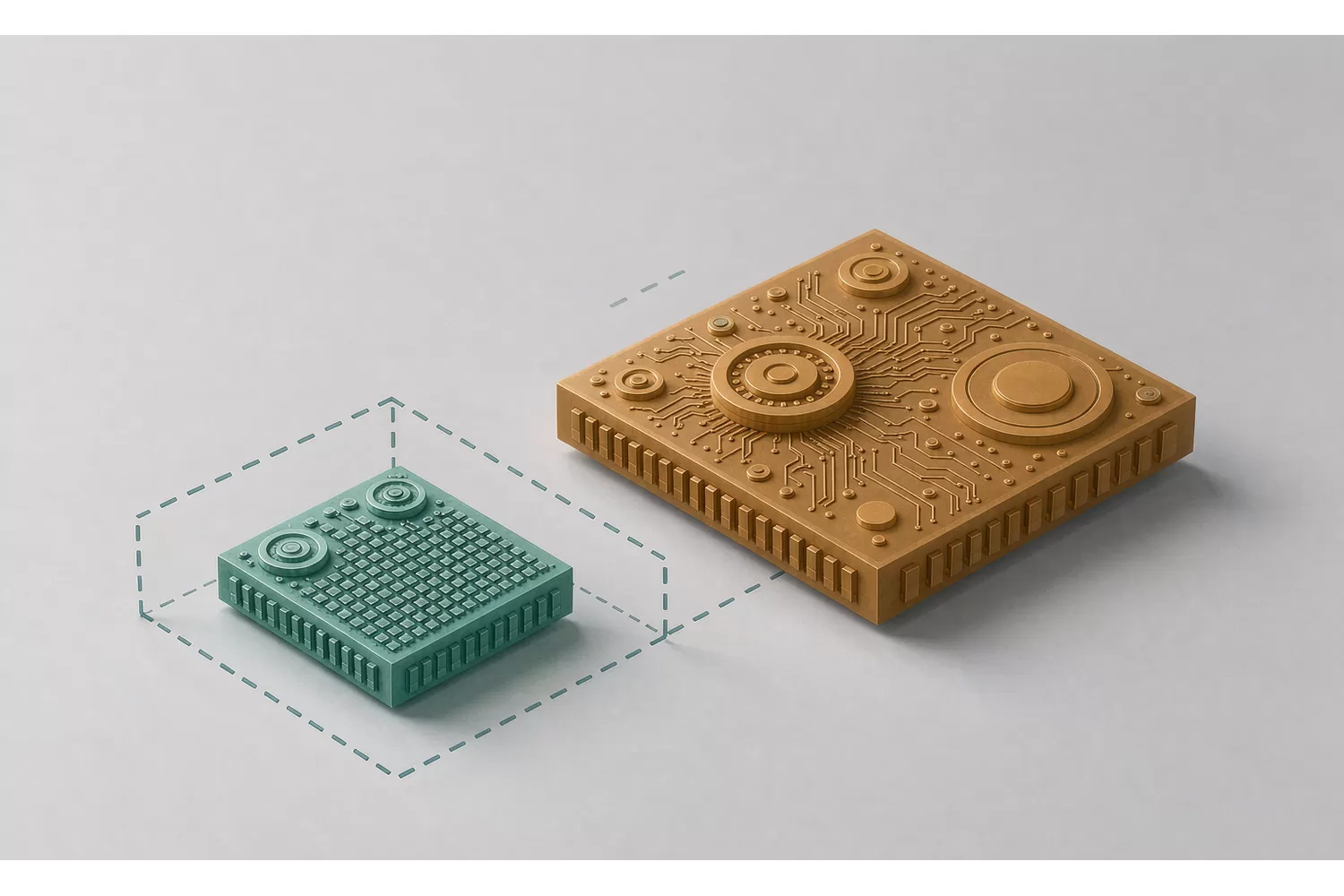
Entry-tier microcontrollers are the most useful parts in a catalogue and the ones most often mis-specified, usually in the direction of buying too much. This article draws the line: what the AT32 entry-tier parts do well, and where spending a little more on a mainstream part such as the AT32F413RBT7 or AT32F415CBT7 is genuinely cheaper.

What entry tier is good at
Entry-tier parts shine in designs whose firmware is small, whose peripherals are few and whose cost sensitivity is high. The classic list:
- Sensor nodes that read one or two channels and report on a fixed interval. li>Thermostats, humidity controllers and other climate controls with a display you do not drive with an GUI stack.
- Small motor drives at a simple control level, with the driver doing the heavy lifting.
- LED drivers and simple power supply controllers.
- Token, meter and instrumentation boards where the interface is a single serial link.
In all of these the firmware fits comfortably in tens of kilobytes and the peripherals are one timer, one ADC group and one serial port. That is the sweet spot, and in that sweet spot the entry part is the right answer.
Where entry tier stops paying
Four situations, in increasing order of pain:
| Situation | Why the entry part struggles | What to consider instead |
|---|---|---|
| Need USB or CAN | No on-chip controller in most entry variants | A mainstream part with the controller |
| GUI on an display | RAM and flash are eaten by the frame buffer | A mainstream or high-performance part |
| OTA firmware update | Needs a second flash bank and careful versioning | More flash than you think you need |
| Heavy communication stack | Stack plus application no longer fits | A mainstream part with more RAM |
The first row is the most expensive mistake in practice. Adding an external USB-to-serial or CAN bridge to save a few cents on the MCU routinely costs more in parts and board area than the mainstream part would have.
Parts in this class that we stock
- AT32F421K8U7 and AT32F421C8T7 — the AT32F421 series.
- AT32F423RCT7 and AT32F423KBU7-4 — the AT32F423 series.
- AT32F425C8T7, AT32F425K8T7, AT32F425F8P7 — the AT32F425 series.
- AT32F011K8U7-4 — the smallest option for the most basic board.
Note the package spread within one series. The F425 alone is offered in LQFP48, LQFP32 and TSSOP20, and that spread often moves the total BOM more than the suffix does.
Keeping the upgrade path open
If there is any chance the product gains a feature later, design for the upgrade now. Three cheap measures:
- Compare the entry-tier and mainstream pinouts before you lay out the board, and check whether your existing connections are a subset.
- Leave the unused pins on a two-pin header or a test point; the cost is a few cents and the value is a re-spin you do not have to make.
- Keep the peripheral driver code in a layer that does not depend on the specific part, so moving up is a re-point and not a rewrite.
These three cost almost nothing today and remove the most expensive possible future cost, which is a board revision to change a microcontroller you already have on the shelf.
Related reading
Microcontrollers and MCUs · AT32F421G8U7 · AT32F426CBT7
Frequently asked questions
What can the AT32F421 and AT32F425 not do compared with a mainstream part?
They have less flash and RAM, fewer advanced timers, and in most variants no USB device controller and no CAN controller. If your design needs either of those interfaces, the entry tier will not cover it and you should be looking at a mainstream part such as the AT32F413 or AT32F415 rather than trying to add an external bridge, which costs more than the difference in MCU price.
Is the entry tier fast enough for control loops?
For control loops that run at kilohertz rates and use the on-chip peripherals to generate the timing, yes. The limit is not the core speed, it is the firmware architecture: if you are polling and doing fixed-point maths in an interrupt at a rate that leaves little headroom, the practical ceiling arrives well before the rated speed.
Can I move up from an entry tier part later without a board change?
Sometimes, if the pins you use are a subset of the larger part's pinout. The safe way to keep that door open is to check the pinout mapping before you lay out the board, and to leave the unused pins as test points. Ask your supplier for both families' pinouts side by side and compare before committing.
Why is the entry tier actually cheaper than I expected?
Because it is built for high volume simple control, the package options are common, and the order quantity is usually large. You get the saving on unit price, on board area and sometimes on assembly. What you do not get is headroom for a second feature release.
When should I stop trying to save on the MCU?
When the MCU you selected is the reason a feature is late, or the reason the board needs an extra chip. At that point the saving is already negative and the decision is costing you more than the part ever did.
About us & trademarks: JTDZ Tech (Shenzhen Jingteng Electronics Technology Co., Ltd.) is an independent distributor of electronic components. We are not an authorised distributor or representative of the manufacturers named in this article. Manufacturer and part names are used for indicative purposes only, to help identify the components discussed; all trademarks remain the property of their respective owners. Always verify specifications against the official datasheet before design-in or purchase.
Recommended next steps
If you are sourcing any of the parts mentioned in this guide, we can help you confirm stock, pricing, and lead times quickly.
- Upload your BOM — send your full parts list and receive a consolidated quote within 2 business hours.
- Browse related in-stock lines: Power Management ICs · Microcontrollers / MCUs · Memory / Logic Devices.
- Contact our team for hard-to-find or end-of-life components.
