
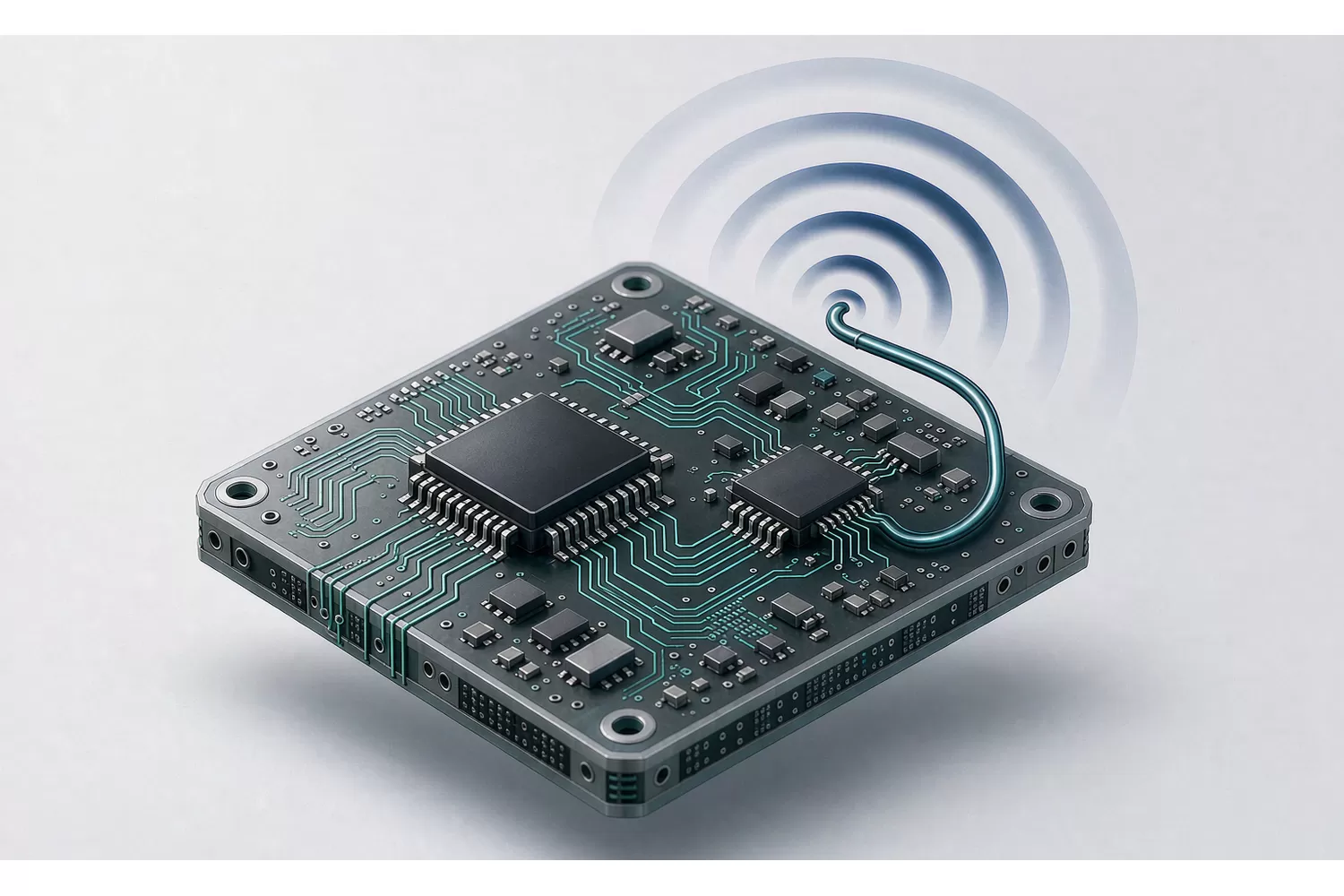
Wireless designs are quoted wrong more often than any other category, because the interesting number is not the chip. This article looks at the AT32WB415 from an engineer's and a buyer's side, and lays out a cost model you can actually defend in a review.

Part discussed: AT32WB415CCU7-7 in QFN48.
The split-versus-single comparison
The classic wireless BOM is a general-purpose MCU talking to a radio over a serial link. It works, and it is what most teams start with. It also carries costs that do not appear on the MCU quote.
| Cost line | MCU plus radio split | Single wireless MCU |
|---|---|---|
| Two silicon positions | Two | One |
| Inter-part link | Serial link, speed and DMA budget | None |
| Firmware images | Two to build and keep in sync | One |
| Board area | Both footprints plus routing | One footprint |
| Power sequencing | Two sets of rails to sequence | One set |
| RF tuning | Usually still needed | Usually still needed |
The firmware line is the one that hurts in practice: two images, two version histories, and a class of field failure where the two halves disagree about state. Those failures are expensive in the way that field failures are expensive.
What the radio section really costs
Once you move past the chip decision, the RF cost lands here:
- Front-end parts — the matching network, the filter and any switch or PA. A reference match from the supplier materially reduces both parts count and tuning time.
- Antenna and keep-out — the antenna itself, its feed, the ground clearance and the board area it forbids. This is often the largest physical cost in the design.
- Crystal — wireless parts are timing-sensitive. A tighter-spec crystal costs more and changes the BOM more than most engineers expect.
- Test and calibration — per-unit RF calibration and test in production. Forget this and the unit cost model is wrong.
We have seen products where the test fixture cost exceeded the silicon saving of the whole wireless decision. It is worth pricing before, not after.
Design rules that keep the RF BOM down
- Start from the supplier's reference layout for the part you chose, and keep the ground plane and keep-out as specified.
- Keep the antenna feed and match away from the digital return paths.
- Separate the analogue supply from the digital supply with a simple filter rather than a full separate regulator unless you need one.
- Plan the test point from day one so production does not add a second iteration of the fixture.
- Build the firmware so application state never lives inside the stack's buffers.
Hardware and firmware notes
The AT32WB415 part comes in a QFN48 package, which keeps the footprint compact and demands a careful thermal and ground plan under the part. For a design team coming from a split solution, the two adjustments that take longest are the ground handling and the fact that there is now one firmware with two very different timing responsibilities.
Related reading
Microcontrollers and MCUs · AT32WB415CCU7-7 · AT32F405CCT7
Frequently asked questions
Why would I consider a wireless MCU instead of a MCU plus a radio module?
Because the split solution carries two sets of board area, two firmware images, a serial link between them, and often an extra regulator. Consolidating onto a single part removes the link, the second firmware image and the coordination work. At volume the saving is usually larger than the per-unit difference between the two designs suggests.
What affects the RF cost more than the chip choice?
The matching network and the antenna solution dominate. A design that needs a tuned match with several discrete components and a keep-out area under the antenna costs more than the difference between two chip choices. If you can use a reference match from the supplier and keep the antenna keep-out clean, the RF case becomes much easier to quote.
How do I cost a wireless product honestly?
Price the SoC, then the front-end parts, the antenna and its matching, the regulator, the crystal, the connector if you have one, and then the test and calibration step. The last item is frequently forgotten and, for a design that needs per-unit RF calibration, it can exceed the silicon.
Does the AT32WB415 change the firmware architecture?
It changes the size of the team's concern rather than the architecture. You still run an application on the core; you additionally have a communication stack that has its own timing requirements. The practical advice is to keep application state separate from stack state, because interleaving them is what produces the hard-to-debug wireless field failures.
Can the same hardware support more than one wireless protocol?
Frequently, if the hardware supports it and the firmware is built accordingly. The honest constraint is certification: any configuration that ships has to be certified, and a design approved for one protocol is not automatically approvable for another without re-testing. Budget for that before promising a multi-protocol product.
About us & trademarks: JTDZ Tech (Shenzhen Jingteng Electronics Technology Co., Ltd.) is an independent distributor of electronic components. We are not an authorised distributor or representative of the manufacturers named in this article. Manufacturer and part names are used for indicative purposes only, to help identify the components discussed; all trademarks remain the property of their respective owners. Always verify specifications against the official datasheet before design-in or purchase.
Recommended next steps
If you are sourcing any of the parts mentioned in this guide, we can help you confirm stock, pricing, and lead times quickly.
- Upload your BOM — send your full parts list and receive a consolidated quote within 2 business hours.
- Browse related in-stock lines: Microcontrollers / MCUs · Interface Chips / RF Chips.
- Contact our team for hard-to-find or end-of-life components.
