
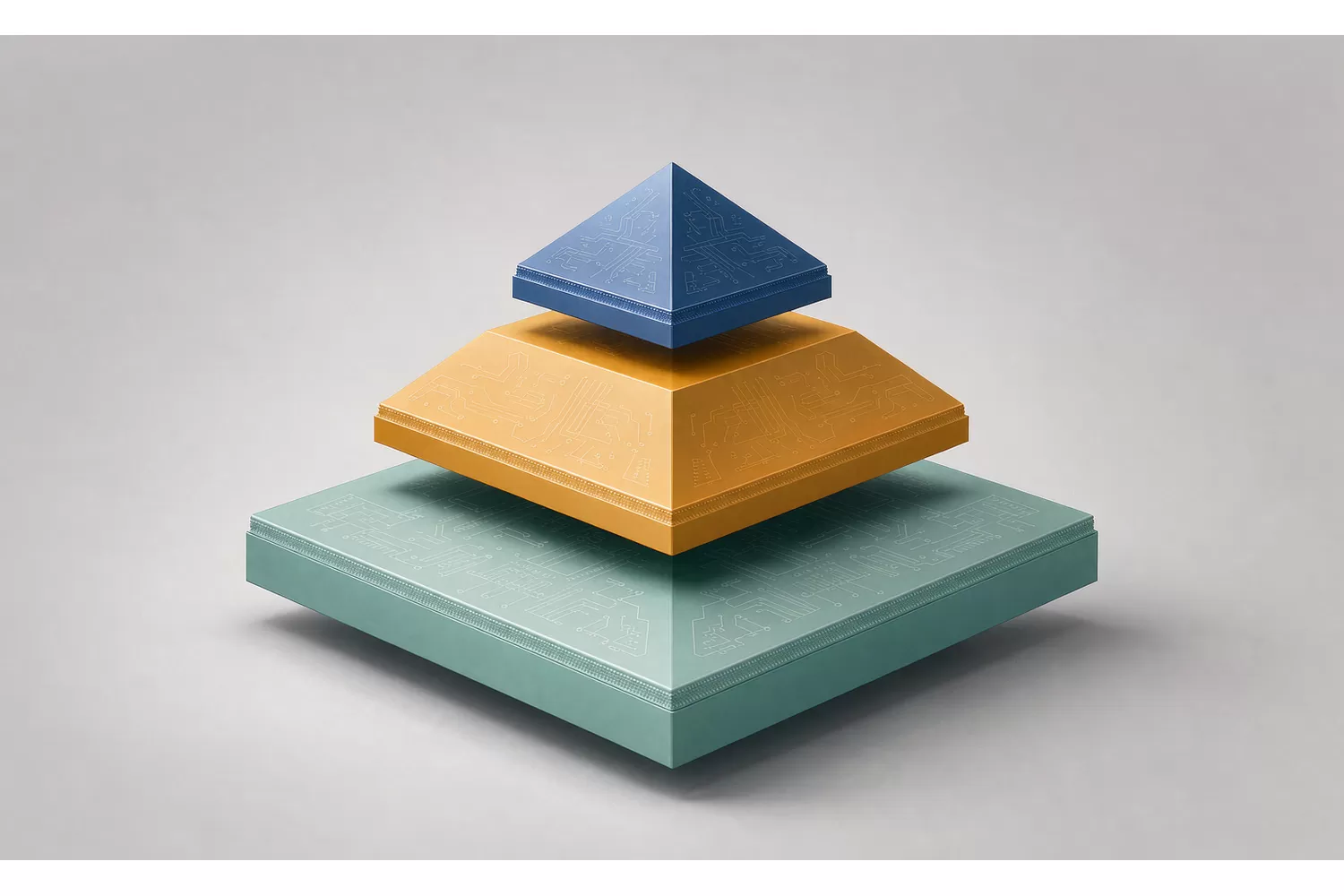
The AT32F4 line from Artery looks like a spreadsheet nightmare: dozens of part numbers that all advertise the same core, the same flash and the same speed. In practice they are not competitors, they are cost tiers. Once you read the family as three tiers rather than as a long list, selection gets fast and the bill of materials gets easier to defend in a review.

We supply the AT32F4 series in volume from our Shenzhen warehouse. This article is written from the two questions we get asked most: what does each tier actually buy you technically, and what does each tier cost you in a BOM.
Reading the AT32F4 family as three cost tiers
Everything below the top performance tier shares the same Cortex-M4 core with DSP and FPU. The differences are flash and RAM size, the peripheral set, the package options and, as a consequence, the unit price.
| Tier | Representative parts | Flash / RAM | Typical use |
|---|---|---|---|
| Entry / value | AT32F421, AT32F422, AT32F423, AT32F425, AT32F426 | 32-128 KB / 8-20 KB | I/O control, simple timers, sensor polling |
| Mainstream | AT32F401, AT32F402, AT32F403A, AT32F405, AT32F407, AT32F413, AT32F415 | 64-512 KB / 16-160 KB | Connectivity, USB, CAN, industrial control |
| High performance | AT32F427, AT32F435, AT32F437 | Up to 1 MB / 288 KB | Graphics, complex motor, gateway class jobs |
Notice that the tiers overlap in speed. A mainstream AT32F413 running a control loop is not slower than a high-performance part running the same loop. The high-performance parts exist because some applications need a big RAM pool for a display frame buffer or a communication stack, not because the maths is harder.
What each tier costs beyond the silicon
Engineers routinely compare the MCU price and stop there. In a real BOM the silicon is often only part of the story. These are the cost items that move when you change tier or package.
| Cost item | Effect of moving down a tier | Effect of moving to a smaller package |
|---|---|---|
| MCU unit price | Direct saving, tier to tier | Direct saving, package to package |
| External EEPROM | Entry parts may still need it for parameter storage | No effect |
| External crystal | Usually unchanged, driven by timing budget not MCU tier | Smaller packages often use the same crystal |
| Board area | Fewer peripherals may shrink the analog front end | Smaller footprint, tightened layout |
| Assembly and inspection | Fewer high-speed nets, simpler stack-up | QFN needs thermal vias and X-ray check |
| Field failure risk | Less margin for a feature you actually use | QFN rework is harder if a rework is needed |
The honest rule we give customers: the tier you do not use is the tier you pay for twice — once in the unit price and once in the support time it costs to hold a firmware baseline you do not need.
Where the entry tier fits
The AT32F421, AT32F422, AT32F423, AT32F425 and AT32F426 parts are aimed at designs whose firmware fits in tens of kilobytes and whose peripherals are one timer, one ADC channel group and one serial port. Common examples are thermostat boards, LED drivers, small pump controllers and instrument panel clusters that read a sensor and drive a display. If your software uses a full RTOS with a graphical stack, the entry tier will feel cramped and you will end up re-quoting.
Two entry parts we stock in volume, shown here with their recommended package options:
AT32F421K8U7 · AT32F421C8T7 · AT32F423RCT7 · AT32F425C8T7
Where the mainstream tier earns its price
The mainstream parts (AT32F403A, AT32F405, AT32F407, AT32F413, AT32F415) add the peripherals that remove other chips from the board. A USB device controller removes a USB-to-serial bridge in some designs. A CAN controller removes an external controller in industrial nodes. An advanced timer with complementary outputs and dead-time control removes an external gate driver stage in power stages.
That is the real cost argument: the mainstream tier is not more expensive than the entry tier if it lets you delete a chip elsewhere. The exercise worth doing before you re-quote is to list the parts on your current board that exist only because your MCU is small.
Representative mainstream parts in stock:
AT32F403ARCT7 · AT32F403ARGT7 · AT32F405CCT7 · AT32F407RGT7 · AT32F413RBT7 · AT32F415CBT7
Where the high-performance tier earns its price
The AT32F427, AT32F435 and AT32F437 parts carry the largest flash and RAM in the family and run the fastest bus. They are justified when the design holds a frame buffer, runs a heavy communication stack, or needs rich external memory interfaces. For a simple control job they are pure cost with no return.
AT32F435RGT7 · AT32F435ZGT7 · AT32F437ZGT7
A selection order that works
- List the peripherals the firmware actually touches on day one.
- Check flash for the largest build you will ship, not the demo you run today.
- Check RAM for the stack plus the largest buffer, and add margin for a future OTA update.
- Pick the package that fits the board with one spare row of copper.
- Only then compare price across tiers.
Doing it in this order stops the most common cost mistake we see: designing against the part you already have and paying for capability that goes unused.
Related reading
Microcontrollers and MCUs · AT32F413RBT7 · AT32F403ACGT7
Frequently asked questions
Why are there so many AT32F4 part numbers for the same core speed?
Because the F4 line is split into cost tiers, not speed tiers. The entry tier (F421, F422, F423, F425, F426) targets simple control jobs, the mainstream tier (F401, F402, F403A, F405, F407, F413, F415) targets general embedded control, and the high-performance tier (F427, F435, F437) targets applications that need a large flash, a big RAM pool and a fast bus. Same Cortex-M4 core, different amount of flash, RAM, timer and connectivity budget. You pay for the block you use and nothing else.
Which AT32F4 tier should I pick for a cost-down project?
Start from the peripheral list you already need, then walk down. If your current design runs fine on 64 KB flash and one advanced timer, an entry-tier part such as the AT32F421 or AT32F423 usually lands lower than the mainstream part you were quoted. The trap is picking a mainstream part for legacy reasons: if you do not use the extra USB, CAN-FD or DMA channels, that capacity is dead cost on every unit you ship.
Does picking a smaller package actually save money?
Yes, and it compounds. A QFN32 part is cheaper per unit than an LQFP48 part of the same die, it uses less board area, and it can cut assembly cost because there are no fine-pitch gull-wing leads to inspect. The cost you take on is thermal and routing: QFN parts need a good thermal via pattern under the centre pad, and hand rework is harder. For volumes above a few thousand units the package decision usually moves the total BOM more than the silicon choice does.
Can I mix tiers across one product line?
Commonly, yes. A flagship model with a display and connectivity can use a mainstream or high-performance part while the base model uses an entry-tier part, and the firmware can share most of its driver layer because the AT32 SDK keeps peripheral APIs consistent across the family. The saving is real, but keep the shared code paths under version control carefully so the two variants do not drift apart.
How do I get a real unit price for an AT32F4 part?
Unit price moves with order quantity, package, lead time and market conditions, so any figure you read on a page is only a reference anchor. Send us the exact part number, package and annual volume and we will quote against what we can actually source. We also flag when a requested package is a long-lead item, because that changes the sourcing decision as much as the price does.
About us & trademarks: JTDZ Tech (Shenzhen Jingteng Electronics Technology Co., Ltd.) is an independent distributor of electronic components. We are not an authorised distributor or representative of the manufacturers named in this article. Manufacturer and part names are used for indicative purposes only, to help identify the components discussed; all trademarks remain the property of their respective owners. Always verify specifications against the official datasheet before design-in or purchase.
Recommended next steps
If you are sourcing any of the parts mentioned in this guide, we can help you confirm stock, pricing, and lead times quickly.
- Upload your BOM — send your full parts list and receive a consolidated quote within 2 business hours.
- Browse related in-stock lines: Power Management ICs · Microcontrollers / MCUs · Memory / Logic Devices.
- Contact our team for hard-to-find or end-of-life components.
