
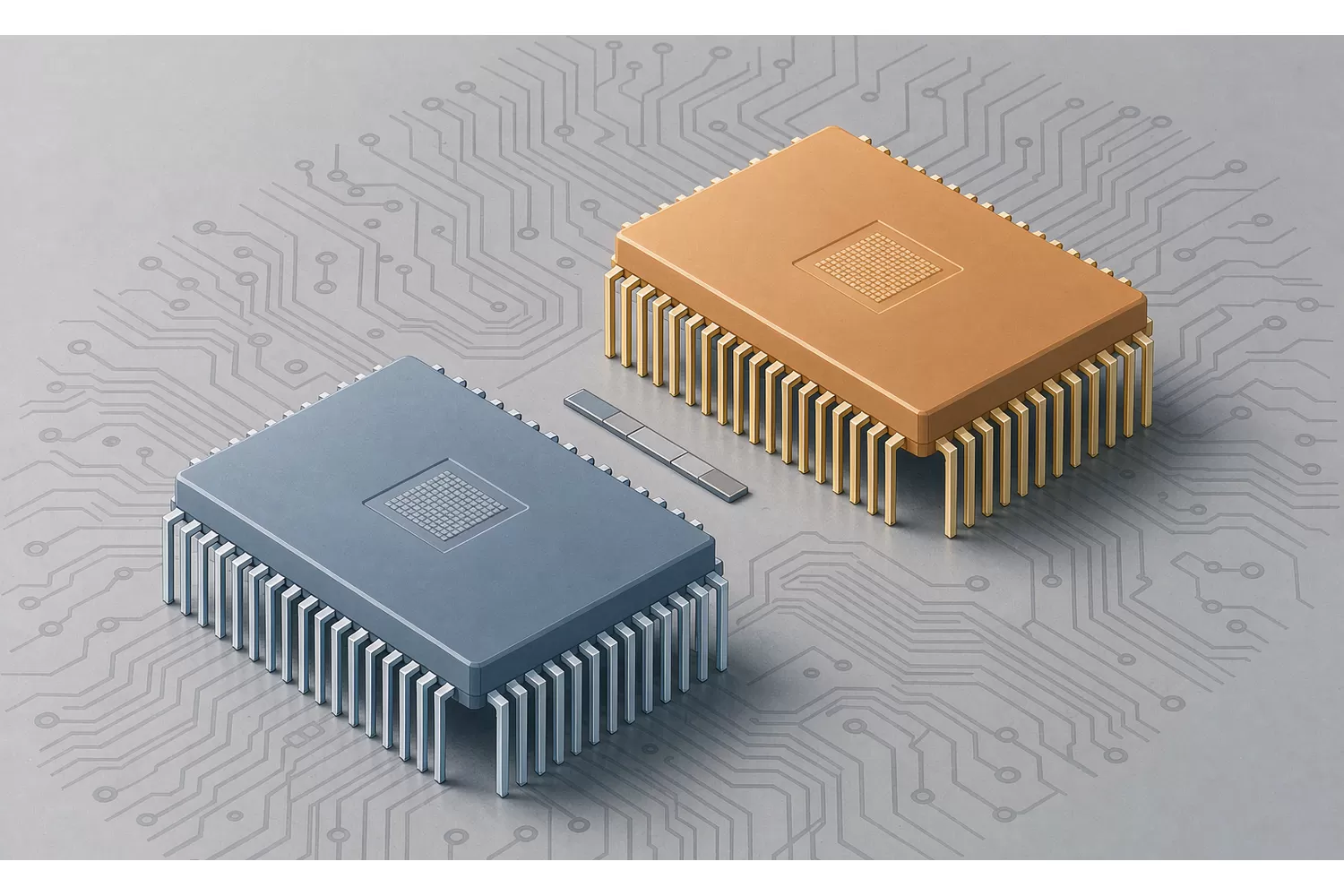
The STM32F103 is one of the most widely used microcontrollers ever shipped, which means a very large number of boards in the field are built around it. When supply or price moves, the first question engineering asks is whether a drop-in alternative exists. The Artery AT32F403A is the part that comes up most often in that conversation. This article covers both halves of the decision: what it takes to migrate, and what the migration is worth in cost terms.

Why the F103 replacement conversation happens
Two triggers push projects to look for an alternative. The first is availability: a legacy part goes on allocation or a long allocation, and a production line that cannot ship is a much bigger cost than any component delta. The second is unit cost at a volume where the original part's price is no longer competitive. Both are valid reasons, and both are answered differently, so it is worth naming which one you are solving before you start.
Pin-level compatibility: what to check first
The AT32F403A is offered in the same common LQFP packages used by the F103, so the physical swap is not the hard part. The checks that matter are:
| Check | What to verify | Risk if ignored |
|---|---|---|
| Package and pin count | LQFP48 vs LQFP64 vs the version on your board | Wrong land pattern, re-spin required |
| Boot mode pins | How the part selects boot source at power-on | Firmware never starts, board looks dead |
| Reset and decouple | Reset pin polarity and decoupling placement | Intermittent hangs that are hard to trace |
| Clock source | Internal oscillator accuracy vs external crystal | UART baud error, USB enumeration failure |
| Flash density | Firmware size now and after the next feature drop | Field update fails on the smaller part |
Run the comparison on a test board using your own layout before you commit. A one-week bench comparison is cheaper than a re-spin.
Firmware porting: a realistic budget
The register names are close enough that porting is normally described as a project re-point rather than a rewrite. In practice the effort concentrates in three places: the clock tree configuration, the flash wait-state setting for the core frequency you want, and anything that assumes the original bootloader's vector placement. For a moderate firmware this is a week of engineering, not a month. Keep the original tree in your repository until the first production batch has shipped, because the fallback path is worth more than the cleanliness of the history.
The cost case, item by item
Here is the comparison we run with customers, in the order we think about it:
| Cost line | What changes on migration | Comment |
|---|---|---|
| MCU unit price | Usually improves at volume | Depends on package and quantity |
| External EEPROM | Can be removed if flash density suffices | Real board-level saving |
| Board area | Smaller package may free area | Also improves routing |
| Assembly | Similar, unless package changes | Check land pattern |
| Engineering time | One-off porting cost | The hidden line item |
| Qualification | Possibly a new supplier approval step | Ask early if you have a qualified vendor list |
The naive comparison is the first row. The honest comparison is the sum of all six. Projects that win the argument are the ones where the silicon delta is large enough, or the availability risk is sharp enough, to repay the porting week quickly.
Where the F403A sits in the wider AT32 range
If you are already migrating, it is worth asking whether the target is the right target. The AT32F403A is a mainstream part aimed squarely at the general-control slot. If your firmware fits comfortably in less flash than the F103 variant you use today, the entry tier may be a better destination and a cheaper one: AT32F413RBT7 and AT32F415CBT7 are both mainstream parts with a different cost profile.
Other mainstream parts in the same family, if you are re-spinning the board anyway:
AT32F403ARGT7 · AT32F405CCT7 · AT32F407VET7 · AT32F413CBT7
Related reading
Microcontrollers and MCUs · AT32F403ARCT7 · AT32F403ERPT7
Frequently asked questions
Is the AT32F403A really pin compatible with the STM32F103?
At the pin level, yes for the common LQFP48 and LQFP64 packages in the standard ordering, which is why migration projects start from a re-layout check rather than a new board. electrically you still need to verify three things: the decoupling and reset pin definitions, the boot mode pin configuration, and the oscillator start-up behaviour. Boot mode handling in particular differs, so keep the boot strapping pins on the first revision even if you think the firmware sets them internally.
What code changes are needed when moving to the AT32F403A?
The peripheral register names are broadly similar, so most of the work is re-pointing the project at the Artery device support package and the AT32 SDK rather than rewriting drivers. The usual pain points are the clock tree configuration, the flash wait-state setting at high core frequencies, and any code that assumes the exact reset vector placement. Budget a porting week for an existing STM32F103 firmware of moderate size, and keep the STM32 tree around until the first production batch ships.
What is the cost argument for the migration?
The saving shows up on the whole BOM, not only on the MCU line. In typical quotes we see the MCU position improve materially at volume, and the board often gets cheaper as well because the AT32F403A integrates more flash than the part it replaces, which lets some designs drop an external EEPROM. Whether the migration pays back depends on your volume and on how much engineering time you can absorb, so treat the silicon delta as one input and the porting cost as another.
Will an AT32F403A drop into an existing STM32F103 footprint without board changes?
Sometimes. The safer path is to order one of each, put both on a test board using your existing layout, and compare power-on behaviour, ADC readings and thermal. We supply both the LQFP48 and LQFP64 variants in small quantities specifically so engineers can run this comparison before committing to a re-spin.
What should I check before placing a volume order?
Confirm the package and temperature grade against your product's operating range, confirm the flash density matches the firmware you will ship in year three, and check the long-lead position for your chosen package. Ask your supplier for the production status and the recommended last-time-buy date before you design it in, not after.
About us & trademarks: JTDZ Tech (Shenzhen Jingteng Electronics Technology Co., Ltd.) is an independent distributor of electronic components. We are not an authorised distributor or representative of the manufacturers named in this article. Manufacturer and part names are used for indicative purposes only, to help identify the components discussed; all trademarks remain the property of their respective owners. Always verify specifications against the official datasheet before design-in or purchase.
Recommended next steps
If you are sourcing any of the parts mentioned in this guide, we can help you confirm stock, pricing, and lead times quickly.
- Upload your BOM — send your full parts list and receive a consolidated quote within 2 business hours.
- Browse related in-stock lines: Microcontrollers / MCUs.
- Contact our team for hard-to-find or end-of-life components.
