
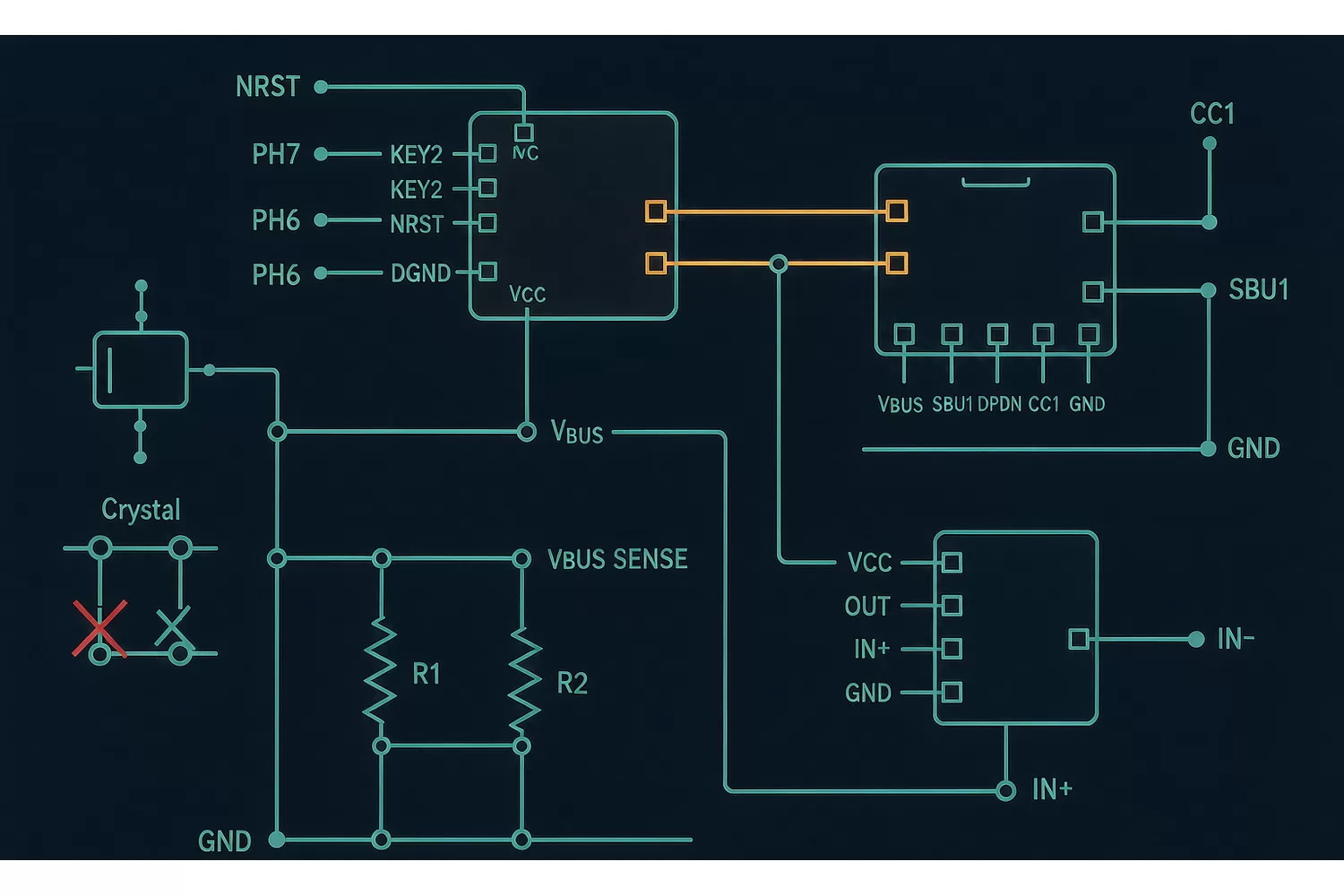
USB is where a cheap swap gets expensive
A USB peripheral is not just an endpoint controller. It is a clock source that has to be accurate enough for the host, a VBUS detection path, and — if the product is a host or a dual-role device — current limiting on the port. Moving to a different MCU touches all four.

Where the AT32F415 sits
The F415 group is the part of the line-up that pairs a Cortex-M4 core with a USB OTG controller and dedicated over-current detection, in small packages down to QFN. That combination is what makes it interesting for dongles, adapters, programming tools and small USB peripherals where an STM32F072 or a small STM32F103 would normally be the default choice.
| Design pattern | Usual incumbent | AT32F415 angle |
|---|---|---|
| USB dongle / adapter | STM32F072, STM32F103 small-density | OTG plus over-current detection on chip |
| USB device with local control | STM32F103 medium-density | M4 core with more compute headroom |
| Port-powered peripheral | 8-bit MCU with external USB bridge | Single-chip, fewer external parts |
| Host or dual-role product | STM32F105 / F107 | Check VBUS drive and current-limit pins first |
Crystal-free operation
Many USB products are built around an internal oscillator trimmed to USB tolerance, which removes the crystal, the load capacitors and the layout constraint around them. If your current design relies on that, verify it explicitly on the target part before you design the board — losing a crystal is only a saving if the replacement actually supports the mode you need.
Over-current and VBUS sensing pins
These are the pins that disappear or move between parts. In a host-capable design they are not optional, and on some packages they share a position with a debug or timer pin. Map them before layout, not after.
Bootloader and DFU expectations
If your production line relies on a ROM bootloader to load firmware over USB, confirm the boot mode entry conditions — which pin, which pull direction, and whether the bootloader ships in the part you are buying. This is a production-process question, not a firmware one.
What a USB swap costs in practice
| Item | Typical effort |
|---|---|
| Pin and package remap | 1 day on paper |
| USB driver and descriptor port | 2-4 days |
| Enumeration and compliance re-test | 1-3 days on the bench |
| Clock accuracy verification | hours, if crystal-free |
| Board revision, if pins moved | the real cost in the project |
The decision rule
If the USB pins land in the same positions and the clock strategy is unchanged, this is a straightforward swap and the saving is real. If either of those moves, you are doing a board revision, and the justification has to be lifecycle or supply security rather than unit price.
In stock at the moment: AT32F415CBT7, AT32F415RBT7, AT32F415CCT7, AT32F415RCT7 and the QFN option AT32F415CCU7. All are filed under Microcontrollers / MCUs.
Verify before you commit: pinout, peripheral mapping and electrical limits differ between part numbers and between silicon revisions. Always confirm against the current official datasheet and errata for the exact order code you intend to use.
Questions & Answers
Can the AT32F415 run USB without an external crystal?
Some parts in this family support crystal-free USB operation using a trimmed internal oscillator. Whether it works for your product depends on USB tolerance and temperature range, so it must be verified on the bench for the exact order code.
What replaces STM32F072 in a dongle design?
The AT32F415 group is the closest fit in this line-up because it combines a Cortex-M4 core with USB OTG and over-current detection in small packages. Package choice usually decides the exact part number.
Do I need to re-certify USB after the swap?
Treat USB enumeration and signal-integrity testing as required. The host-side view of the device must be identical, and that is verified on the bench rather than assumed.
Which pins most often force a board change?
VBUS sensing, over-current input and the USB D+/D- pair. If any of these move on the package you choose, the change is a layout change, not a firmware change.
Recommended next steps
If you are sourcing any of the parts mentioned in this guide, we can help you confirm stock, pricing, and lead times quickly.
- Upload your BOM — send your full parts list and receive a consolidated quote within 2 business hours.
- Browse related in-stock lines: Microcontrollers / MCUs · Filters / Crystal Oscillators · Interface Chips / RF Chips.
- Contact our team for hard-to-find or end-of-life components.
About us & trademarks: Jingteng Electronics (Shenzhen Jingteng Electronics Technology Co., Ltd.) is an independent distributor of electronic components. We are not an authorised distributor, agent or representative of any manufacturer named in this article. Manufacturer names, part numbers and trademarks are used for identification and technical compatibility only and belong to their respective owners.
