
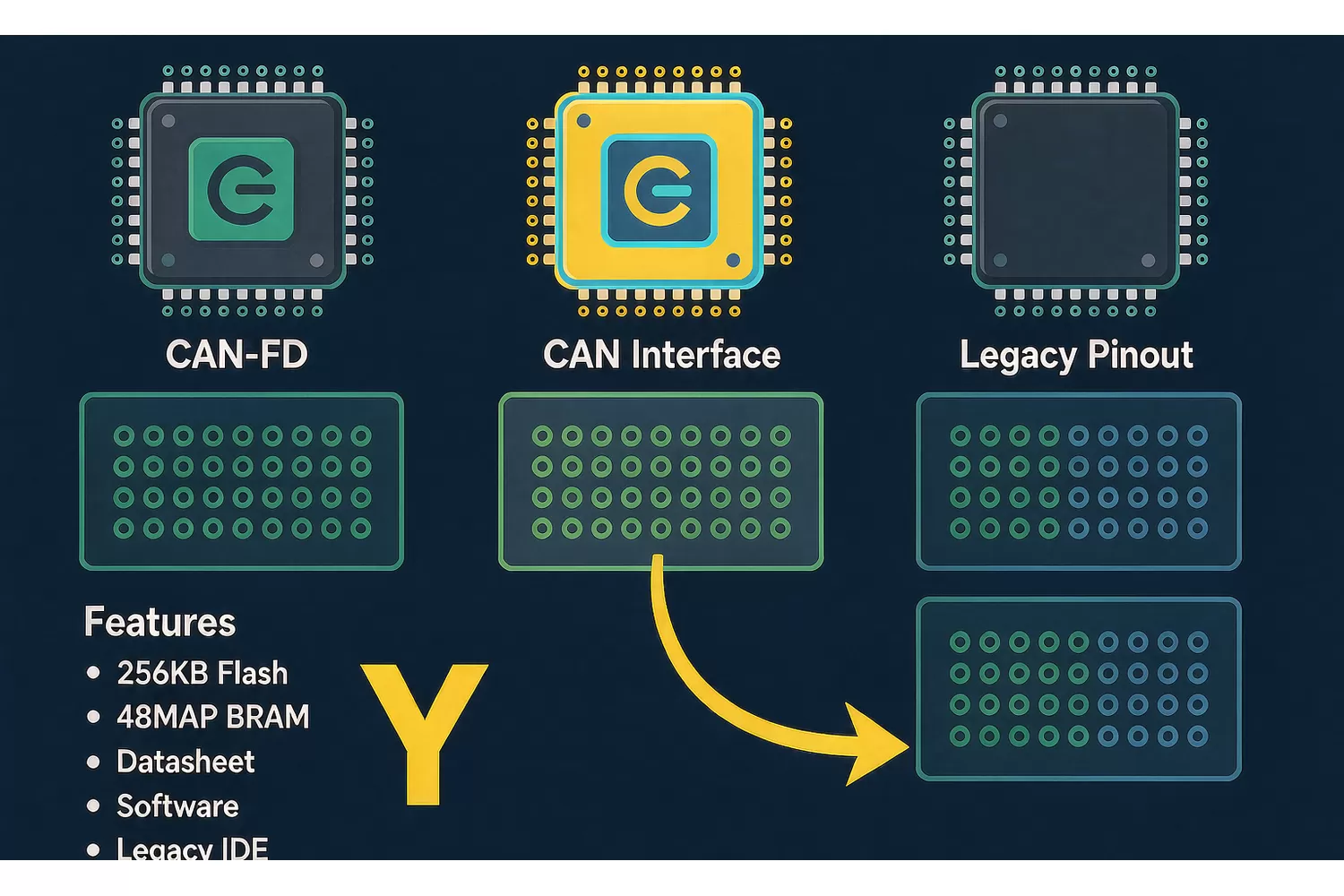
The choice is usually made on one missing feature
When three parts share a 48-pin footprint, the datasheets look alike and the decision comes down to whichever interface the application cannot live without. Sorting that out first saves a week of comparing specification tables.

Sort by what you cannot drop
| If the design must have | Lean toward | Why |
|---|---|---|
| USB with CAN-FD in one small package | AT32F405 | The F405 sub-family is the one that carries both |
| CAN-FD for industrial networking | AT32F405 | CAN-FD is the differentiator in this group |
| CAN (classic) and USB, cost sensitive | AT32F402 | Keeps the core interfaces without the premium |
| Maximum pin compatibility with an existing F103-class design | AT32F403A | The 48-pin F403A route is the best-trodden migration |
Notice that the answer rarely comes from core speed. At this level the core is not the constraint — the interface set is.
The three migration profiles
AT32F403A — the well-documented path
This is the part with the largest body of published migration experience behind it. If your priority is to reduce risk rather than to squeeze cost, starting here means more reference material and fewer surprises. It is the sensible default for a first Artery design.
AT32F402 — the cost-down option
Choose it when the interface list is modest and the volume is high. The engineering effort is not lower than the F403A path, so it only pays off if the unit volume justifies the qualification work.
AT32F405 — the one that carries CAN-FD
If the product roadmap includes CAN-FD, choosing the F405 now avoids a second migration in eighteen months. This is usually the strongest argument for paying more per unit today.
What all three share, and what that saves you
- Same package family, so a single footprint decision covers all three.
- Same toolchain flow, so the debug and programming setup does not change.
- Same pin-table methodology, so the verification work is done once and reused.
That is the practical reason to standardise on one vendor line: the second and third migrations cost a fraction of the first.
A five-step decision sequence
- Write down the interfaces the product cannot ship without.
- Write down the interfaces the roadmap adds within two years.
- Pick the part that covers the union of those two lists.
- Confirm the package still fits the board area you have.
- Only then compare unit price.
Doing steps four and five first is how teams end up migrating twice.
All three are on the shelf now: AT32F402CCT7, AT32F405CCT7, AT32F403ACGT7 and AT32F403ARCT7. The full set is listed under Microcontrollers / MCUs.
Verify before you commit: pinout, peripheral mapping and electrical limits differ between part numbers and between silicon revisions. Always confirm against the current official datasheet and errata for the exact order code you intend to use.
Questions & Answers
Which part should I pick for CAN-FD?
The AT32F405 sub-family is the one in this group that carries CAN-FD alongside USB. If CAN-FD is on the roadmap at all, choosing it now avoids a second migration later.
Is the AT32F403A the safest first migration?
It has the largest body of published migration experience behind it, which usually means fewer surprises. For a first Artery design that matters more than a small unit-price difference.
Can I use the same PCB footprint for all three?
They share a 48-pin footprint family, but you still have to verify the alternate-function mapping for every signal you use. Footprint compatibility is not pin-function compatibility.
How do I justify paying more for the F405?
Compare the cost of the higher part against the cost of a second migration later, including firmware porting, re-validation and a board revision. That comparison usually favours covering the roadmap now.
Recommended next steps
If you are sourcing any of the parts mentioned in this guide, we can help you confirm stock, pricing, and lead times quickly.
- Upload your BOM — send your full parts list and receive a consolidated quote within 2 business hours.
- Browse related in-stock lines: Power Management ICs · Microcontrollers / MCUs · Memory / Logic Devices.
- Contact our team for hard-to-find or end-of-life components.
About us & trademarks: Jingteng Electronics (Shenzhen Jingteng Electronics Technology Co., Ltd.) is an independent distributor of electronic components. We are not an authorised distributor, agent or representative of any manufacturer named in this article. Manufacturer names, part numbers and trademarks are used for identification and technical compatibility only and belong to their respective owners.
