
The reason to move is usually cost, not performance
Teams rarely leave 8-bit parts because they ran out of compute. They leave because the price gap closed, because the toolchain is better, or because a customer requirement — a bootloader, a protocol stack, a firmware update path — is awkward to build on an 8-bit core. The technical work that follows is predictable and worth planning properly.

The assumption that breaks first: voltage
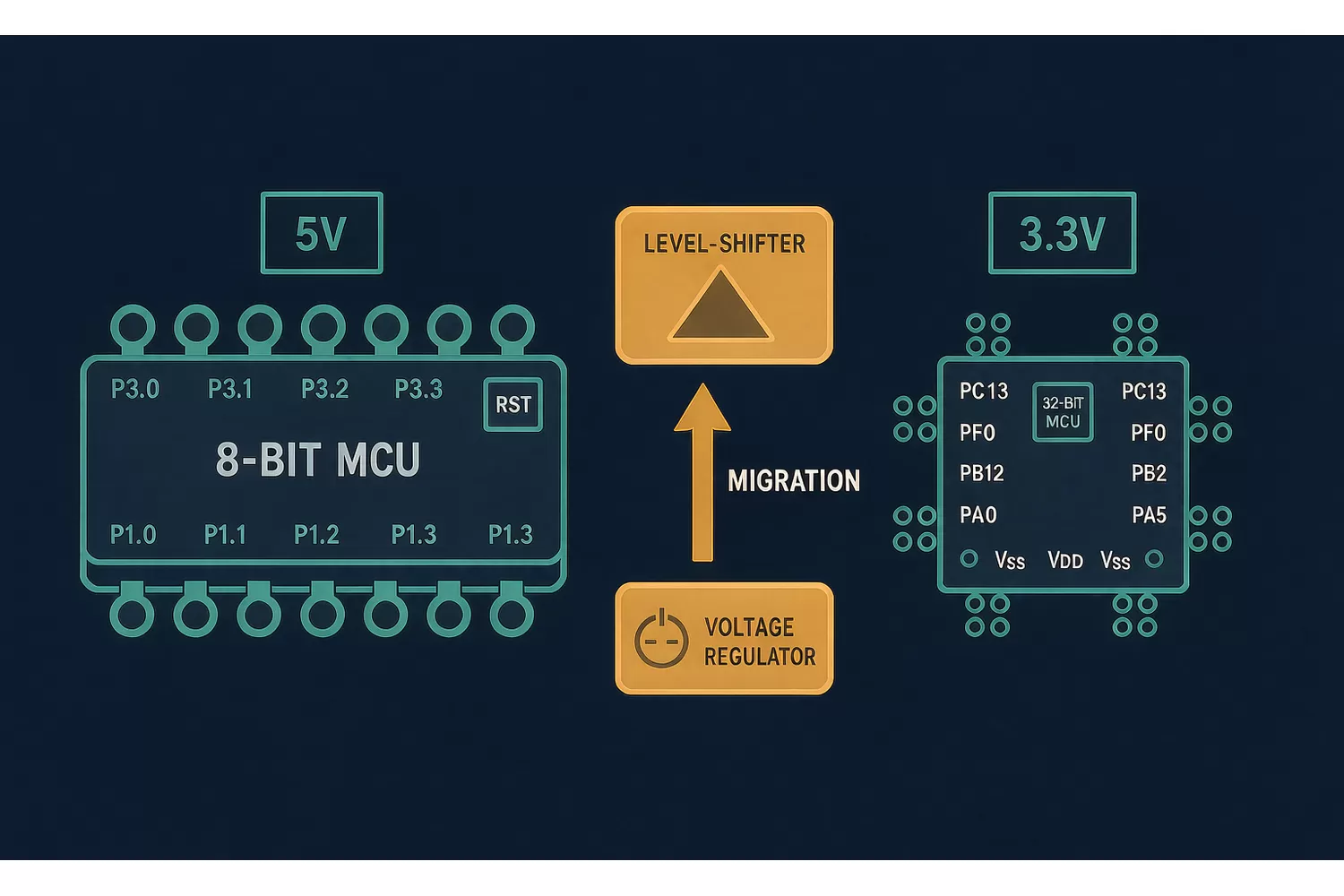
A large share of 8-bit designs run the whole board at 5 V, with the MCU driving sensors, displays and drivers directly at that level. A Cortex-M part runs at 3.3 V, and that single change propagates through the entire schematic.
| Circuit block | Typical 8-bit reality | What has to change at 3.3 V |
|---|---|---|
| Digital sensor inputs | 5 V logic levels | Level shifting, or confirm the sensor is 3.3 V tolerant |
| Display and driver outputs | 5 V drive direct from the MCU | Level shifter or a driver with logic-level input |
| Analogue reference | VDD as reference | Decide between VDD-referenced and an external reference |
| Debug header | Vendor-specific programmer | SWD header plus a supported probe |
| Supply | Single 5 V rail | 3.3 V regulator, or a 5 V tolerant part budget |
Design reviews that start with this table almost always find one interface that forces an extra component. Finding it on paper is much cheaper than finding it on a board.
Lightweight and entry-tier parts in this line
The AT32F011 group is positioned as the entry point of the line, aimed at exactly this kind of replacement where the application needs a modern core with a modest peripheral set. The AT32F421 group steps up to a faster core with a wider package choice, and is the usual landing place when the design has more than one serial interface and a display.
| Design profile | Suggested landing point |
|---|---|
| Simple control, one or two analogue inputs | AT32F011 group, QFN packages |
| Small form factor with a display | AT32F421 group, QFN or TSSOP |
| Multiple serial interfaces plus PWM | AT32F421 group, LQFP |
| Needs USB | Look at the AT32F415 group instead |
Firmware structure changes more than the code does
- Register access. Bit-oriented code written directly against 8-bit registers does not transfer. Expect to rewrite the low-level layer and keep the application logic.
- Peripheral model. Timers with capture/compare units replace the simple timer blocks used on many 8-bit parts. PWM code usually becomes shorter, not longer.
- ADC resolution and reference. Higher resolution exposes reference noise that was invisible before. Layout of the decoupling and the reference path starts to matter.
- Interrupt priorities. A nested vector controller with priorities is a different model from a simple interrupt enable register. Priority mistakes show up as intermittent faults.
The migration order that works
- Map every I/O to a voltage domain and flag anything that is not 3.3 V tolerant.
- Prototype on a development board with the actual sensor and display attached.
- Port the low-level layer first, get the board alive, then bring the application across.
- Re-check the analogue path on a real board, not on the development kit.
Entry-tier parts we hold include AT32F011K8U7-4, AT32F421F8P7, AT32F421G8U7 and AT32F421K8U7-4. All are listed under Microcontrollers / MCUs.
Verify before you commit: pinout, peripheral mapping and electrical limits differ between part numbers and between silicon revisions. Always confirm against the current official datasheet and errata for the exact order code you intend to use.
Questions & Answers
Can I drop a 3.3 V MCU into a 5 V board?
Only for pins that are explicitly 5 V tolerant in the datasheet, and the tolerance applies to specific pin groups. Everything else needs level shifting, so map the voltage domain of every signal before layout.
Which AT32 part suits a small 8-bit replacement?
The AT32F011 group is the entry point for simple control designs, and the AT32F421 group covers applications with more peripherals and a display. Package availability often decides between them.
Do I have to rewrite all the firmware?
The application logic usually survives. The low-level layer — register access, timing and interrupt configuration — has to be rewritten, and that is where most of the schedule goes.
Is analogue performance automatically better?
Resolution is higher, but that exposes reference and layout noise that the previous design ignored. Budget board time to verify the analogue path rather than assuming the specification carries over.
Recommended next steps
If you are sourcing any of the parts mentioned in this guide, we can help you confirm stock, pricing, and lead times quickly.
- Upload your BOM — send your full parts list and receive a consolidated quote within 2 business hours.
- Browse related in-stock lines: Microcontrollers / MCUs.
- Contact our team for hard-to-find or end-of-life components.
About us & trademarks: Jingteng Electronics (Shenzhen Jingteng Electronics Technology Co., Ltd.) is an independent distributor of electronic components. We are not an authorised distributor, agent or representative of any manufacturer named in this article. Manufacturer names, part numbers and trademarks are used for identification and technical compatibility only and belong to their respective owners.
