
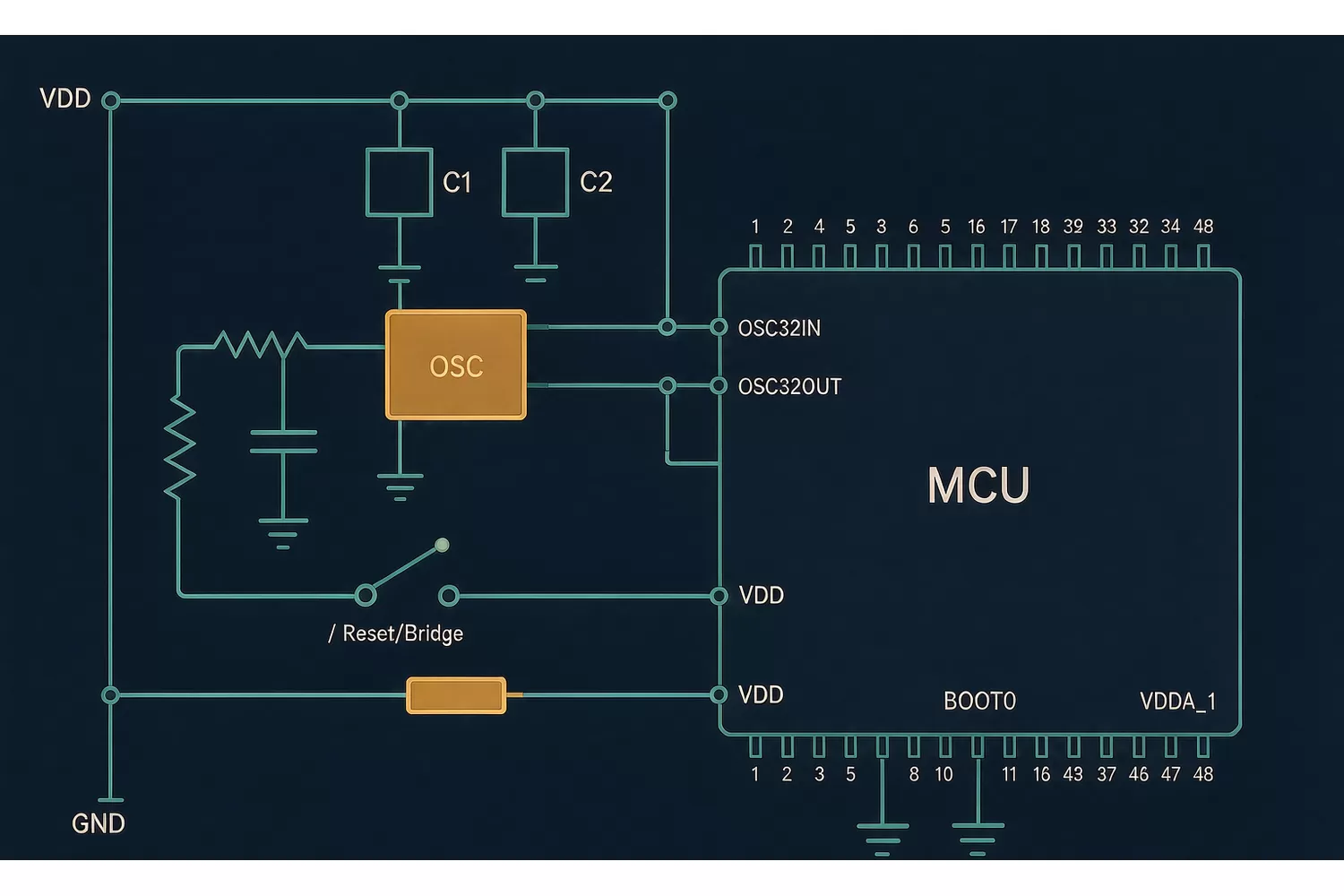
The four pins that decide whether it boots
Firmware gets the attention during an MCU replacement, but the boards that fail to come up usually fail on the analogue and configuration pins: the high-speed crystal, the low-speed crystal if there is one, the reset network and the boot strap. All four are decided at layout time and all four are cheap to get right on paper.

High-speed crystal
| Parameter | Why it changes between parts | What to do |
|---|---|---|
| Load capacitance | The internal capacitance and the oscillator drive differ | Recalculate the external load capacitors; do not copy the previous value |
| Drive level / ESR | A part may need a lower-ESR crystal to start reliably | Pick a crystal specified for the new part's oscillator, not the cheapest one |
| Frequency | The PLL input range constrains the crystal you can use | Confirm the crystal can reach the system clock you want before choosing it |
| Start-up margin | Margin shrinks at low temperature | Verify start-up over the full temperature range, not just at room temperature |
If the previous design used a crystal whose only justification was that it was already in the warehouse, treat that as a variable rather than a constraint.
Low-speed crystal
The 32.768 kHz oscillator is the most common source of "the RTC drifts" and "it will not start in a cold room". Layout matters as much as the component: keep the traces short, guard them with ground, and avoid routing anything switching underneath.
Reset network
Modern parts have an internal power-on reset, so an external RC is often redundant — but not always. Two situations justify keeping one: the supply ramps very slowly, or the board has other devices that must be held in reset until the MCU is stable. Removing a reset capacitor that previously masked a slow supply ramp is a classic way to introduce an intermittent boot failure.
Reset pin sharing
On small packages the reset pin sometimes doubles as an I/O. If the design needs both, the reset function has to be configured correctly and the external network re-thought. This is a layout-visible decision that should be made before the board is ordered.
Boot strap pins
Boot mode is selected by holding specific pins at defined levels during reset. Between vendors and between sub-families the pin name and the default pull direction can differ. Three things to confirm:
- Which pin selects boot mode, and what its internal pull is by default.
- Whether leaving it floating is safe, or whether an external resistor is required.
- Whether the production programming fixture relies on that pin being driven.
Supply and decoupling
Two rails to think about, not one: VDD and VDDA. The analogue supply needs its own filtering, and the decoupling capacitors belong next to the pins they serve. When an MCU swap raises the core frequency, the transient current changes and marginal decoupling that was acceptable before can start producing intermittent faults.
Bench order
- Power up with no crystal fitted and confirm the internal oscillator runs.
- Fit the crystal and verify start-up across temperature, including a cold start.
- Verify the reset behaviour with a deliberately slow supply ramp.
- Confirm every boot mode entry path used in production.
Parts commonly used for this kind of board work: AT32F421C8T7, AT32F425C8T7 and AT32F413CBT7. The wider line is under Microcontrollers / MCUs, and crystal and oscillator options are under Filters / Crystal Oscillators.
Verify before you commit: pinout, peripheral mapping and electrical limits differ between part numbers and between silicon revisions. Always confirm against the current official datasheet and errata for the exact order code you intend to use.
Questions & Answers
Do I need a new crystal when I change MCU?
Not necessarily a different frequency, but the load capacitance and drive requirements must be recalculated. Copying the previous capacitor values is the most common reason a board fails to start.
Can I remove the external reset circuit?
Often yes, because modern parts include an internal power-on reset. Keep external reset if your supply ramps slowly or if other devices must be held until the MCU is stable.
What does the boot pin do?
It selects which memory the part starts from at power-up, typically internal flash or a system bootloader. Confirm the pin, the default pull direction and the level your production fixture applies.
Why does an MCU swap cause intermittent faults?
Marginal decoupling and oscillator start-up margin. A change in core frequency changes transient current, which exposes weaknesses the previous part happened to tolerate.
Recommended next steps
If you are sourcing any of the parts mentioned in this guide, we can help you confirm stock, pricing, and lead times quickly.
- Upload your BOM — send your full parts list and receive a consolidated quote within 2 business hours.
- Browse related in-stock lines: Microcontrollers / MCUs · Filters / Crystal Oscillators.
- Contact our team for hard-to-find or end-of-life components.
About us & trademarks: Jingteng Electronics (Shenzhen Jingteng Electronics Technology Co., Ltd.) is an independent distributor of electronic components. We are not an authorised distributor, agent or representative of any manufacturer named in this article. Manufacturer names, part numbers and trademarks are used for identification and technical compatibility only and belong to their respective owners.
