
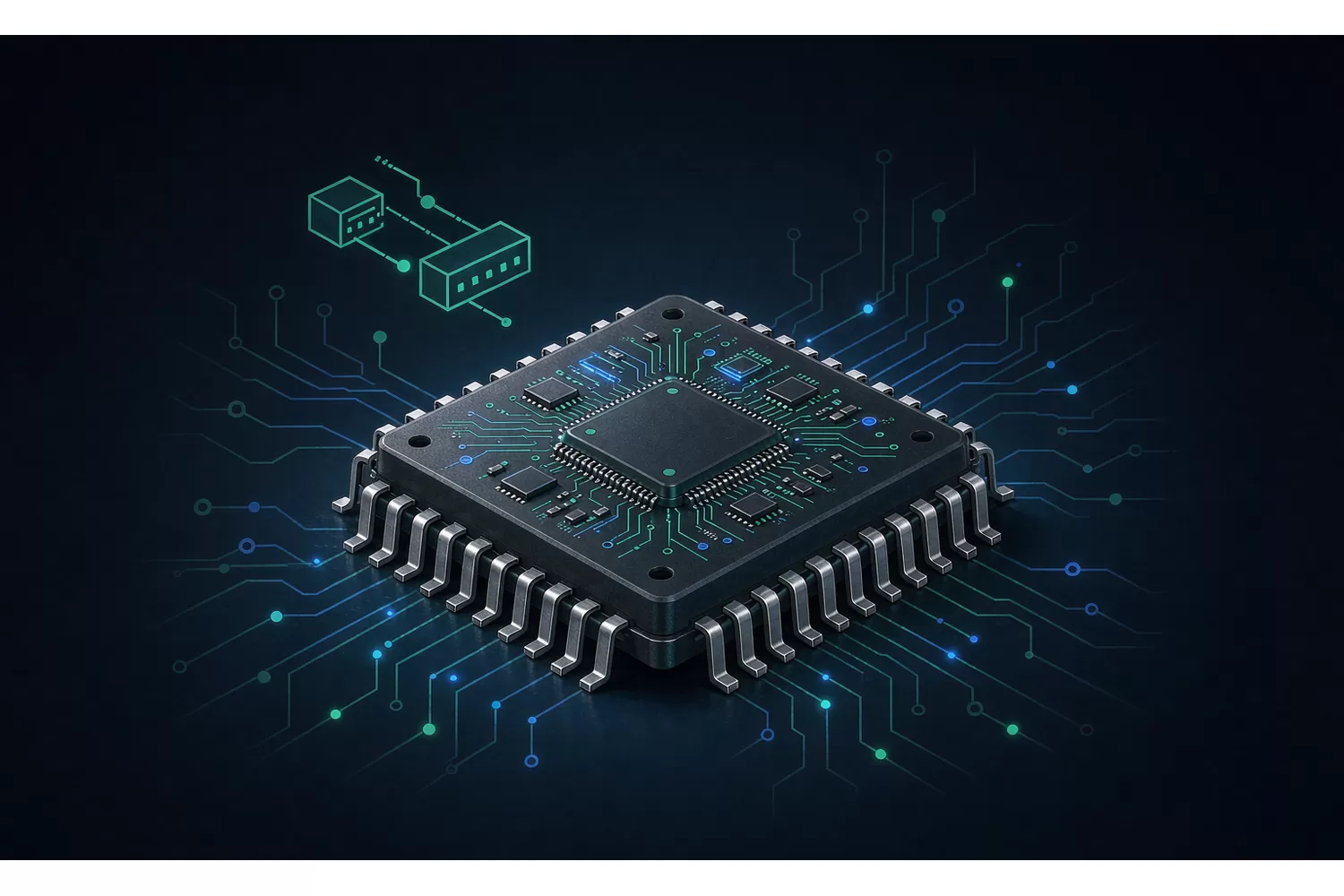
When a design needs a capable 32-bit core but the bill of materials will not stretch to a premium MCU, a value-line Cortex-M part is the usual answer. The AT32F425C8T7 from Artery Technology (雅特力) is a Cortex-M4 device running up to 96 MHz with 64 KB of flash and 20 KB of SRAM in a LQFP48 package, and it includes both CAN and USB. This guide looks at where that combination pays off and what to check when moving a design onto it.

Right-sizing the core
A Cortex-M4 at up to 96 MHz with 64 KB of flash and 20 KB of SRAM is a comfortable fit for motor control, sensor hubs, small user interfaces and fieldbus nodes. The engineering question is rarely raw speed; it is whether the peripheral mix covers the interfaces the product needs without adding support chips. Lean toward choosing the smallest part that closes the design comfortably, and keep a pin-compatible step up in mind for future variants.
Integrated CAN and USB
- CAN — a fieldbus that survives electrically noisy industrial environments and long cable runs.
- USB — a host link for configuration, data logging or firmware update.
- Both on one die — removes an external bridge chip and the firmware that would have driven it.
- Shared tooling — the ARM ecosystem means familiar compilers, debuggers and middleware.
Moving a design onto an AT32 part
The ARM core means the software architecture carries over, but a port is still a port. Work through the clock tree, the peripheral register map, the pinout and any DMA differences, and lean on the vendor's migration documentation. Validate the start-up, the ADC timing and the communication peripherals on real hardware, because those are the areas where small differences surface. Confirm every rating against the manufacturer datasheet before committing to volume.
Microcontrollers we stock
| Part | Core / feature | Package | Link |
|---|---|---|---|
| AT32F425C8T7 | Cortex-M4 up to 96 MHz, CAN + USB (Artery) | LQFP48 | AT32F425C8T7 |
| AT32F425K8T7 | Cortex-M4 value line (Artery) | QFN | AT32F425K8T7 |
| AT32F4212C8T7 | Cortex-M4 value line (Artery) | LQFP48 | AT32F4212C8T7 |
| AT32L021C8T7 | Low-power Cortex-M4 (Artery) | LQFP48 | AT32L021C8T7 |
Browse the MCU range. Send your peripheral list, package and quantity for a quote.
Frequently asked questions
What is a 'value line' MCU?
Value-line families target cost-sensitive designs by trimming the feature set and the price while keeping a modern core. The AT32F425 family uses a Cortex-M4 core at up to 96 MHz with 64 KB of flash and 20 KB of SRAM, so it covers a lot of control and connectivity work without the cost of a higher-end part.
Why does CAN plus USB matter on a small MCU?
Many industrial and consumer products need one fieldbus or one host link, and often both. Having CAN and USB on the same value-line device removes an external bridge chip, which saves cost, board area and a firmware layer. That combination is a large part of why these parts get designed in.
Can I move a design from an imported Cortex-M MCU to an AT32 part?
The core is the same ARM Cortex-M architecture, so the code structure carries over, but peripherals, clock tree, register names and the toolchain details differ. Treat it as a port, not a drop-in: check the pinout, the peripheral set and the vendor's migration notes, and validate on real hardware. Send us the imported part number and we will confirm the closest AT32 option.
Do you stock AT32F425C8T7 and other Artery MCUs?
Yes. We stock the AT32F425C8T7 along with the wider AT32 range, and we can quote by quantity with date codes so you can validate before committing to volume.
Recommended next steps
If you are sourcing any of the parts mentioned in this guide, we can help you confirm stock, pricing, and lead times quickly.
- Upload your BOM — send your full parts list and receive a consolidated quote within 2 business hours.
- Browse related in-stock lines: Microcontrollers / MCUs.
- Contact our team for hard-to-find or end-of-life components.
About us & trademarks: JTDZ Tech (Shenzhen Jingteng Electronics Technology Co., Ltd.) is an independent distributor of electronic components. We are not an authorised distributor or representative of the manufacturers named in this article. Manufacturer and part names are used for indicative purposes only, to help identify the components discussed; all trademarks remain the property of their respective owners. Always verify specifications against the manufacturer's datasheet before design-in or purchase.
