
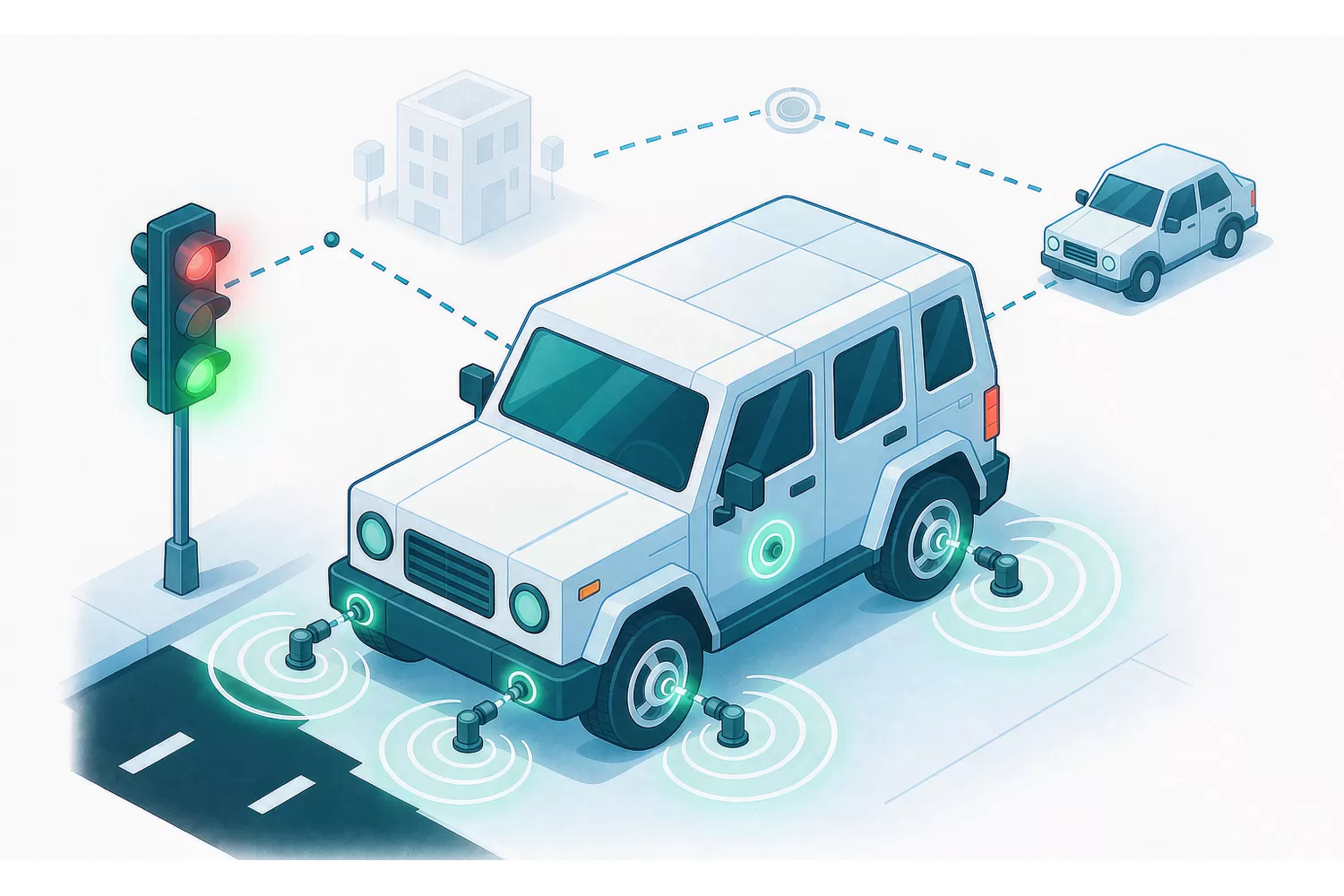
Cars became radios long before they became computers. Today a single vehicle may carry several radar sensors, a cellular and V2X modem, a GNSS receiver, tyre-pressure monitors and a keyless-entry system — each a small RF subsystem. The common thread is that automotive RF has to work where consumer RF would not: across temperature extremes, under vibration, and surrounded by electrical noise.

Radar: seeing without eyes
Adaptive cruise control and automatic emergency braking rely on radar, most commonly around 77 GHz for long range and 24 GHz for shorter range. The radar chain is a familiar one: a transmit amplifier builds the pulse, switches and filters shape it, and on receive a low-noise amplifier recovers the faint echo against clutter. Linearity and noise figure decide whether the system can tell a real obstacle from noise.
We stock amplifiers such as the TQP3M9019 and RFPA3800TR13, and switching parts like the QPC6044TR13, that are commonly referenced in radar and sensor radio paths.
Connectivity: V2X, cellular and GNSS
V2X lets the car talk to infrastructure and other vehicles; GNSS tells it where it is; the cellular modem keeps it online. All of these need clean receive paths and well-matched antenna switching. Small-signal gain blocks such as the SGA-6389Z and ERA-1SM+ support the receive and driver stages.
Convenience RF: TPMS and keyless entry
Tyre-pressure monitors and keyless-entry fobs are low-power radio links that must be reliable for the life of the car. Filtering rejects in-band interferers and a low-loss switch selects the antenna. We stock filter families such as the LFCN-3800+ low-pass filter for this kind of front-end conditioning.
Sourcing for a qualified supply chain
Automotive programmes run for years and cannot afford a mystery part. We focus on traceable sourcing, date-code and lot consistency, and inspection options (visual, X-ray, decapsulation, electrical test) so that the parts feeding a safety-relevant system can be accounted for. See the RF and interface chip range and the Qorvo collection for related devices.
Frequently asked questions
What RF chips are used in a car today?
Modern vehicles use RF across several systems: radar at 24 GHz and 77 GHz for adaptive cruise and collision avoidance, V2X for vehicle-to-everything communication, GNSS for positioning, tyre-pressure monitors, and keyless-entry receivers. Each needs its own amplifiers, switches, filters and often specialised transceivers.
Why is automotive RF harder than consumer RF?
The operating environment is brutal: temperature swings, vibration, electromagnetic noise from the ignition and motors, and a safety requirement that consumer gear does not have. Parts must be qualified to automotive temperature grades and traceable through the supply chain.
What specifications matter for automotive radar RF?
Radar chains care about output power and linearity on transmit, and about noise figure and dynamic range on receive, because the difference between a real obstacle and clutter is often small. Low-loss switching and filtering keep the chain clean.
Can you supply automotive-grade and automotive-relevant RF parts?
We supply RF switches, amplifiers, attenuators and filters commonly referenced in automotive and industrial radio designs, from traceable sources with date-code verification. Send the part numbers and your qualification needs for a quote.
About us & trademarks: JTDZ Tech (Shenzhen Jingteng Electronics Technology Co., Ltd.) is an independent distributor of electronic components. We are not an authorised distributor or representative of the manufacturers named in this article. Manufacturer and part names are used for indicative purposes only, to help identify the components discussed; all trademarks remain the property of their respective owners. Always verify specifications against the manufacturer's datasheet before design-in or purchase.
