
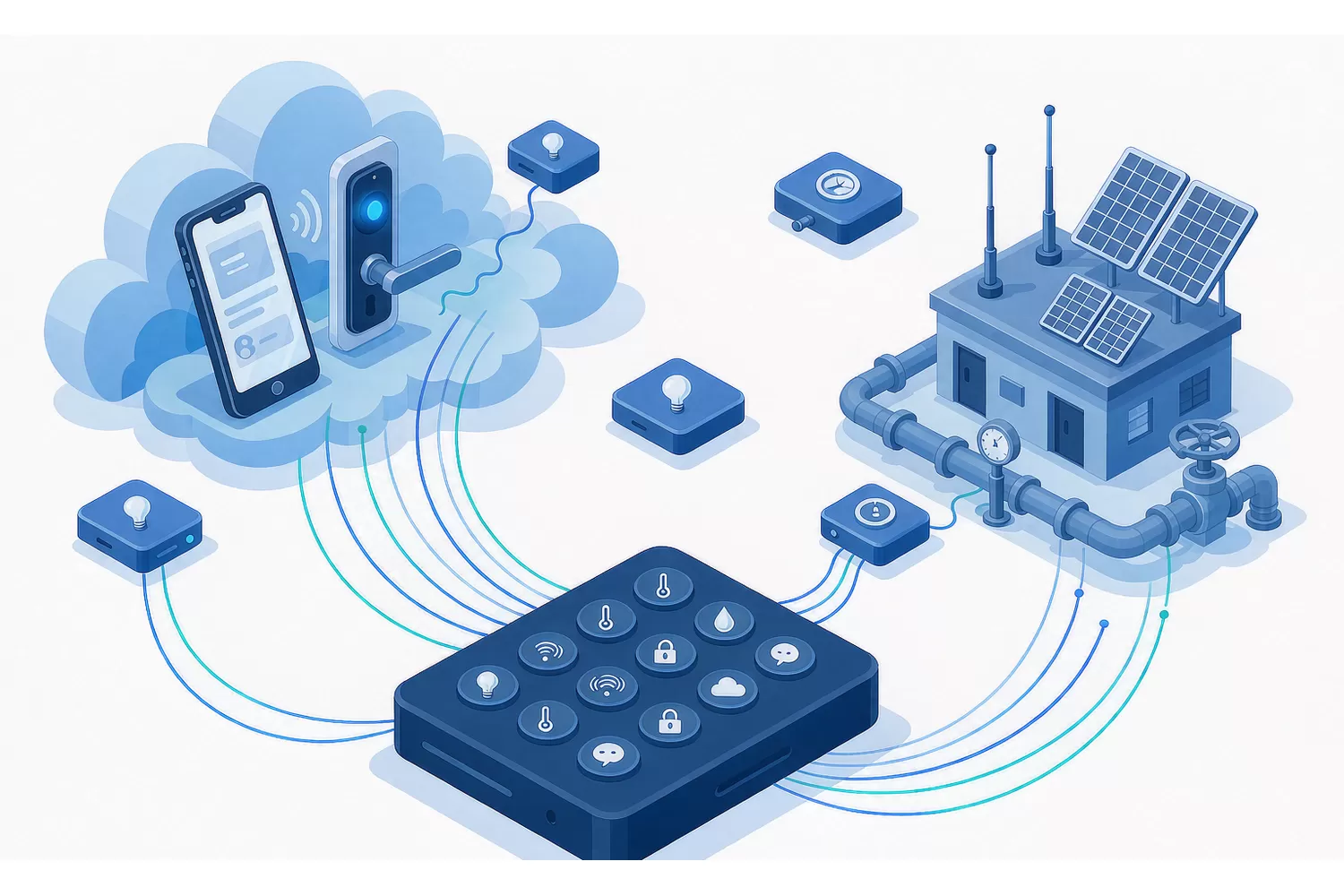
The Internet of Things is really a radio problem wearing a software costume. Every sensor node, tracker, badge and meter has to get data from where it is to where it matters, usually without a wire and often without frequent battery changes. That makes the RF section — and the parts around the wireless chip — central to whether a product succeeds.

The protocols and what they need
Wi-Fi gives range and bandwidth at higher power. Bluetooth Low Energy trades bandwidth for tiny current draw. Zigbee and Thread build self-healing meshes for the smart home. LoRa reaches kilometres at very low data rates. Each protocol reuses the same building blocks: a transceiver or SoC, an antenna, a switch, amplification, and filtering.
Receiver sensitivity is battery life
A node that can be heard at lower transmit power can sleep sooner and live longer. That is why a clean low-noise or gain-block amplifier in the receive path pays for itself in battery life. We stock small-signal gain blocks such as the ERA-1SM+ and GALI-21+, which are commonly referenced where a low-power receive or driver stage is needed.
Choosing the antenna path
Many nodes use antenna diversity or switch between bands, which needs a small, low-loss RF switch. The AS179-92LF SPDT switch is representative of the kind of switching used to select or combine antenna paths in compact wireless devices.
Keeping the band clean
IoT devices sit next to Wi-Fi, Bluetooth and cellular noise. A high-pass or low-pass filter rejects what you do not want. We stock LC filter families such as the HFCN-5500+ high-pass and LFCN-3800+ low-pass filters for this purpose.
Trimming level
A step attenuator lets firmware protect a sensitive receiver or calibrate a path. We supply the PE4302-52 step attenuator, and fixed pads such as the ATN3580-02.
Sourcing for volume IoT
IoT builds are often high volume with tight margins, so a single constrained line can ripple through the whole bill of materials. We help by supplying the RF discretes from traceable sources and finding alternatives when a part is allocated. Browse the RF and interface chip range for the full selection.
Frequently asked questions
What RF chips does an IoT node typically use?
Most nodes use a single wireless SoC or a transceiver for the chosen protocol — Wi-Fi, Bluetooth Low Energy, Zigbee, Thread or LoRa — plus external components: a switch for antenna diversity, a low-noise amplifier or gain block for range, filters for coexistence, and sometimes an attenuator for level control.
Why does low power matter so much in IoT RF?
Many nodes run for years on a coin cell or a small battery. The radio usually dominates the power budget, so the duty cycle, the transmit current and the receive sensitivity (which determines how little power you need to be heard) decide battery life. A better low-noise amplifier can let you transmit less often.
How do you keep IoT radios from interfering with each other?
Coexistence is mostly filtering and channel planning. Filters keep the wanted band clean and reject nearby interferers such as Wi-Fi or cellular. A switch can select between antennas or bands. Good layout and antenna matching do the rest.
Can you supply RF parts for IoT and sensor designs?
Yes. We stock low-power-friendly gain blocks, switches, filters and step attenuators commonly referenced in wireless sensor and IoT designs. Send your part list and quantity for a quote.
About us & trademarks: JTDZ Tech (Shenzhen Jingteng Electronics Technology Co., Ltd.) is an independent distributor of electronic components. We are not an authorised distributor or representative of the manufacturers named in this article. Manufacturer and part names are used for indicative purposes only, to help identify the components discussed; all trademarks remain the property of their respective owners. Always verify specifications against the manufacturer's datasheet before design-in or purchase.
