
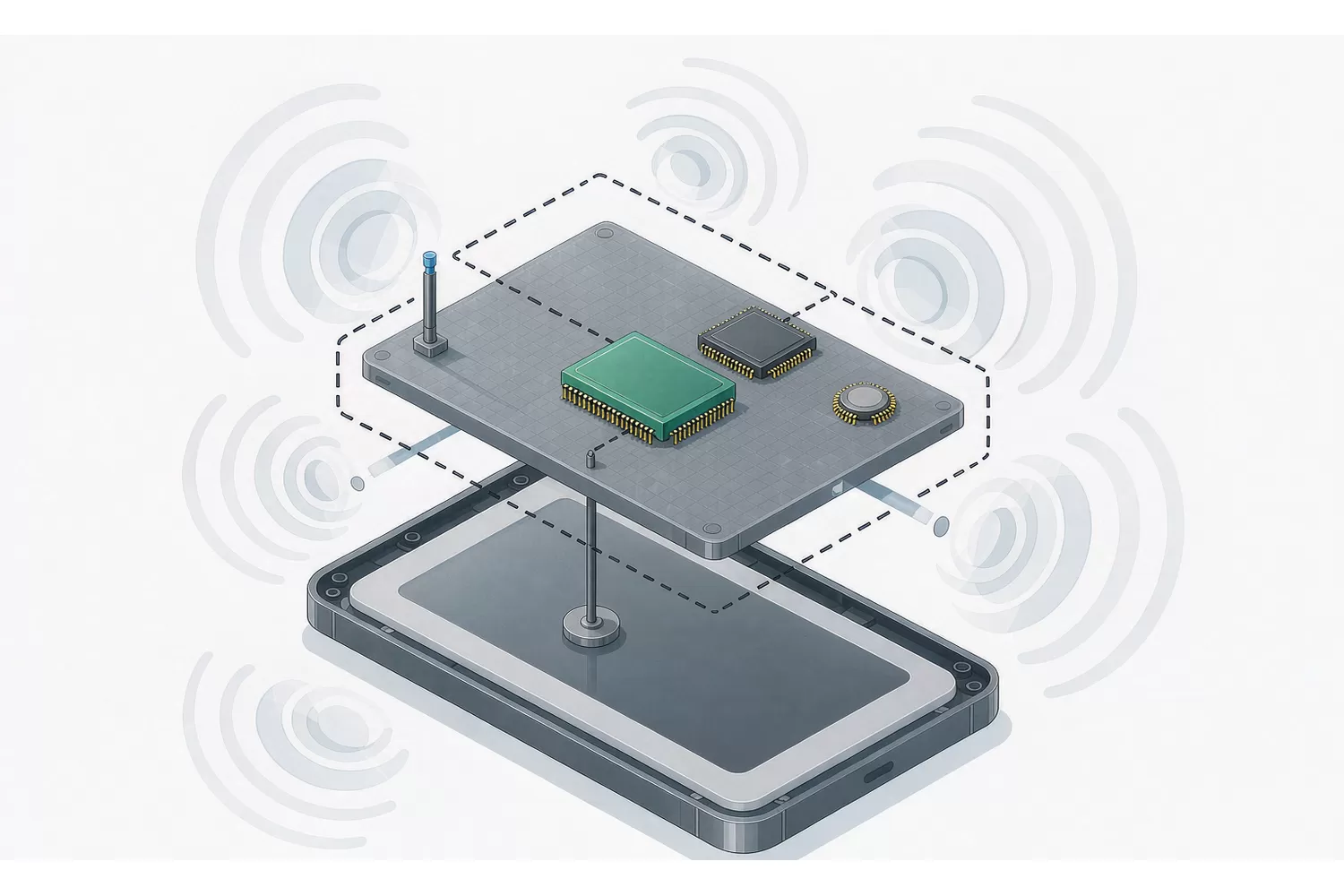
A modern smartphone is a multi-band radio crammed into a few cubic centimetres. It talks on several cellular bands at once, jumps between Wi-Fi and cellular, and keeps a Bluetooth and GNSS receiver alive — all sharing one small antenna system. The component that makes this possible is the RF front-end module, and the discrete parts around it are where most of the real engineering (and most of the sourcing risk) lives.

What the front end must do
The transceiver chip handles modulation and demodulation, but it cannot drive an antenna directly. Between it and the antenna sit:
- Power amplifiers — boost the transmit signal to the level the band needs.
- Low-noise amplifiers — recover weak incoming signals without adding noise.
- Switches and antenna tuners — select bands and match the antenna across frequencies.
- Filters — keep each band clean and isolated from its neighbours.
- Attenuators — trim levels so strong signals do not overload the receiver.
The switch is the unsung hero
With 30-plus bands to manage, the antenna switch does constant work. It needs high isolation so one band does not leak into another, very low insertion loss so battery and sensitivity are not wasted, and a tiny footprint. Parts like the AS179-92LF SPDT switch and the SKY13575-639LF are representative of the kind of small-signal switching used in handset radio paths.
Gain where it counts
On receive, a clean low-noise or gain-block amplifier sets the sensitivity of the whole phone. We stock devices such as the SGA-6389Z, the ERA-1SM+ and the GALI-21+ gain blocks, plus transmit and driver amplifiers like the RFPA3800TR13.
Controlling level
Digital step attenuators let the radio trim signal strength under software control, which matters for both receiver protection and transmit calibration. We supply the PE4302-52 step attenuator for this role.
Sourcing the parts around the FEM
When a FEM is allocated or a discrete line goes constrained, the whole build can stall. Having traceable sources for the switches, amplifiers, attenuators and filters — and alternatives when a part is unavailable — is what keeps production on schedule. See the full RF and interface chip range and the Skyworks and pSemi collections for related parts.
Frequently asked questions
What is an RF front-end module (FEM) in a phone?
It is the integrated block that handles all the radio conditioning between the antenna and the transceiver chip: power amplifiers, low-noise amplifiers, switches, filters and sometimes antenna tuners, packaged together. Modern phones support many bands, so the FEM does the heavy lifting of band selection and routing.
Why are phones so demanding on RF switches?
A phone may support 30-plus bands across many modes, and the switch must route the right path with high isolation and very low insertion loss, in a tiny package that draws almost no current. Every dB lost in the switch is paid for in battery life or receive sensitivity.
What is carrier aggregation and why does it need RF parts?
Carrier aggregation combines several frequency blocks to raise data rate. The front end must be able to receive or transmit on multiple bands at once, which multiplies the number of filters, switches and amplifiers that have to coexist without interfering.
Can you source the discrete RF parts used around phone FEMs?
Yes. We supply discrete switches, low-noise amplifiers, power amplifiers and step attenuators that are commonly referenced in handset and small-device radio designs. Send the exact part numbers and quantity for a quote.
About us & trademarks: JTDZ Tech (Shenzhen Jingteng Electronics Technology Co., Ltd.) is an independent distributor of electronic components. We are not an authorised distributor or representative of the manufacturers named in this article. Manufacturer and part names are used for indicative purposes only, to help identify the components discussed; all trademarks remain the property of their respective owners. Always verify specifications against the manufacturer's datasheet before design-in or purchase.
