
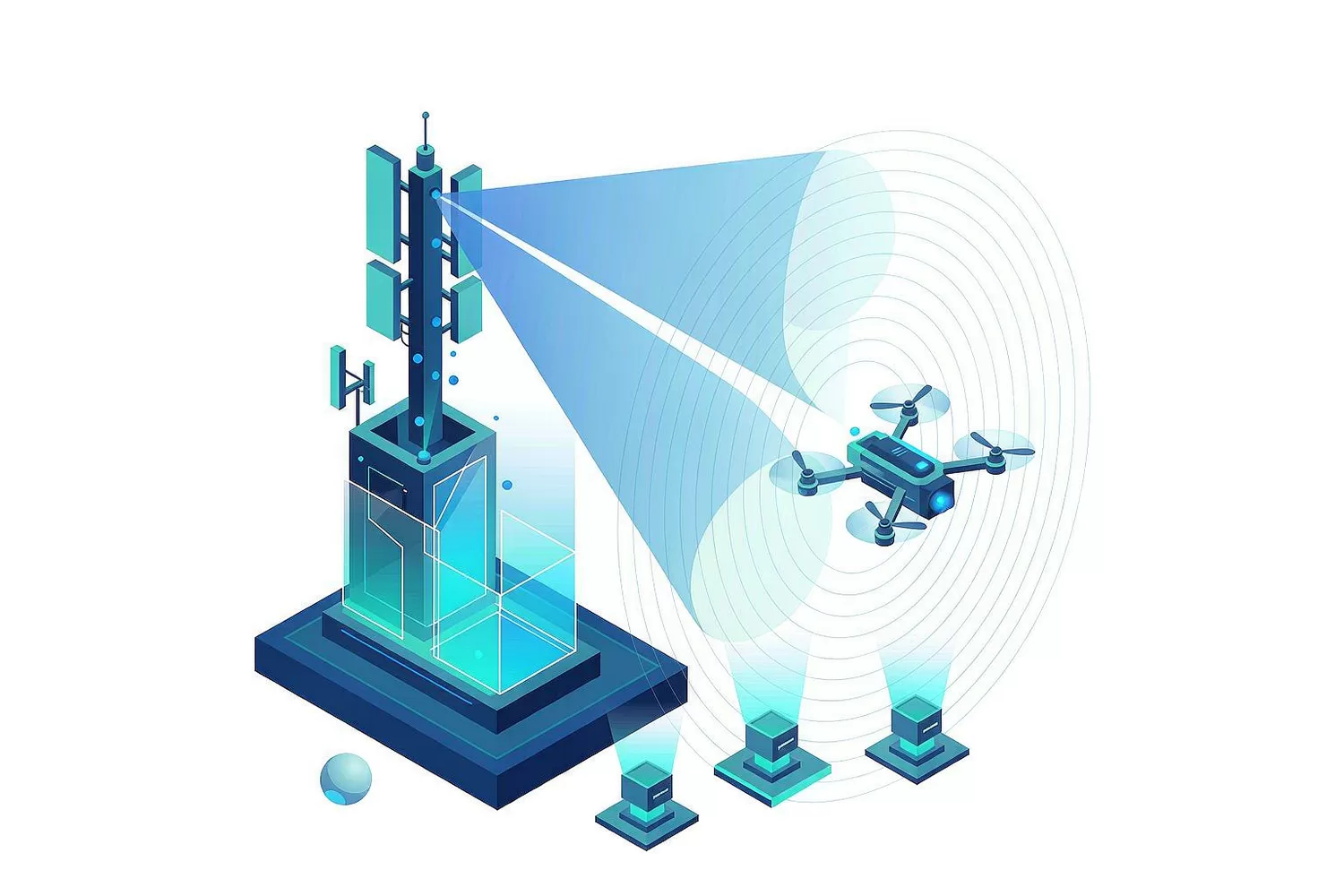
5G did not invent radio, but it changed the economics of the RF chain. Where a 4G macro site might use a handful of transmit and receive paths, a 5G massive-MIMO radio stacks dozens of them behind a single antenna panel. Every one of those paths is a small copy of the same front end: filter, low-noise amplifier, switch, power amplifier, filter again. This guide explains what those blocks do in a 5G base station and the specifications that decide whether they work.

The receive path: pulling a whisper out of the noise
In a 5G radio the uplink from a phone is weak by the time it reaches the antenna. The first active block it meets is usually a filter, then a switch for band or path selection, then a low-noise amplifier. The noise figure of that first amplifier sets the noise floor of the entire receiver, so gain-with-minimum-noise is the design goal. After the LNA the signal is strong enough to survive the rest of the chain without the downstream noise mattering much.
We stock low-noise and gain-block amplifiers such as the TQP3M9019 and SGA-6389Z, which are commonly referenced in receive and driver stages, alongside small-signal gain blocks like the ERA-1SM+ and GALI-21+.
The transmit path: pushing power cleanly
On the downlink the priorities flip. The power amplifier must deliver the output level the antenna needs while staying linear enough that adjacent channels are not polluted. Efficiency matters because a 64-path radio dissipates enormous heat, and thermal design is often the real limiting factor. A low-loss switch selects the band or routes transmit versus receive.
For transmit and driver amplification we supply parts such as the RFPA3800TR13 and SBB-3089Z. For routing we stock switches like the QPC6044TR13 and SKY13575-639LF.
Filters keep the spectrum honest
Every modern band sits next to something else. Low-pass filters suppress the harmonics a power amplifier inevitably generates, and band-pass or duplexer filters keep your transmitter out of a neighbouring receiver. A few tenths of a dB of insertion loss on the receive side is paid for directly in sensitivity, so filter choice is not trivial.
We stock LC filter families such as the LFCN-3800+ low-pass and HFCN-5500+ high-pass filters.
Why this matters for sourcing
Massive MIMO multiplies the bill of materials by the number of paths, and those parts are often the ones that go constrained when a network build ramps. Having a supply channel for the switches, amplifiers, attenuators and filters — and the ability to find alternatives when a line is allocated — is what keeps a build moving. Browse the full RF and interface chip range, or the dedicated Qorvo, Skyworks and Mini-Circuits collections.
Frequently asked questions
What does an RF front end in a 5G base station actually do?
It sits between the antenna and the baseband, conditioning the signal in both directions. On receive it filters, switches and amplifies weak uplink signals with the lowest possible added noise. On transmit it boosts the downlink to the power level the antenna needs, while keeping the spectrum clean. Massive MIMO simply repeats this chain across many antenna paths.
Why do 5G base stations need so many RF paths?
Beamforming and spatial multiplexing work by controlling the phase and amplitude of many parallel antenna elements. Each element needs its own filter, low-noise amplifier, switch and power amplifier, so a 64T64R radio can contain well over a hundred RF components. That is what drives the volume demand for small, efficient, linear RF parts.
What specifications matter most for 5G RF parts?
On the receive side it is noise figure and linearity (OIP3); on the transmit side it is output power at compression, efficiency and adjacent-channel linearity. Insertion loss of every passive stage directly adds to the receiver noise budget, so low-loss switches and filters are valuable.
Can you supply RF parts for 5G repair and build?
Yes. We stock a range of RF switches, amplifiers, attenuators and filters commonly referenced in 5G and small-cell designs. Send us the part numbers, package and quantity and we will quote availability and date code.
About us & trademarks: JTDZ Tech (Shenzhen Jingteng Electronics Technology Co., Ltd.) is an independent distributor of electronic components. We are not an authorised distributor or representative of the manufacturers named in this article. Manufacturer and part names are used for indicative purposes only, to help identify the components discussed; all trademarks remain the property of their respective owners. Always verify specifications against the manufacturer's datasheet before design-in or purchase.
