
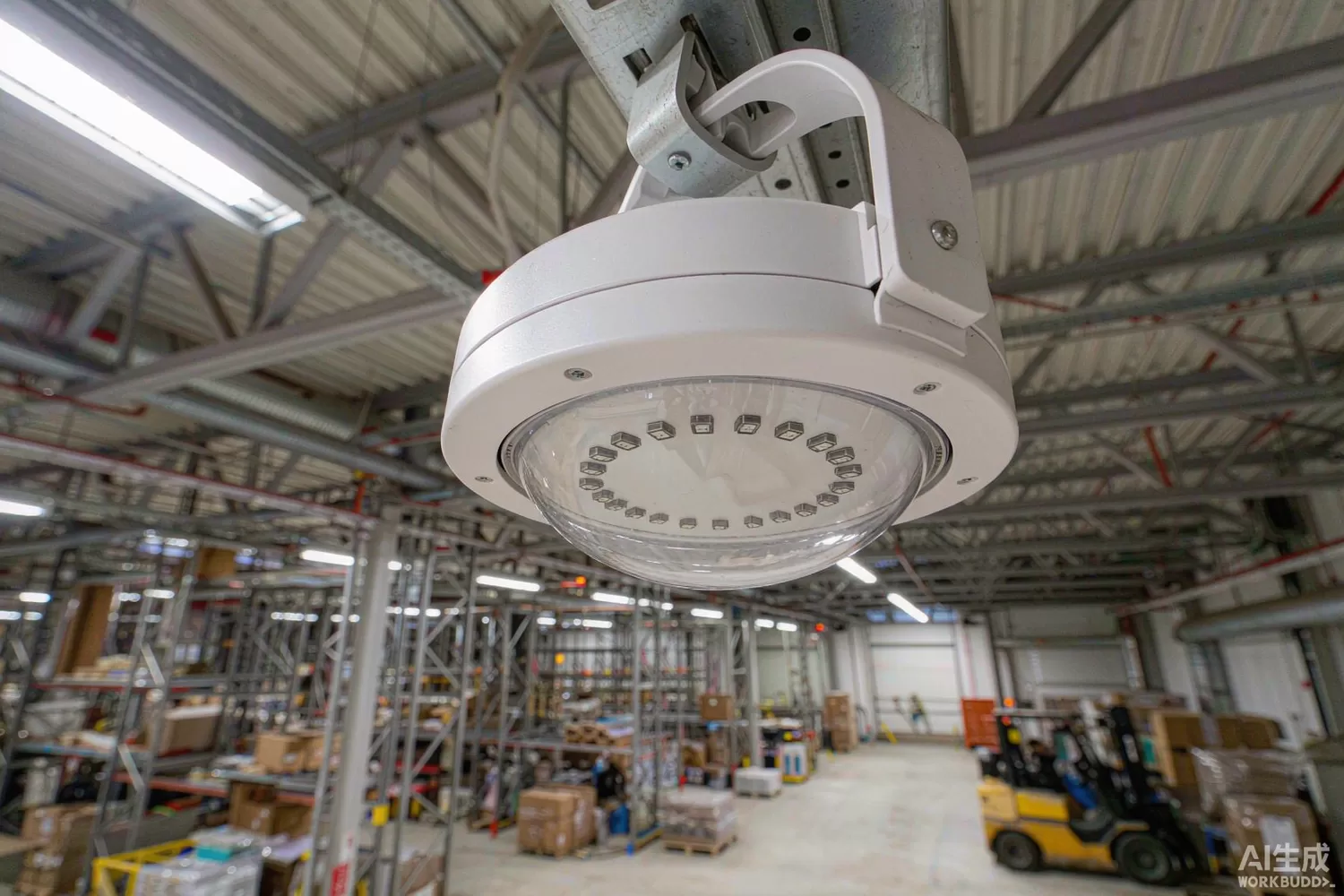
Indoor positioning has spent a decade promising centimetres and delivering floor plans with a dot in the wrong aisle. The reason is usually the measurement: received signal strength tells you how loud a tag is, not where it is, and a body, a forklift or a metal rack changes loudness more than distance does. Bluetooth direction finding replaced that estimate with an angle. Instead of guessing distance from amplitude, a locator measures the phase difference of the same signal arriving at several antennas, and a triangle of locators turns angles into a position. This article explains how the array and the sampling work, where the accuracy really comes from, and how the technique differs from Bluetooth ranging, a distinction that matters because the two are often confused. For the ranging side, see our UWB ranging article.

Application logic: measure an angle, then triangulate
- The tag transmits, the locator measures — unlike ranging, where two devices exchange timestamps, direction finding is mostly one-way. A battery tag broadcasts; the locator listens and computes the bearing. That keeps the tag cheap and its battery small, and it puts the complexity in the infrastructure.
- Constant tone extension — after the packet, the tag appends a pure unmodulated tone. During that tone the locator switches antennas in a fixed pattern and samples in-phase and quadrature values, producing a phase sequence whose slope encodes the arrival angle.
- Switched array — a locator typically carries 4 to 12 patch antennas and an RF switch. The spacing must be under half a wavelength at 2.44 GHz, roughly 6 cm, which is why locator enclosures are wider than a typical access point.
- Triangulation — two or more locators with known positions intersect their bearings. In practice three are used, because a single bearing line plus a wall reflection produces a confident and wrong answer.
- Fusion — real deployments blend angle with RSSI, inertial data and floor-plan constraints. The radio gives a bearing; the system gives a position.
- Why not just use ranging — Bluetooth Channel Sounding measures distance between two radios, which is excellent for a phone-to-car or door-lock decision and poor for tracking hundreds of passive tags, because every distance needs a two-way exchange. Angle-of-arrival scales to many tags per locator; ranging does not.
The parameters that decide whether the dot lands in the right aisle
- Phase calibration — every antenna path has a different delay through the switch, trace and connector. Without per-unit calibration the angle carries a fixed bias, which shows up as a whole zone being reported one bay to the left.
- Antenna pattern consistency — elements must be similar in gain and phase. A cheap array with 3 dB spread across elements limits accuracy more than the sampling rate does.
- Multipath rejection — warehouses are echo chambers. Array size, element count and the estimator all matter, but the single biggest factor is locator placement: a locator mounted at rack height looking down a steel aisle will be lied to.
- Update rate and tag density — a locator resolves one tag at a time per tone window. With hundreds of tags, the schedule becomes the bottleneck, and the system’s advertised update rate collapses.
- Tag simplicity — the tag needs a CTE-capable radio and a stable clock, nothing more. That is why cheap asset tags are possible, and why the locator BOM carries the cost.
- Coexistence — the locator competes with Wi-Fi and with other locators. Antenna placement and channel planning decide whether the deployment works in a live building.
What is changing: hybrid positioning and locators that think
Three shifts stand out. First, hybrid estimation: locators now combine angle with distance measurements where the tag supports them, and with inertial dead reckoning for tags that move slowly, which fixes the corridor problem where two bearings are nearly parallel. Second, edge processing: locators increasingly run the angle estimation and the position solve on-device, emitting coordinates over the network instead of raw samples. That reduces backhaul by orders of magnitude and turns the locator into a sensor rather than a radio. Third, higher element counts and dual-polarisation arrays entered mainstream designs, improving performance in multipath at the cost of a larger enclosure, a more complex switch and a harder calibration routine. On the silicon side the direction is toward SoCs that integrate the radio, the switch control and a DSP block capable of the estimator, which is precisely where domestic vendors are now competing.
Domestic alternatives: suppliers and indicative cost
The imported anchor for direction finding is Nordic’s nRF52833-class SoC, which supports both angle-of-arrival and angle-of-departure and comes with a mature SDK and antenna reference designs. Domestic supply is credible at SoC level: Tailing Micro’s TLSR9 series implements Bluetooth 5.2 direction finding and is used in domestic locator and tag designs, and several module makers build locator front ends around it. For the array itself, domestic antenna and module houses supply switched patch arrays, but the calibration fixture and the estimation firmware are usually the integrator’s responsibility. For the locator’s host processor, Artery’s AT32F435 provides the memory and DSP throughput for a multi-antenna estimator plus a network stack. Cross-reference a domestic SoC only after confirming CTE support in the exact part number, because families mix direction-finding and non-direction-finding members under similar names.
A realistic locator BOM: an Artery AT32F435CGT7 as the host and estimator, a COS29752WU for the radio rail, a GD25Q64CSIG for firmware and calibration tables, and a TS2502PN on the PoE-facing port. Where the design needs a low-current always-on supply for the wake radio, the HX2001 is a practical choice. Our antenna selection guide covers the array matching side.
Price figures below are indicative public-market reference ranges for moderate volumes, compiled from publicly observable listings. They fluctuate with the spot market, package option, grade (industrial, automotive, screened) and order quantity, and must not be read as a quotation. Ask us for a firm price on your exact part numbers and quantities.
| Function (imported anchor) | Example import part / class | Indicative import price (USD) | Domestic candidate | Indicative domestic price (USD) |
|---|---|---|---|---|
| Direction-finding BLE SoC | Nordic nRF52833 class | 3.5 – 6.5 | Tailing Micro TLSR9 series (confirm CTE support per part) | 1.00 – 2.40 |
| Locator host / estimator MCU | STM32F4-class Cortex-M4 | 3.0 – 6.0 | AT32F435CGT7 (Artery) | 1.20 – 2.60 |
| RF switch for array switching | Imported SP4T RF switch | 0.80 – 2.00 | Domestic SP4T/SP8T RF switch families (family level) | 0.25 – 0.80 |
| Switched patch antenna array | Imported 8-element array | 6.0 – 15.0 | Domestic patch array modules (calibration by integrator) | 2.5 – 7.0 |
| Radio-rail LDO | Imported low-noise LDO | 0.25 – 0.70 | COS29752WU (Cosine) | 0.06 – 0.20 |
| Firmware and calibration NOR | 64 Mbit serial NOR | 0.45 – 1.00 | GD25Q64CSIG (GigaDevice) | 0.14 – 0.40 |
| PoE-port ESD protection | Imported TVS array | 0.20 – 0.55 | TS2502PN (Titan Micro) | 0.03 – 0.12 |
Where the cost difference actually comes from
In a locator, the array and the enclosure are a large share of the BOM, and the SoC is a modest one, so a domestic radio saves less than the headline percentage suggests. The real economic difference appears on the tag side: a direction-finding deployment can use thousands of simple broadcast tags, and there the domestic BLE SoC’s price is decisive. The second hidden cost is calibration. An imported SDK ships with a reference calibration procedure and antenna layout; a domestic SoC requires you to build the fixture, characterise the switch and write the estimator. For a first product that engineering cost can exceed several years of component savings, so the sensible sequence is to prove the deployment with an imported reference design, then migrate the tag first and the locator second.
Validation flow before you commit
Calibrate in an anechoic or at least a quiet room and verify angle error across the full 360 degrees at several elevations, because a locator that is accurate on the horizontal plane can be badly wrong for a tag on a high shelf. Then test in the real building: aisle by aisle, with racks loaded, and compare reported zones against ground truth rather than against a floor plan. Measure update rate with the real tag population, not with one tag. Finally, run the locator for a week and log angle jitter per tag; drift that appears after thermal soak points to a calibration that depended on temperature.
Frequently asked questions
Is angle-of-arrival the same as Bluetooth Channel Sounding?
No. Channel Sounding measures distance between two radios that exchange packets; angle-of-arrival measures the bearing of a one-way transmission at an antenna array. They solve different problems and are increasingly combined.
How accurate is it in a warehouse?
Metre-level zone accuracy is realistic with a well-placed three-locator deployment and calibrated arrays; sub-metre claims usually assume favourable geometry, low tag density and little multipath.
Why do locators need so many antennas?
More elements improve the angle estimate and multipath rejection, but they also need a wider enclosure and a harder switch and calibration. Eight elements is a common compromise.
Can I reuse a Wi-Fi access point enclosure?
Rarely. The element spacing at 2.44 GHz forces an array wider than a typical AP, and metal enclosures distort the pattern; the mechanical design follows the array, not the other way round.
About us & trademarks: JTDZ Tech (Shenzhen Jingteng Electronics Technology Co., Ltd.) is an independent distributor of electronic components. We are not an authorised distributor or representative of the imported manufacturers named in this article. Manufacturer, brand and part names are used for identification purposes only; all trademarks remain the property of their respective owners. Cross-reference information in this article is based on publicly available sources, is subject to change, and is not a substitute for your own engineering validation. Always verify specifications against the manufacturer's datasheet before design-in or purchase.
