
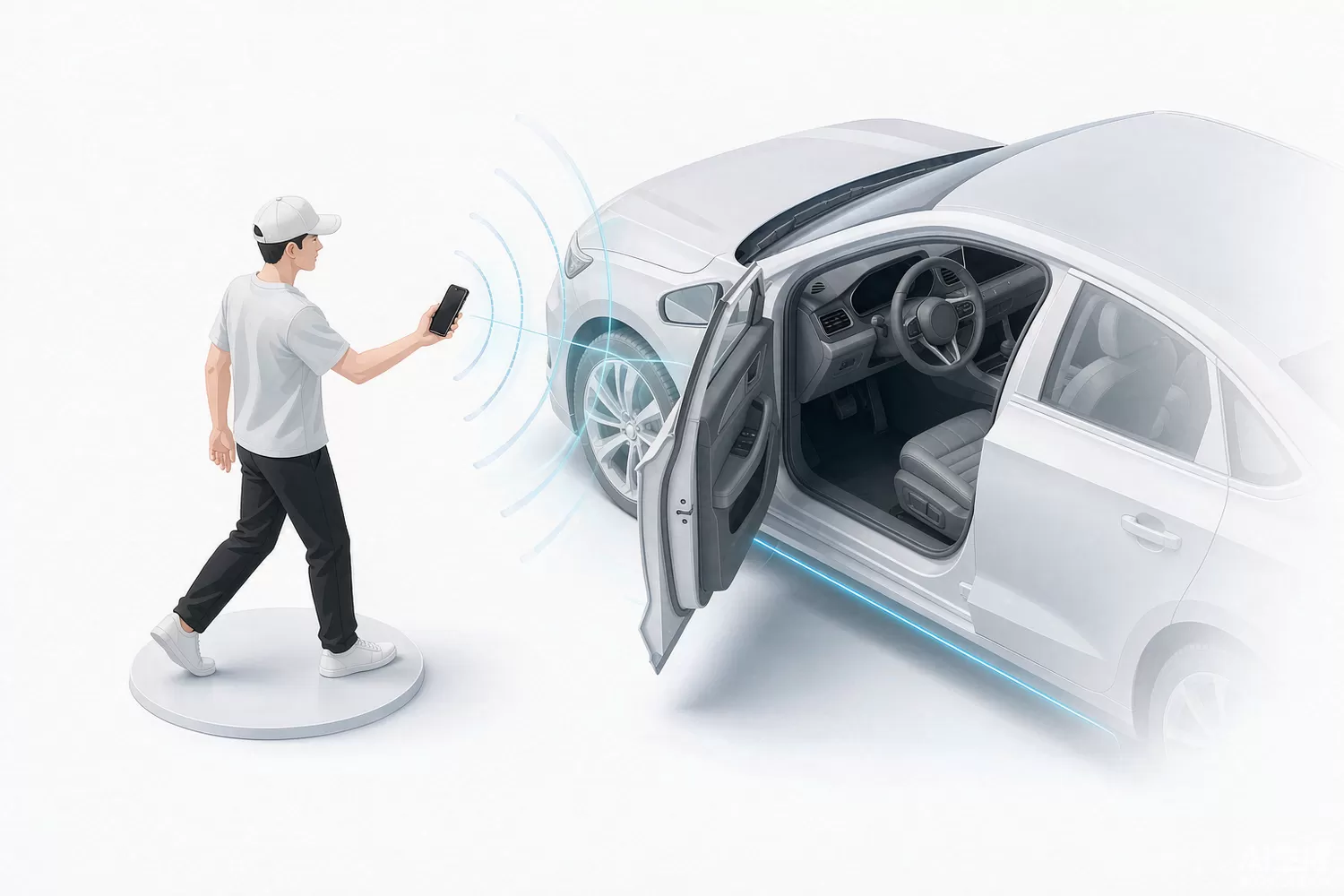
Ultra-wideband was for years a technology with a famous demo and few sockets: precise indoor positioning at trade shows, and little else. That changed when phone makers put UWB radios into handsets for digital car keys and item-finding tags. The category is now driven by three markets at once — automotive digital key, indoor positioning and asset tracking — and it is one of the fastest-moving RF chip categories where domestic design houses are shipping silicon rather than roadmaps.

Application logic: how a UWB link actually measures distance
A UWB radio transmits very short pulses spread across a band at least 500 MHz wide (commonly the 6.5 GHz and 8.0 GHz channel groups under IEEE 802.15.4z). Because the pulses are short in time, the receiver can resolve the first arriving path and measure time of flight rather than signal strength. Two-way ranging (TWR) exchanges timestamps and solves the round-trip time, which cancels most clock offset; time-difference-of-arrival (TDoA) with synchronised anchors scales to many tags. A multi-antenna array adds phase-difference-of-arrival, which is how a phone knows a key is on the driver's side of the car rather than the passenger side.
The engineering decisions that decide whether a UWB product works: antenna count and spacing (angle accuracy depends on aperture), clock quality (a cheap TCXO costs centimetre accuracy directly), packet scheduling and latency (ranging rounds must fit the access-control time budget), and security (the whole point of digital key is distance bounding against relay attacks, so the scrambling and STS features of the standard matter). If you are new to link-budget thinking, our GNSS receiver RF guide covers the same first-arriving-signal discipline.
New technology in UWB
- Carrier-and-packet-level integration: modern UWB SoCs combine the RF front end, the digital baseband, the ranging engine and an MCU, which removes most of the external BOM that first-generation modules needed.
- Digital key profiles: automotive-grade parts now target CCC digital-key profiles with secure ranging, secure-element interfaces and AEC-Q100 qualification paths.
- Angle-of-arrival in package: two- and three-antenna configurations with documented phase calibration let products deliver direction, not just distance.
- Convergence with BLE: the common architecture pairs BLE for coarse discovery and connection with UWB for the precise ranging burst, so combo silicon is replacing two separate chips.
- Radar mode: the same impulse radio can be re-used for short-range presence and gesture sensing, an emerging secondary function in consumer devices.
Domestic alternatives: what to analyse before switching
The sequence we recommend to engineering teams evaluating a domestically produced UWB candidate:
- Confirm the supported channel groups (6.5 GHz low band, 8.0 GHz high band, or both) and the in-band regulatory mask for your selling regions.
- Compare ranging accuracy under multipath and non-line-of-sight conditions in your own geometry, not just in a clean room.
- Check the security feature set: STS/scrambled-timestamp support, distance-bounding behaviour and how keys are stored.
- Review the SDK and antenna reference design — the firmware calibration flow matters as much as the datasheet.
- Verify qualification evidence (industrial or automotive) and, for digital key, the ecosystem approvals your customer requires.
- Run a power budget for the whole ranging round: UWB bursts are short but the receiver wake-up pattern dominates average current.
Indicative cost comparison: imported originals vs domestic candidates
Price figures below are indicative public-market reference ranges for moderate volumes, compiled from publicly observable listings. They fluctuate with the spot market, package option, reel size and order quantity, and must not be read as a quotation. Ask us for a firm price on your exact part numbers and quantities.
| Device class | Common imported reference | Indicative imported unit price | Commonly referenced domestic candidate | Indicative domestic unit price |
|---|---|---|---|---|
| UWB transceiver SoC, single antenna | Qorvo/Decawave DW3000 class; NXP Trimension SR040 class | USD 3.0–6.5 | Domestic UWB SoCs from Chinese design houses (e.g. NewRadio Tech NRT81xxx family) | USD 1.3–3.0 |
| UWB SoC with AoA support (2–3 antennas) | NXP Trimension SR150/SR250 class; Qorvo DW3720 class | USD 5.0–10.0 | Domestic AoA-capable UWB SoCs (e.g. NewRadio Tech, Metar, Chixin programmes) | USD 2.2–5.0 |
| UWB module / evaluation hardware | Imported UWB module with certified antenna | USD 12–30 | Domestic module or EVM with reference antenna | USD 5–14 |
The pattern is familiar: a domestically produced UWB SoC typically lands 45–60 percent below the imported incumbent at moderate volumes, and the gap widens at high volume because the domestic supply chain for 6.5/8 GHz SiGe and CMOS UWB front ends is now local. What you pay for on the imported side is a mature SDK, decades of application notes, and certification evidence that some end customers have already accepted. Cost the integration effort honestly before assuming the swap is free.
Commonly referenced alternative models
| Imported original (reference) | Domestic candidate (public sources) | Why it is referenced |
|---|---|---|
| Qorvo / Decawave DW1000 — first-generation UWB transceiver | Domestic UWB SoCs from NewRadio Tech (NRT81xxx family) and equivalents | Same 802.15.4 UWB ranging function with integrated MCU; the domestic part removes external components and adds AoA support. |
| Qorvo / Decawave DW3000 — low-power UWB, channels 5 and 9 | Chixin Semiconductor UWB SoC family; Metar MK8000-class parts | Publicly announced for digital key, tag and anchor products; compare receiver sensitivity and packet-rate support. |
| NXP Trimension SR040 / SR150 — automotive and IoT UWB | NewRadio Tech NRT82xxx-class parts; domestic automotive UWB programmes | Targeted at the same CCC digital-key and secure-ranging use cases; qualification evidence is the decisive item. |
One caution: UWB is a young domestic category with frequent silicon revisions. Treat every model reference as a starting point for an evaluation order, and always confirm the current datasheet revision, channel support and lifecycle status with the vendor before design-in.
Validation checklist
- Ranging accuracy and repeatability with the real antenna arrangement, including non-line-of-sight cases.
- Angle accuracy across the intended field of view, plus calibration flow and factory-test implications.
- Secure-ranging behaviour against relay and distance-reduction attempts.
- Average and peak current in the actual ranging schedule, including BLE coordination.
- Regional spectrum compliance (FCC, ETSI, and the relevant national regimes) for every channel you enable.
- Lifecycle and second-source plan: at least two pin-compatible supply options for volume products.
Related reading on our blog
RF chips in IoT and wireless sensor nodes · Smartphone RF front-end modules · RF switches and antenna tuning
Frequently asked questions
What does UWB do that Bluetooth cannot?
UWB measures the time of flight of very short pulses, so it can resolve distance to roughly a ten-centimetre scale and determine the angle of arrival from a multi-antenna array. Bluetooth RSSI-based ranging typically lands at metre-level accuracy and drifts badly indoors. That difference is what makes UWB usable for hands-free vehicle access and secure door locks.
Are domestic UWB chips already in production?
Several Chinese design houses have publicly announced UWB SoCs and modules, with the first volume applications in digital keys, tags and indoor-positioning anchors. Production status, channel plan support and certification should be confirmed per part number, because availability moves quickly in this category.
Does switching to a domestic UWB part change the antenna design?
Usually it changes at least the matching network and the balun or feed arrangement, because the RF port impedance and the supported channels differ. Budget for an antenna and matching review plus a fresh ranging calibration, not only a firmware port.
Can you supply both imported and domestic UWB parts?
Yes. We quote imported UWB transceivers and evaluation hardware as well as the domestically produced candidates referenced in this article. Send your target part numbers, package and annual volume and we will come back with availability, date codes and indicative pricing.
About us & trademarks: JTDZ Tech (Shenzhen Jingteng Electronics Technology Co., Ltd.) is an independent distributor of electronic components. We are not an authorised distributor or representative of any manufacturer named in this article. Manufacturer, brand and part names are used for identification purposes only; all trademarks remain the property of their respective owners. Cross-reference information in this article is based on publicly available sources, is subject to change, and is not a substitute for your own engineering validation. Always verify specifications against the manufacturer's datasheet before design-in or purchase.
