
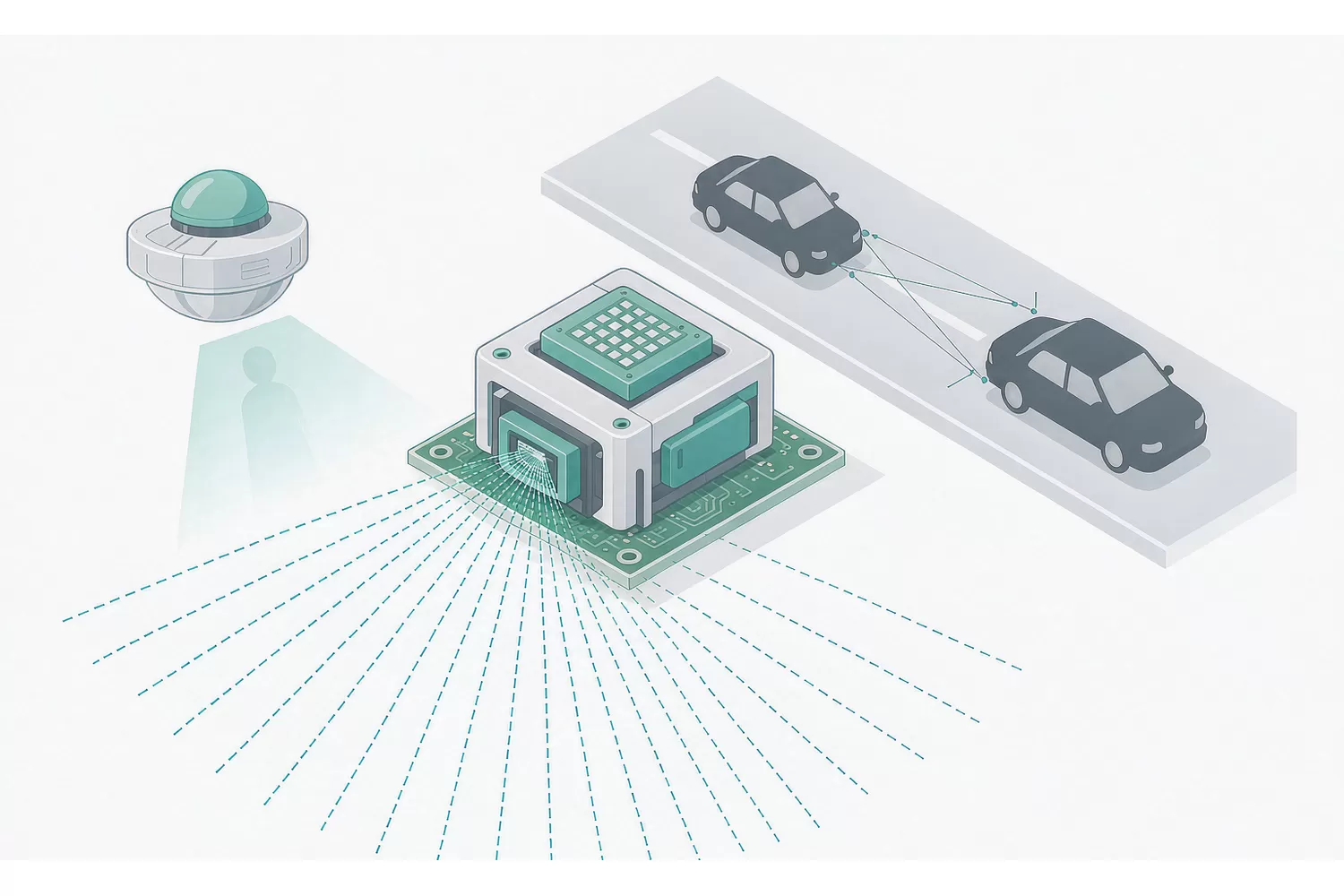
Millimetre-wave radar has escaped the automotive lane. The same FMCW technology that measures range and velocity for adaptive cruise control now watches for occupants in parked cars, counts people in meeting rooms, senses hand gestures above a dashboard, and measures liquid levels in industrial tanks. The imported incumbents — Texas Instruments’ IWR/AWR families and Infineon’s 60 GHz parts — defined the developer experience, while domestic vendors led by Calterah (Calterah Microelectronics) have brought 77 GHz CMOS radar SoCs to series production. This article covers the application logic, the technology frontier, and the substitution economics.

Application logic: how FMCW radar sensing works
An FMCW radar transmits a frequency-modulated continuous wave (a chirp) and mixes the reflection with the transmitted signal; the beat frequency encodes range, and the phase across chirps encodes velocity. Multiple receive channels enable angle estimation through phase comparison — the reason radar SoCs integrate 2–4 receive chains with their ADCs on one die. The design questions that decide success: chirp bandwidth (range resolution), frame rate versus processing budget, antenna design (often antenna-in-package at these frequencies), and the signal-processing chain (CFAR detection, clustering, tracking) that turns ADC data into decisions. Power and heat matter for always-on sensing products; certification matters everywhere, since 60/77 GHz emissions rules are strict.
New technology in mmWave radar
- 4D imaging radar: higher channel counts and cascaded SoCs resolving elevation for ADAS perception.
- Antenna-in-package: integrated antennas shrink modules and simplify RF layout dramatically.
- 60 GHz presence sensing: always-on occupancy and vital-sign detection entering HVAC, lighting and smart-home products.
- On-chip processing: hardware accelerators for CFAR and angle estimation reduce host load.
Domestic alternatives: analysis before switching
The evaluation structure: (1) confirm band plan and chirp flexibility against your sensing requirement; (2) compare RX channel count, TX chains and on-chip DSP acceleration; (3) review the SDK — radar algorithms are half the product, and tooling maturity differs sharply between vendors; (4) check antenna-in-package options and reference designs for your geometry; (5) for automotive use, qualification evidence (AEC-Q100, ASPICE-adjacent process documentation) is decisive; (6) validate detection performance in your actual installation geometry — radar is unforgiving of naïve bench assumptions.
Indicative cost comparison: imported originals vs domestic candidates
Price figures below are indicative public-market reference ranges for moderate volumes, compiled from publicly observable listings. They fluctuate with the spot market, package option, reel size and order quantity, and must not be read as a quotation. Ask us for a firm price on your exact part numbers and quantities.
| Device class | Common imported part (reference) | Indicative imported unit price | Commonly referenced domestic candidate | Indicative domestic unit price |
|---|---|---|---|---|
| 77 GHz automotive radar SoC | TI AWR-class single-chip radar | USD 8–18 | Calterah (Calterah) Alps series | USD 3.5–8 |
| 60 GHz sensing radar SoC | TI IWR6843 class; Infineon 60 GHz families | USD 8–16 | Calterah sensing-class and other domestic 60 GHz programs | USD 3–7 |
| Cascade / imaging-radar solutions | Imported 4D imaging platforms | USD 25–60 (per-SoC basis) | Domestic 4D radar chip sets in development or early production | Case-by-case |
Radar SoC substitution is a systems decision: the chip saving is real (typically 40–60 percent), but the SDK, reference antenna design and algorithm ecosystem around the imported incumbents carry value that must be costed honestly. For industrial sensing products the trade usually lands in favour of domestic candidates; for safety-rated automotive programs the evidence burden is higher.
Commonly referenced alternative models
| Imported original | Domestic candidate (public sources) | Why it is referenced |
|---|---|---|
| TI AWR2243 / AWR1843 class — 76–81 GHz FMCW radar SoC | Calterah Alps series | Publicly documented 77 GHz CMOS radar SoCs in series production with Chinese automotive OEMs; SDK and antenna-module ecosystem documented by the vendor. |
| TI IWR6843 — 60 GHz sensing SoC | Calterah sensing-class parts; other domestic 60 GHz programs | Domestic 60 GHz offerings target presence, gesture and industrial sensing; evaluate SDK tooling for your algorithm team. |
| Infineon BGT60-series 60 GHz radars | Domestic 60 GHz CMOS programs | Series-level reference; confirm chirp flexibility and processing support for your use case. |
Candidate references here are series- and program-level by intent: radar qualification is too application-specific for universal part-number claims, and responsible substitution starts with a scoped evaluation using the vendor's EVM and your target geometry.
Validation checklist
- Range and velocity accuracy verification against your sensing specification.
- Angular-accuracy check across the field of view in the real mounting geometry.
- False-alarm rate characterisation in realistic interference and clutter.
- Thermal and power profile for always-on operation.
- Qualification evidence review (AEC-Q100, process documentation) for automotive paths.
Related reading on our blog
mmWave applications: 60 GHz and 5G · Automotive RF, radar and V2X · Why your 50-ohm trace is not 50 ohm
Frequently asked questions
What bands do mmWave radar SoCs use?
Common bands are 60 GHz (presence sensing, gesture, industrial sensing), 77–81 GHz (automotive radar) and legacy 24 GHz designs. The parts discussed target the 60/77 GHz FMCW classes.
Is the domestic 77 GHz radar chip mature for automotive use?
The publicly documented domestic programs have reached series production in Chinese-market vehicles across ADAS applications. Maturity claims should be evaluated against your own qualification flow — AEC-Q100 evidence, functional-safety documentation and OEM track record are the decisive items.
Can I evaluate a mmWave radar without a full automotive program?
Yes — the 60 GHz sensing-class parts and evaluation modules let industrial teams build presence and level-sensing prototypes quickly. Start with an EVM, characterise detection in your geometry, then decide on integration.
Do you supply imported radar front ends and related RF parts?
Yes. We quote imported RF components across the spectrum — amplifiers, switches, filters and related devices — and can discuss sourcing channels for radar-class parts and their supporting components.
About us & trademarks: JTDZ Tech (Shenzhen Jingteng Electronics Technology Co., Ltd.) is an independent distributor of electronic components. We are not an authorised distributor or representative of any manufacturer named in this article. Manufacturer, brand and part names are used for identification purposes only; all trademarks remain the property of their respective owners. Cross-reference information in this article is based on publicly available sources, is subject to change, and is not a substitute for your own engineering validation. Always verify specifications against the manufacturer's datasheet before design-in or purchase.
