
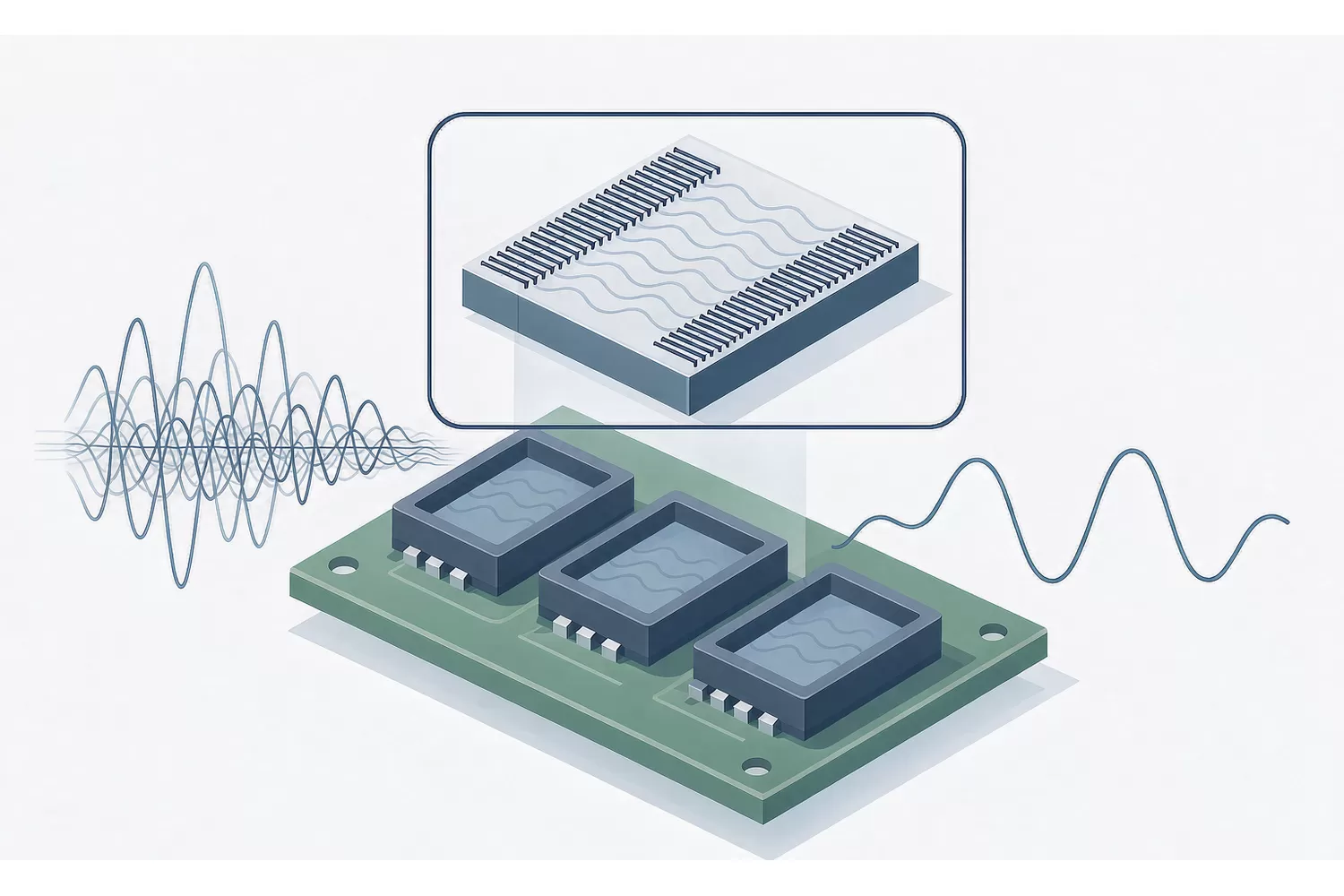
Filters are the quiet disciplinarians of an RF front end: they decide which signals the radio is allowed to see. The imported incumbents — Murata, Taiyo Yuden, Tai-Saw and their peers — built the SAW and BAW market, and imported parts like the Tai-Saw TB0614A and TA0224A remain widely quoted. Domestically produced SAW filters have meanwhile reached industrial scale. This article explains the application logic of RF filters, what is new, and how the substitution arithmetic works.

Application logic: choosing and placing an RF filter
Three questions define a filter choice. Where does it sit in the chain — before the LNA (protecting it from out-of-band blockers) or after (cleaning up TX spurious)? What passband must it preserve — centre frequency, bandwidth, and how much insertion loss your link budget can spare? And what rejection must it deliver — the out-of-band signals that would otherwise desensitise the receiver. SAW filters earn their place when the roll-off must be steep: their acoustic resonances deliver skirt selectivity that LC networks cannot reach in the same footprint. Temperature is the classic trap: a standard SAW’s passband drifts down with heat, and a band-edge filter can slide out of spec on a hot board — hence TC-SAW. For filter-family overviews see our SAW/BAW/LC comparison and the Taiyo Yuden FAR-F6KA product page for a representative high-frequency SAW.
New technology in RF filters
- TC-SAW mainstreaming: temperature compensation moving from premium to standard parts.
- BAW scaling: higher-frequency cellular bands and Wi-Fi 6E/7 push acoustic filters upward; domestic BAW development is active.
- Miniaturisation: smaller die and wafer-level packaging cut footprint per pole of selectivity.
- Filter-plus-multiplexer integration: diplexers and multiplexers combining bands in one package for crowded front ends.
Domestic alternatives: analysis before switching
Compare candidates on: insertion loss across the full passband (not just centre); rejection at the specific blockers your product faces; temperature drift against your board’s environment; package parasitics and layout compatibility; and manufacturing consistency — request lot-level statistical data. Where public information supports only series-level references for domestic vendors, treat the exact cross-reference as a supplier conversation, which our team can coordinate.
Indicative cost comparison: imported originals vs domestic candidates
Price figures below are indicative public-market reference ranges for moderate volumes, compiled from publicly observable listings. They fluctuate with the spot market, package option, reel size and order quantity, and must not be read as a quotation. Ask us for a firm price on your exact part numbers and quantities.
| Device class | Common imported part (reference) | Indicative imported unit price | Domestic candidates (public sources) | Indicative domestic unit price |
|---|---|---|---|---|
| SAW band filter (sub-2.5 GHz) | Tai-Saw / Murata / Taiyo Yuden SAW series | USD 0.10–0.45 | Haoda Electronics (Haoda) SAW series; Deqing Huaying (Deqing Huaying) SAW series; Maijie Technology (Macroxy) filter series | USD 0.04–0.18 |
| TC-SAW / demanding band filter | Imported TC-SAW families | USD 0.25–0.70 | Domestic TC-SAW programs (vendor-dependent maturity) | USD 0.10–0.30 |
| BAW-class high-band filter | Imported BAW families (Qorvo, Broadcom heritage) | USD 0.40–1.20 | Maxscend (Maxscend) BAW program; Kaiyuan Communication (Kaiyuan) filter families | USD 0.15–0.50 |
Per-filter savings look modest in isolation; they compound because a connected product uses several filters (band selection, coexistence, image rejection). For high-volume consumer platforms, filter cost is one of the top three RF line items after the FEM and the transceiver.
Commonly referenced alternative models
| Imported original | Domestic candidate (public sources) | Notes |
|---|---|---|
| Tai-Saw TB0614A / TA0224A SAW filters (product pages: TB0614A, TA0224A) | Haoda Electronics / Deqing Huaying SAW series | Series-level reference for common ISM and cellular-band SAWs; match centre frequency, bandwidth and footprint from current line cards. |
| Taiyo Yuden FAR-F6KA-1G5754-L4AAMZ — high-frequency SAW (product page) | Domestic SAW series at 1.5–2.5 GHz class | Confirm temperature stability class; TC-SAW candidates where band-edge drift matters. |
| Imported BAW parts for high bands | Maxscend BAW program; Kaiyuan Communication families | Emerging domestic programs; request performance data and qualification evidence for your band. |
This is the category where we most strongly recommend parallel sourcing during validation: order the imported original and the domestic candidates in the same project, measure them on your board, and let the data decide.
Validation checklist
- Network-analyser sweep of insertion loss and return loss across passband and skirt.
- Rejection measurement at your actual blocker frequencies and power levels.
- Temperature-chamber passband check at your product's extremes.
- Layout delta review: parasitics around the filter footprint matter at these frequencies.
- Vendor quality data: lot consistency, PPM history, qualification reports.
Related reading on our blog
SAW vs dielectric vs LC filters for 2.4 GHz IoT · LTCC low-pass / high-pass filter guide · Insertion-loss budget and link margin
Frequently asked questions
When is a SAW filter the right choice versus an LC filter?
When you need steep roll-off in a compact footprint at RF frequencies below roughly 2.5–3 GHz: band selection, image rejection, and coexistence filtering. LC filters handle simple low-pass/high-pass shaping at lower selectivity; our LTCC filter guide covers that segment.
What do TC-SAW and BAW add over standard SAW?
Temperature-compensated SAW holds its passband over temperature, important at band edges. BAW (bulk acoustic wave) moves the ceiling to higher frequencies with steeper skirts, at higher cost — it dominates the high bands of cellular front ends.
Are domestic SAW filters suitable for export products?
Domestic SAW production has scaled substantially and parts are widely used in consumer devices shipping worldwide. For your product, evaluate insertion loss and rejection on your own board, and confirm the vendor's quality system and consistency data for volume production.
Can you quote the imported filters referenced here?
Yes — Tai-Saw, Taiyo Yuden and related imported SAW parts in our catalog are regularly quoted, and we can supply them alongside domestic candidates during evaluation.
About us & trademarks: JTDZ Tech (Shenzhen Jingteng Electronics Technology Co., Ltd.) is an independent distributor of electronic components. We are not an authorised distributor or representative of any manufacturer named in this article. Manufacturer, brand and part names are used for identification purposes only; all trademarks remain the property of their respective owners. Cross-reference information in this article is based on publicly available sources, is subject to change, and is not a substitute for your own engineering validation. Always verify specifications against the manufacturer's datasheet before design-in or purchase.
