
The conflict at 2.4 GHz
Industrial, scientific and medical radios share the 2.4 GHz band with Wi-Fi, Bluetooth, Zigbee and a long list of proprietary protocols. Your receiver must see a weak wanted signal while everything else in the room transmits at high power nearby. That conflict drives the whole filter choice: you need sharp skirts to reject the neighbours, low loss to keep sensitivity, small size for a handheld device, and stable behaviour across a temperature range that a consumer part may never experience.

How the three technologies differ
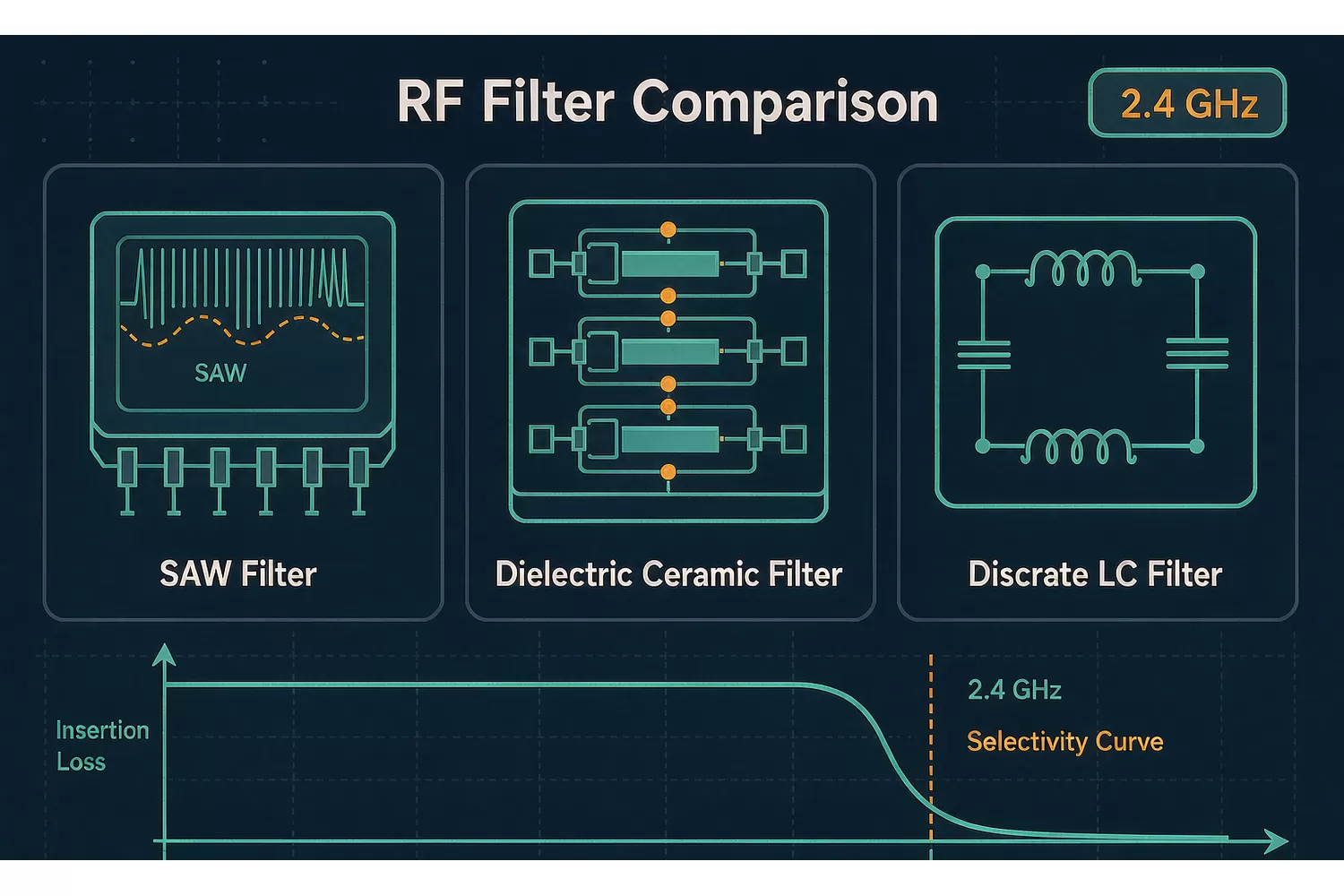
Surface acoustic wave filters use a piezoelectric substrate with interdigital transducers. They give excellent selectivity in a tiny package, which is why they dominate consumer modules. Their trade-off is power handling and a skirt shape that is fixed by the design. Dielectric resonator filters offer very high quality factor and good power handling, at the cost of size and cost. LC filters built from discrete inductors and capacitors are cheap, flexible, and limited by the self-resonant frequency of the parts and the accuracy of the board layout.
Decision table
| Technology | Best at | Watch out for |
|---|---|---|
| SAW | Sharp skirts, small size, cheap | Power handling and drift at high temperature |
| Dielectric resonator | High Q, high power, stability | Size, cost, placement care |
| LC discrete | Low cost, tunable, low frequency | Board parasitics, limited by part self-resonance |
What high temperature actually does
A filter that measures perfectly at room temperature can drift out of a compliant band when the enclosure heats up, because the piezoelectric substrate and the mounting structure both move with temperature. If the product is an outdoor meter, a vehicle module or anything inside a sealed enclosure, ask for measured curves across temperature before committing. This is the most common source of a filter that passes evaluation and fails qualification.
Building the rest of the chain around the filter
Preselect filters belong in front of the low noise amplifier, and the choice of filter determines the amplifier's blocking requirement. After the filter, a low-loss path to the switch and mixer matters as much as the filter itself, because loss in front of the amplifier raises the noise figure directly. Then the matching should be done with parts whose parasitics were included in the simulation, not added afterwards by hand.
On stock we hold the discrete filter options for 2.4 GHz-class chains: Mini-Circuits LFCG-630+, Mini-Circuits HFCG-1100+ and Mini-Circuits HFCG-3800+. For ceramic-surface-wave selectivity in a small footprint, MicroGate MBPF18M2450-M11 is the part to look at. Filter and oscillator parts are grouped under Filters & Crystal Oscillators.
Questions & Answers
Which filter type gives the best selectivity per dollar?
SAW gives the best selectivity per dollar and per cubic millimetre for consumer-type volumes, but its power handling is lower than dielectric resonator parts.
Why do my LC filters behave differently from the simulation?
The parasitics of the inductors and the board pad change the response, and the self resonance of the inductor limits how high the filter can go. Simulation that ignores both will drift from the bench.
Is a dielectric resonator filter worth the size for IoT?
If the product has to survive high power nearby and a wide temperature range, yes. For a battery sensor in a controlled environment, SAW or LC is usually enough.
Can one filter serve both receive and transmit?
Sometimes, but check the isolation between the ports and the power handling on the transmit path. Sharing a filter is a common way to save cost that silently costs transmit efficiency.
Related RF Components & Articles
- Browse our full range of RF chips & RF components.
- Related Mini-Circuits parts: Mini-Circuits components.
- Looking for LFCG-630? Check stock and specs on the product page.
- Looking for HFCG-1100? Check stock and specs on the product page.
- Looking for HFCG-3800? Check stock and specs on the product page.
- Looking for MBPF18M2450-M11? Check stock and specs on the product page.
- Related article: RF Switch Selection: Insertion Loss, Isolation and the Charge Pump You Forgot.
- Related article: RF Front-End Module vs Discrete Design: What Integration Actually Buys You.
- Need pricing or availability? Upload your BOM or contact our team.
Recommended next steps
If you are sourcing any of the parts mentioned in this guide, we can help you confirm stock, pricing, and lead times quickly.
- Upload your BOM — send your full parts list and receive a consolidated quote within 2 business hours.
- Browse related in-stock lines: Filters / Crystal Oscillators.
- Contact our team for hard-to-find or end-of-life components.
About us & trademarks: Jingteng Electronics (Shenzhen Jingteng Electronics Technology Co., Ltd.) is an independent distributor of electronic components. We are not an authorised distributor, agent or representative of any manufacturer named in this article. Manufacturer names, part numbers and trademarks are used for identification and technical compatibility only and belong to their respective owners.
