
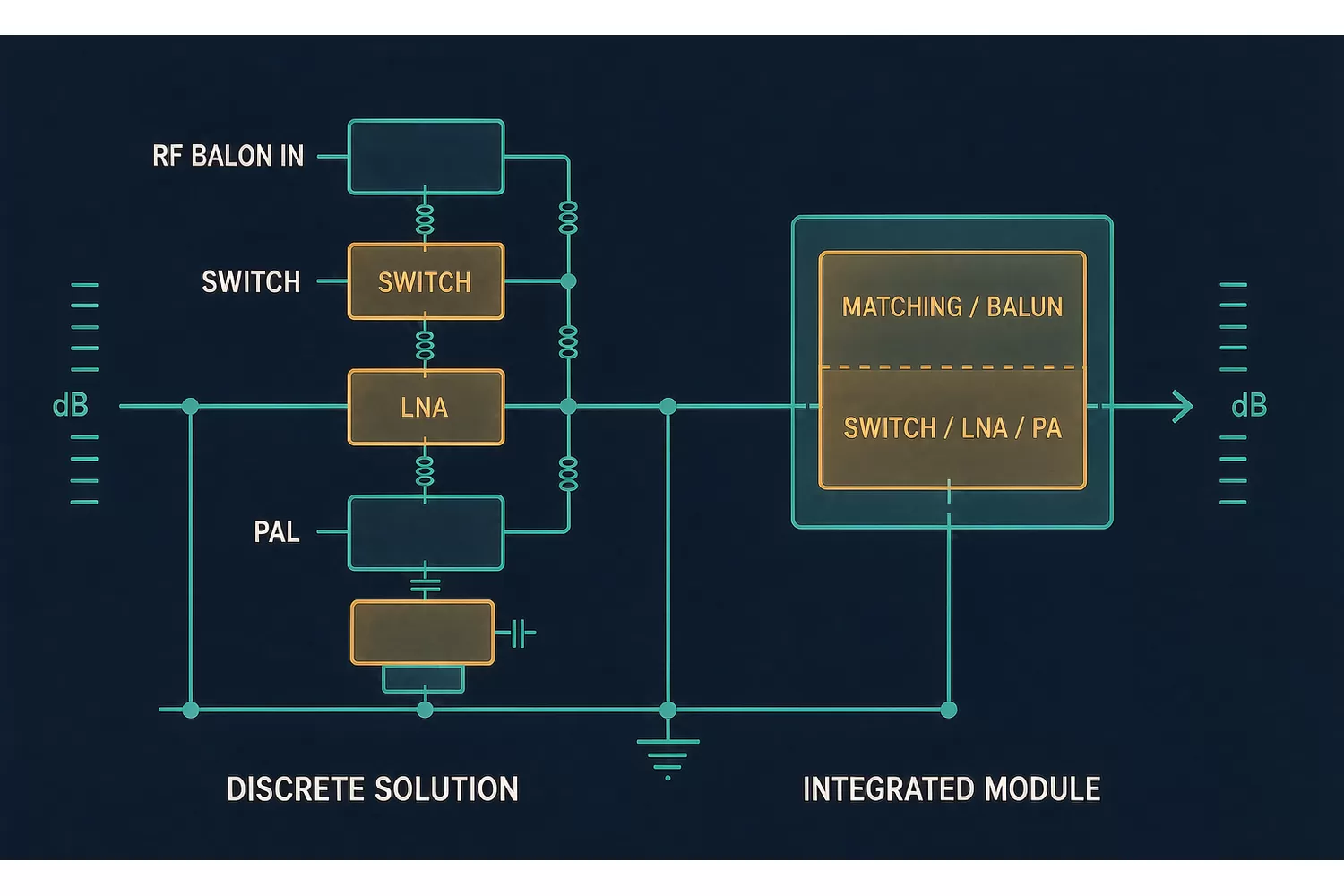
The comparison most people make is the wrong one
Buying a front-end module looks like paying for convenience. The module costs more per unit than the sum of a switch, an LNA, a PA, two matching networks and a handful of passives, so the bill-of-materials comparison always favours discrete. The BOM number is not the cost. Tuning time, rework cycles, second-source risk and the engineer-hours burned on a board that barely meets its EVM target are all part of the cost too.

What the module actually absorbs
On a typical 2.4 GHz or sub-6 GHz transceiver chain, the module absorbs four problems that are individually hard to solve with discretes:
- Blocking and desensitisation. The switch, its isolation and the LNA protection network are characterised together. You inherit a measured behaviour instead of hoping your discretelayout performs like the reference design.
- Parasitic tuning. The ground referenced matching is inside the module, so your PCB trace is a short feeder rather than a part of the matching network.
- Thermal behaviour. The PA and the switch sit on the same substrate with a known thermal path, so the module's datasheet efficiency is closer to what you get on the bench.
- Assembly risk. One placement instead of nine, and no risk of a 0201 coupling capacitor being placed at the wrong angle by the pick-and-place program.
Where discrete still wins
Discrete tends to win when the design needs a topology the product family does not offer, when you need the LNA off during TX for listen-before-talk schemes, when extreme low-power sleep currents matter more than size, or when the design has to stay on air for a decade and you want two independent sources. If you are shipping 500 units a year rather than 500,000, the engineering time you save is worth less than the unit cost you lose.
A realistic BOM comparison
| Line item | Front-end module | Discrete chain |
|---|---|---|
| Active devices | 1 part | 3 parts (switch, LNA, PA) |
| Matching components | ~4 inside module | 8-12 on board |
| Board area | ~9 mm2 | ~35-45 mm2 |
| Tuning iterations | usually 0 | 2-5 |
| Blocking performance | guaranteed by datasheet | you must verify |
| Second source | limited | wide |
| Unit cost at 10k pcs | higher | lower |
How to decide
Budget the module premium against a fixed engineering cost you already know: your own engineer's hourly rate multiplied by the number of expected re-spin cycles. If the module saves two board revisions, the premium paid for itself. If your design is already stable and you only need a cheaper build of the same function, discrete is the right call.
On this site we carry both sides of that decision. For integrated solutions: Skyworks SKY65014-70LF RF front-end module and Qorvo TQL9048 cellular power amplifier module. For designs that need to be built piece by piece: Qorvo RFPA5201TR13 for the amplifier stage and pSemi PE42441E-Z when the switching function needs to be visible to your firmware. All of these are listed under Interface / RF Chips.
Questions & Answers
Is a front-end module cheaper than discrete?
Per unit, usually not. The module costs more than the individual parts it replaces. The saving shows up in tuning time, board area and how often the design needs a re-spin.
Can I still use the module's LNA during transmit?
That depends on the specific product. Most integrated modules shut the LNA path down in transmit mode, so if your protocol needs the receiver live during TX you should look at discrete LNA and switch parts.
Is a module harder to source than discrete parts?
Usually easier to get started and harder to keep in production. One part number can stop at end of life. Discrete designs give you more alternatives, but each alternative needs re-characterisation before you commit it.
What should I check first when selecting a module?
The operating band, the required output power with a realistic duty cycle, the EVM the module supports, and the thermal derating curve. Those four decide whether the part is usable at all.
Related RF Components & Articles
- Browse our full range of RF chips & RF components.
- Related Skyworks parts: Skyworks components.
- Related Qorvo parts: Qorvo components.
- Related pSemi (Murata) parts: pSemi (Murata) components.
- Looking for SKY65014-70LF? Check stock and specs on the product page.
- Looking for TQL9048? Check stock and specs on the product page.
- Looking for RFPA5201TR13? Check stock and specs on the product page.
- Looking for PE42441E-Z? Check stock and specs on the product page.
- Related article: Receiver Noise Figure Budget: How Many dB You Can Actually Afford.
- Related article: Insertion Loss Budget: How Filter Loss Eats Your Link Margin.
- Need pricing or availability? Upload your BOM or contact our team.
Recommended next steps
If you are sourcing any of the parts mentioned in this guide, we can help you confirm stock, pricing, and lead times quickly.
- Upload your BOM — send your full parts list and receive a consolidated quote within 2 business hours.
- Browse related in-stock lines: Interface Chips / RF Chips.
- Contact our team for hard-to-find or end-of-life components.
About us & trademarks: Jingteng Electronics (Shenzhen Jingteng Electronics Technology Co., Ltd.) is an independent distributor of electronic components. We are not an authorised distributor, agent or representative of any manufacturer named in this article. Manufacturer names, part numbers and trademarks are used for identification and technical compatibility only and belong to their respective owners.
