
The three numbers are not the same number
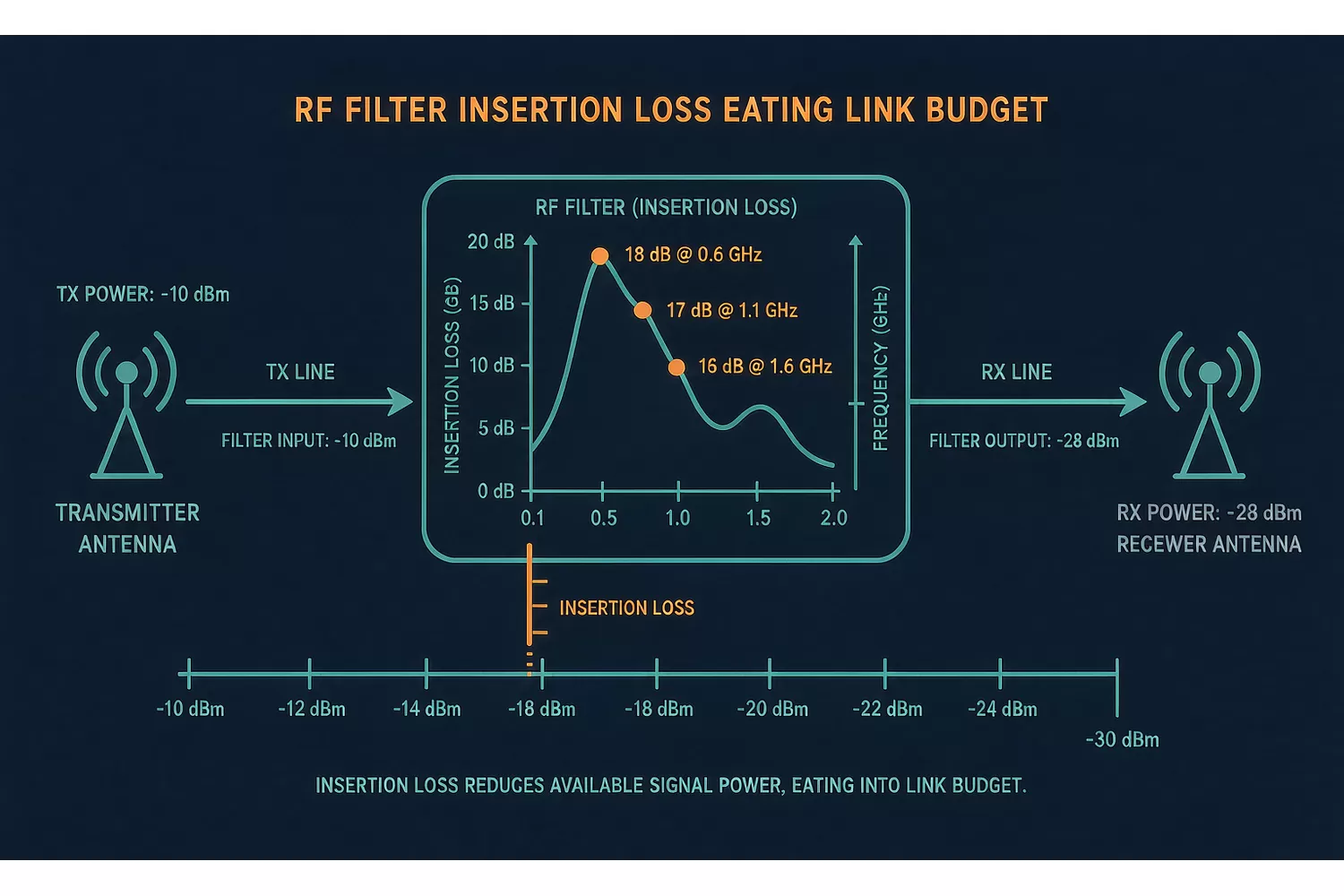
Filter datasheets list insertion loss, insertion loss at the passband edge, and the shape factor. Buyers compare the first number and ignore the rest. Your link does not care about the first number alone: what matters is the loss at the exact frequency of your channel, at the operating temperature, across production spread. A filter quoted at 1.2 dB typical can easily be 2.5 dB worst case at 85 degrees Celsius.

Why capacitor and inductor choices dominate
A low-pass LC filter built with parts that have high equivalent series resistance converts part of the signal into heat. The self-resonant frequency of each inductor caps the usable band, above which the impedance stops behaving like an inductor. That is why a filter specified for DC to 5 GHz is not the same part as the same topology built from different inductor grades, even at identical nominal values.
Reading insertion loss against the application
For a receiver front end, every dB of preselect loss raises the cascaded noise figure and shortens range. For a transmitter, every dB of filter loss arrives at the antenna as heat instead of signal, which either reduces output power or forces the amplifier to work harder and run hotter. High-loss transmit filters are a common cause of a PA that meets its datasheet in isolation and fails in a thermal chamber.
Practical comparison of common RF filter forms
| Filter type | Typical form factor | Typical loss at passband |
|---|---|---|
| Ceramic / LC low-pass | SMD chip, 0603-1206 | 0.3-1.5 dB up to a few GHz |
| Dielectric resonator | Metal or ceramic block | 1.5-3.5 dB, high Q |
| SAW / BAW | Ceramic SMD package | 1.5-4.0 dB, very sharp skirts |
| Cavity | Metal housing | 0.5-2.0 dB at high power |
How to spec a filter without over-buying
Define the band you must pass, the adjacent channels you must reject, the maximum power the part will see, and the temperature range. Then ask the supplier for measured curves across temperature rather than the typical line on the datasheet. A filter at 1.8 dB that holds 1.9 dB across temperature beats one quoted at 1.2 dB that drifts.
Our stock includes a range of low-loss LC filters suitable for these budgets: Mini-Circuits LFCG-1200+, Mini-Circuits HFCG-1600+ and the Mini-Circuits LFCG-630+ for lower frequency chains. For sharper selectivity in a small footprint, see the Murata SAFSF1G44AA0T00R12 SAW filter. All filter and oscillator parts are grouped under Filters & Crystal Oscillators.
Questions & Answers
Is higher Q always better?
Higher Q gives sharper skirts, which is what you want near the band edge, but the loading effect and the achievable matching may cost you passband loss. A very sharp filter that eats 4 dB is a bad trade for a link with 10 dB of margin.
Why does my filter measure worse at high temperature?
Component values drift and the equivalent series resistance of the inductors rises with temperature, so loss increases. This is not a defect, it is the reason worst case curves exist on datasheets.
Can I compensate for insertion loss in software?
You can calibrate out a fixed gain offset, but you cannot calibrate out loss that changes with temperature or with a mismatched load. Analogue loss stays analogue.
Should the filter go before or after the low noise amplifier?
Preselect filters normally go in front of the LNA to block strong out-of-band signals that would otherwise desensitise it. If the filter has significant loss, weigh it against the receiver blocking spec carefully.
Related RF Components & Articles
- Browse our full range of RF chips & RF components.
- Related Mini-Circuits parts: Mini-Circuits components.
- Looking for LFCG-1200? Check stock and specs on the product page.
- Looking for HFCG-1600? Check stock and specs on the product page.
- Looking for LFCG-630? Check stock and specs on the product page.
- Related article: Why Your 50-Ohm RF Trace Is Not 50 Ohm.
- Related article: Power Amplifier Compression: The Real Cost of Pushing Past 1 dB.
- Need pricing or availability? Upload your BOM or contact our team.
Recommended next steps
If you are sourcing any of the parts mentioned in this guide, we can help you confirm stock, pricing, and lead times quickly.
- Upload your BOM — send your full parts list and receive a consolidated quote within 2 business hours.
- Browse related in-stock lines: Filters / Crystal Oscillators.
- Contact our team for hard-to-find or end-of-life components.
About us & trademarks: Jingteng Electronics (Shenzhen Jingteng Electronics Technology Co., Ltd.) is an independent distributor of electronic components. We are not an authorised distributor, agent or representative of any manufacturer named in this article. Manufacturer names, part numbers and trademarks are used for identification and technical compatibility only and belong to their respective owners.
