
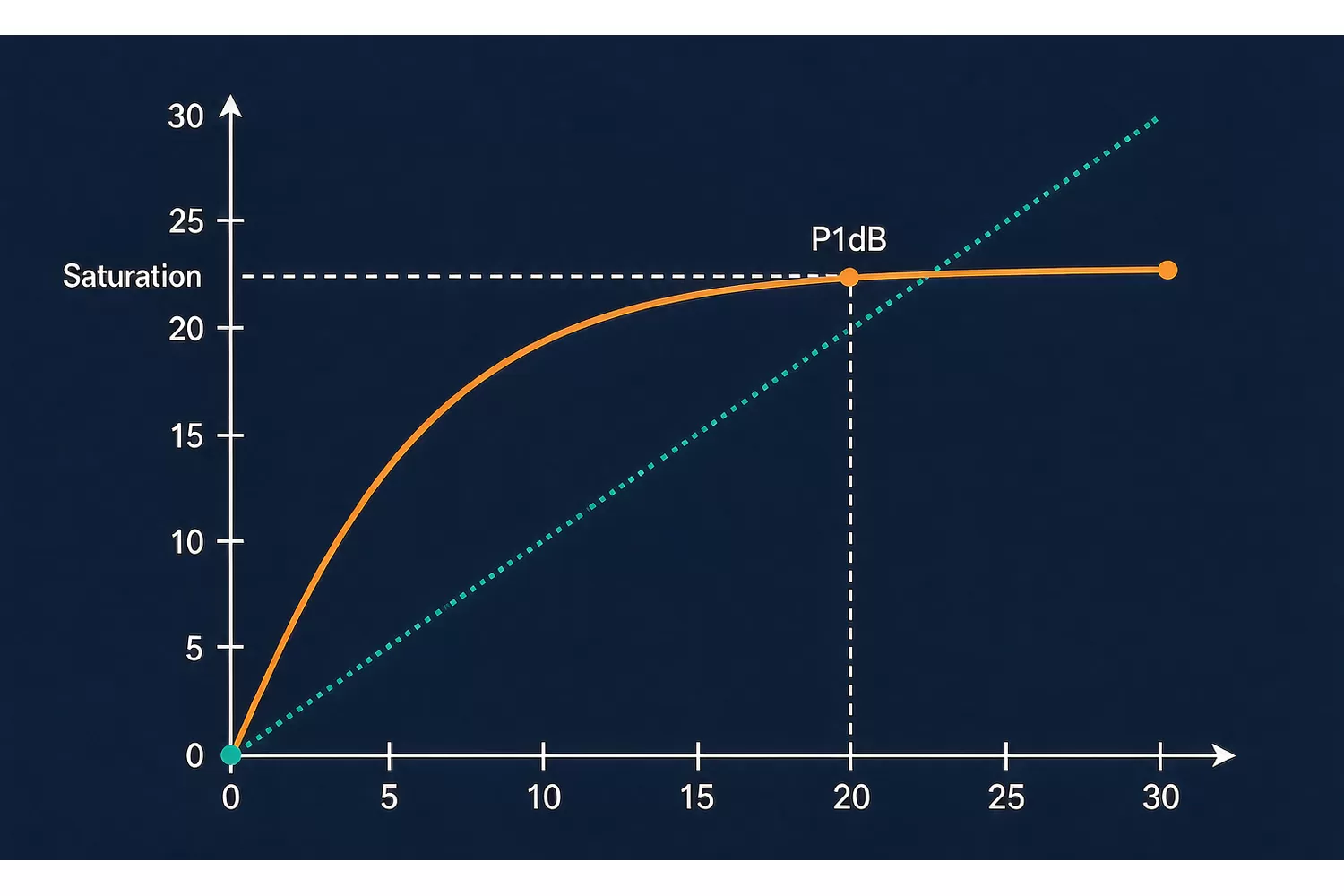
Compression is not a sudden cliff
An amplifier delivers linear output up to a point, then the gain starts to drop. The 1 dB compression point is where the output is 1 dB below what a perfectly linear extrapolated gain would give. Push further and the output keeps rising, but slowly, while the harmonic and spectral regrowth grow much faster. The part is still nominally working and the link still functions, which is exactly why this mistake survives review.

What compression costs in three currencies
First, heat. A compressed amplifier converts the signal it cannot amplify into heat in the output stage. Second, spectrum. Adjacent channel leakage rises, which fails the regulatory mask even though the carrier looks fine. Third, efficiency. The current drawn per delivered watt gets worse, so the battery drains faster for a modest increase in coverage. In a 20 dBm design that squeezes 2 dB more out by compressing the amplifier, most of the gain ends up as temperature at the output transistor.
How to read a datasheet compression curve
Look for the output power quoted at a specific harmonic distortion level rather than the saturated output power alone. Check whether the datasheet curve is measured with a pure tone or with a modulated signal, since modulated measurements reveal the memory effects that cause spectral regrowth. Check the thermal derating too: an output rating valid at 25 degrees is often not valid inside a sealed enclosure.
Choosing an amplifier for the job
| Application | What matters most | Typical topology |
|---|---|---|
| Constant-envelope links | High output, tolerant of compression | Class AB or C |
| Modulated data links | Linearity and spectral mask | Class AB, Doherty |
| IoT sensor nodes | Efficiency in steady TX bursts | Class C or switching |
| Test and instrumentation | Repeatability and flat gain | Class A |
Practical rules of thumb
Leave 2 to 3 dB of headroom between your required output and the amplifier's compression point when the design is modulated. Use the worst-case supply voltage, not the nominal one, in the derating calculation. Measure the thermal case temperature under sustained transmit rather than in a single burst, because most amplifier failures in the field happen on the third minute of continuous TX, not the first.
Matched amplifiers for these budgets include Qorvo SGC4463Z, Qorvo RF2317TR13 and Qorvo SGA-1263Z. If the design needs a module rather than a device, Qorvo RFPA5201TR13 and Qorvo TQL9048 are both in stock, and the power management category under Power Management Chips covers the supply rail that has to hold up under the resulting load step.
Questions & Answers
Can I run an amplifier at its 1 dB compression point?
You can, but you are trading headroom for heat and spectral regrowth. For modulated signals the 1 dB point is well past where the spectral mask usually starts to fail.
Why does efficiency drop when I compress the amplifier?
Because the extra drive pushes the output stage further into a non-linear region where power is dissipated as heat instead of being delivered to the load.
Is saturated output power the same as linear output power?
No. Saturated output is what the amplifier gives when driven hard. Linear output is what you keep before compression damages the signal. Product specs usually quote one and leave you to infer the other.
How do I check thermal derating early?
Read the derating curve in the datasheet against the worst case ambient inside the enclosure, then measure case temperature during a sustained transmit burst rather than trusting a single-shot reading.
Related RF Components & Articles
- Browse our full range of RF chips & RF components.
- Related Qorvo parts: Qorvo components.
- Looking for SGC4463Z? Check stock and specs on the product page.
- Looking for RF2317TR13? Check stock and specs on the product page.
- Looking for SGA-1263Z? Check stock and specs on the product page.
- Looking for RFPA5201TR13? Check stock and specs on the product page.
- Looking for TQL9048? Check stock and specs on the product page.
- Related article: RF Attenuators and Limiters: Protecting the Front End Without Killing Sensitivity.
- Related article: SAW vs Dielectric vs LC Filters for 2.4 GHz IoT: How to Choose.
- Need pricing or availability? Upload your BOM or contact our team.
Recommended next steps
If you are sourcing any of the parts mentioned in this guide, we can help you confirm stock, pricing, and lead times quickly.
- Upload your BOM — send your full parts list and receive a consolidated quote within 2 business hours.
- Browse related in-stock lines: Power Management ICs.
- Contact our team for hard-to-find or end-of-life components.
About us & trademarks: Jingteng Electronics (Shenzhen Jingteng Electronics Technology Co., Ltd.) is an independent distributor of electronic components. We are not an authorised distributor, agent or representative of any manufacturer named in this article. Manufacturer names, part numbers and trademarks are used for identification and technical compatibility only and belong to their respective owners.
