
Protection has a price, and the price is loss
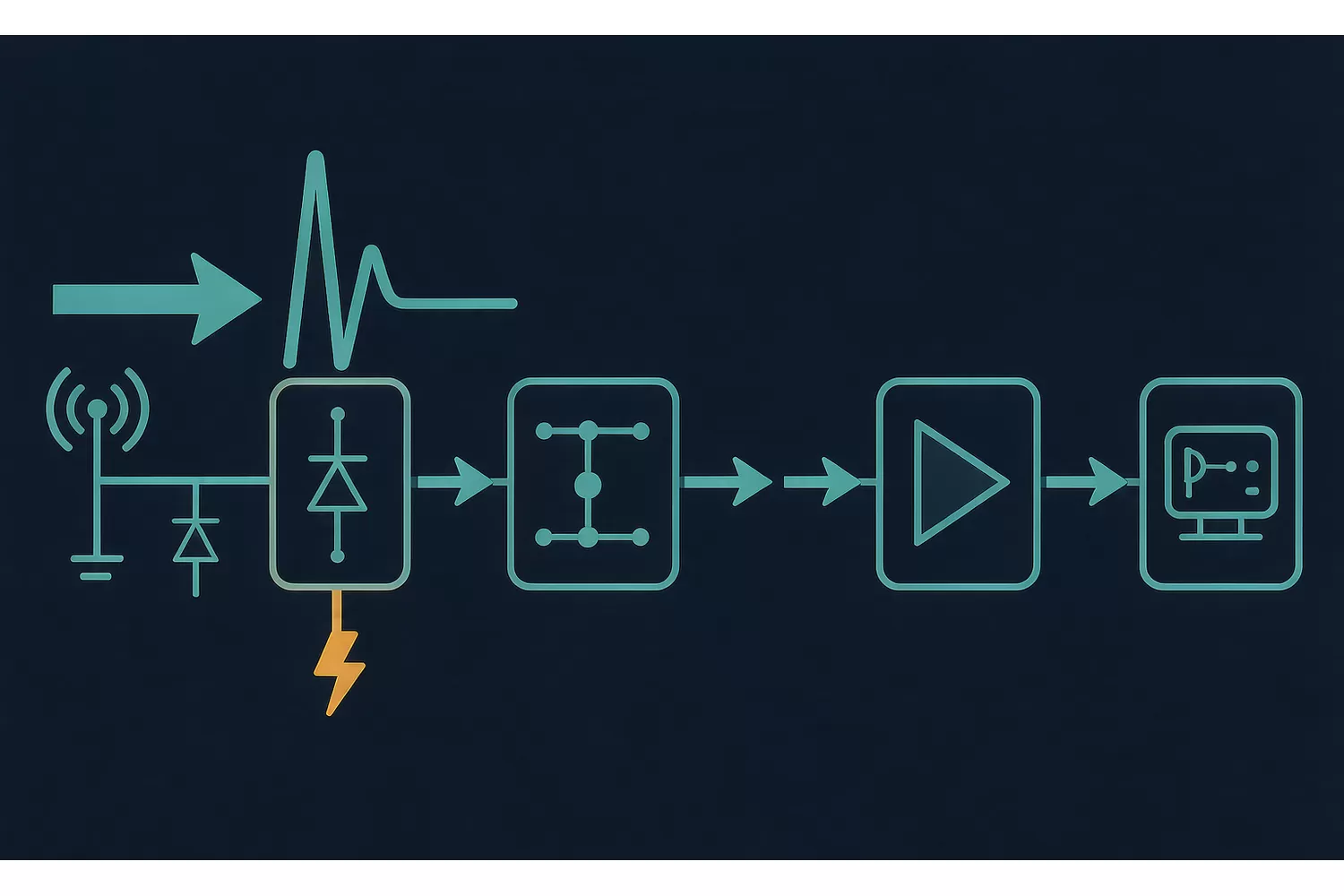
Any device between the antenna and the low noise amplifier inserts loss when it is not blocking. That loss raises the cascaded noise figure and shortens the range, which is a real cost in every unit that ships. The design question is not whether protection costs anything; it is whether the cost is less than the field failure it prevents. For a device that spends most of its life in a quiet environment, a permanent attenuator is usually the wrong answer.

Step attenuators vs continuous attenuators
A digital step attenuator gives you a known, repeatable gain setting driven by a bus, which makes calibration straightforward. A continuous attenuator gives smooth control but is harder to calibrate because the actual attenuation changes with temperature and supply. In a design that runs an automatic gain control loop, the step part is usually easier to make stable over temperature; in a design where only one gain state is used, either works.
Limiters are not attenuators
A limiter clips. Once the input exceeds its threshold it presents a reduced gain, and at high enough input it can present almost a short to ground. It protects the following electronics from a large transient, but it also compresses the signal while doing it. The parts to check are the clamping level, the handling power, and the recovery time after a large event, since a slow recovery means the receiver stays desensitised for a while after the interferer leaves.
Choosing protection by scenario
| Scenario | Recommended approach | What to watch |
|---|---|---|
| Strong nearby transmitter | Step attenuator before the LNA | Loss at the weak-signal setting |
| Antenna open or shorted | Limiter plus protection diode network | Recovery time |
| Fast (ESD) transients | TVS plus series resistance | Insertion loss on the signal path |
| Long-term interference | Filter selectivity plus the LNA's own linear range | Blocking spec |
A layout note that matters more than the part
Where the protection sits on the board often decides whether it works. A limiter placed after the filter is protecting a small signal; a limiter placed before it protects everything but also takes the full antenna power. The series elements that protect against static discharge must be placed where the current actually flows, not wherever the layout looks tidiest.
Parts commonly used for this stage: MACOM ETC1-1TTR for phase shifting and attenuation control, MACOM MA4L062-134 for limiting, and MACOM AM50-0004TR in designs that need a dedicated amplifier stage ahead of the receiver. See the RF and interface range under Interface / RF Chips.
Questions & Answers
Does an attenuator hurt receive sensitivity?
Yes, in proportion to its loss in the signal path. Every dB of attenuation before the low noise amplifier reduces the signal the receiver sees, which is why the smallest practical setting should be the default.
When should I use a limiter instead of an attenuator?
When the front end can see an antenna that may be shorted, open, or connected to something that produces a large transient. A limiter handles the event; the attenuator only reduces the level.
What is recovery time and why does it matter?
It is how quickly the part returns to its normal attenuation after a large input event. A slow recovery leaves the receiver desensitised for longer after the interferer disappears.
Can I use a step attenuator for calibration?
Yes, and it is the usual choice. Because each step is a defined discrete value, the measured curve is easier to reproduce across production units than a continuous attenuator.
Related RF Components & Articles
- Browse our full range of RF chips & RF components.
- Looking for ETC1-1TTR? Check stock and specs on the product page.
- Looking for MA4L062-134? Check stock and specs on the product page.
- Looking for AM50-0004TR? Check stock and specs on the product page.
- Related article: SAW vs Dielectric vs LC Filters for 2.4 GHz IoT: How to Choose.
- Related article: RF Switch Selection: Insertion Loss, Isolation and the Charge Pump You Forgot.
- Need pricing or availability? Upload your BOM or contact our team.
Recommended next steps
If you are sourcing any of the parts mentioned in this guide, we can help you confirm stock, pricing, and lead times quickly.
- Upload your BOM — send your full parts list and receive a consolidated quote within 2 business hours.
- Browse related in-stock lines: Interface Chips / RF Chips.
- Contact our team for hard-to-find or end-of-life components.
About us & trademarks: Jingteng Electronics (Shenzhen Jingteng Electronics Technology Co., Ltd.) is an independent distributor of electronic components. We are not an authorised distributor, agent or representative of any manufacturer named in this article. Manufacturer names, part numbers and trademarks are used for identification and technical compatibility only and belong to their respective owners.
