
Two numbers disagree on purpose
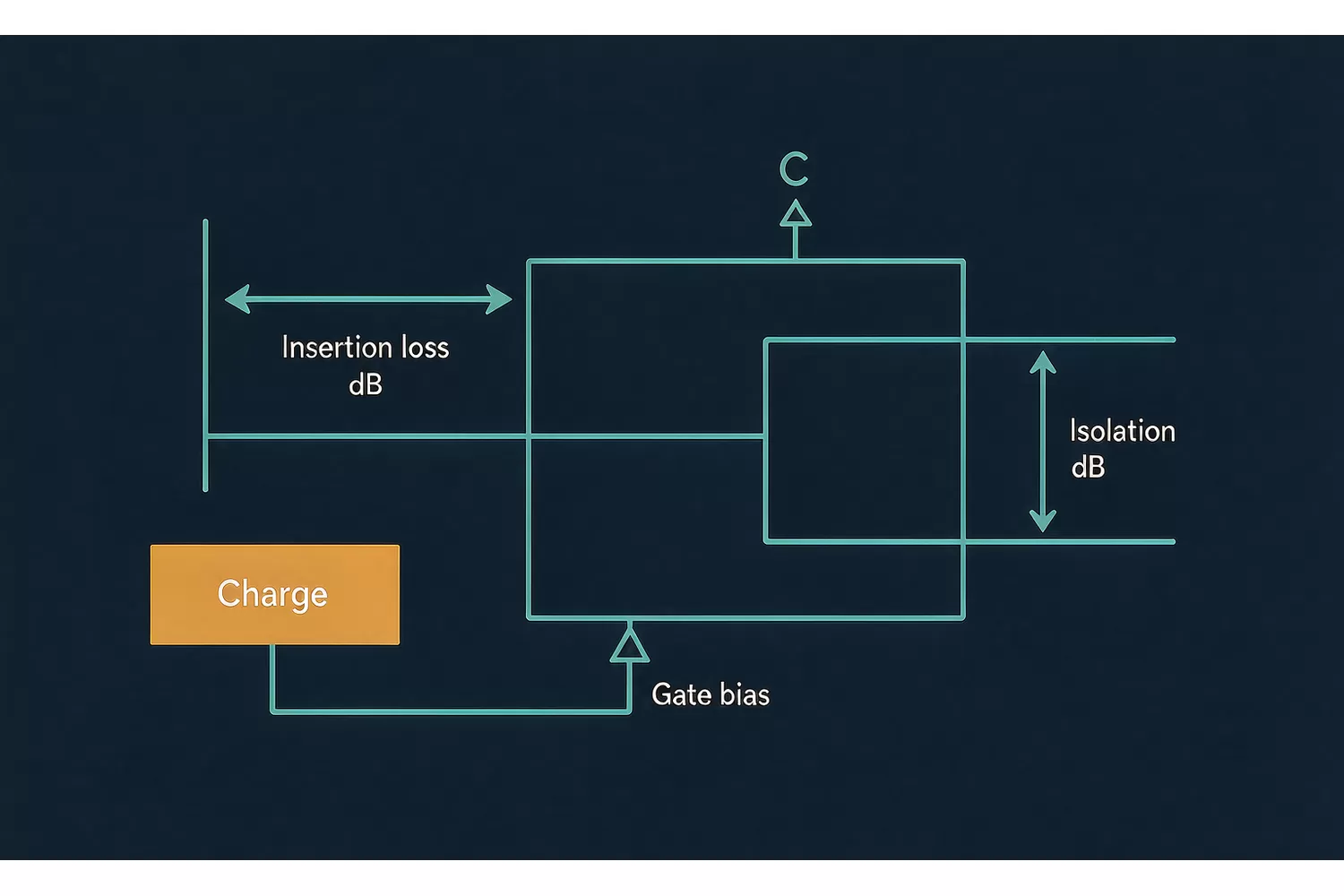
Every switch datasheet quotes insertion loss for the path you are using and isolation for the path you are not. Designers track insertion loss closely and often read isolation only when choosing between parts, which is backwards. In a time-division duplex or a shared front end, isolation determines how much of your transmit power leaks into the receive path, and that leak raises the floor of what the receiver can detect. Both numbers matter, and they are quoted at different bias points, so compare the curves rather than the summary table.

The charge pump is part of the design
Most GaAs and GaN switches need a gate bias generated internally by a charge pump, which means the part needs a supply, a decoupling capacitor and a landing pad for the bootstrap network. Omitting the decoupling capacitor or placing it across the board instead of next to the pin leaves the pump unregulated under load, which moves the threshold and changes both insertion loss and isolation with temperature. This is the classic first-silicon bug for a switch integration.
Switch types and where each belongs
| Switch type | Best used for | Typical limitation |
|---|---|---|
| PIN diode | High power, high isolation | Needsbias current, slower |
| GaAs FET | Handset-class loss and isolation | Charge pump and finite ESD rating |
| GaN HEMT | High power, radar, infrastructure | Cost and driver complexity |
| CMOS / RF CMOS | Low cost, moderate power | Higher loss than GaAs at microwave |
What to verify before committing
Check the insertion loss across the full band rather than at the test frequency, because a switch that is excellent at 2.4 GHz can be poor at 5 GHz. Check the required gate drive voltage against your available rails. Check the ESD rating against the assembly process, particularly if the switch is the only thing between the antenna and the outside world. And confirm that the switch is qualified for the temperature range, since pump and threshold behaviour drift.
In stock we carry RF switches and the related RF control parts: pSemi PE42441E-Z for handset-class switching, Qorvo RF3827TR7 and MACOM MASWSS0115TR-3000 where higher isolation is needed, and pSemi PE42462A-X as the second-source option. They are listed under Interface / RF Chips.
Questions & Answers
Why does my switch loss change with temperature?
The charge pump that provides gate bias drifts with temperature, shifting the device threshold. Without proper decoupling on the pin, that drift shows up directly as extra insertion loss and reduced isolation.
Is insertion loss or isolation the more important number?
It depends on the architecture. In a receive chain, insertion loss before the low noise amplifier raises noise. In a shared or time-division front end, isolation decides how much transmit energy contaminates the receive path.
Do I need a separate bias supply for the switch?
Most switched GaAs or GaN parts generate their own gate bias, so they need a supply rail and decoupling rather than an external bias current. Always follow the bootstrap layout in the evaluation board.
How do I compare switches from different vendors?
Compare measured curves at the same bias voltage and temperature, over your full operating band, and check the ESD rating and package thermal behaviour. Summary tables at one frequency are not comparable between vendors.
Related RF Components & Articles
- Browse our full range of RF chips & RF components.
- Related Qorvo parts: Qorvo components.
- Related pSemi (Murata) parts: pSemi (Murata) components.
- Looking for PE42441E-Z? Check stock and specs on the product page.
- Looking for RF3827TR7? Check stock and specs on the product page.
- Looking for MASWSS0115TR-3000? Check stock and specs on the product page.
- Looking for PE42462A-X? Check stock and specs on the product page.
- Related article: RF Front-End Module vs Discrete Design: What Integration Actually Buys You.
- Related article: Receiver Noise Figure Budget: How Many dB You Can Actually Afford.
- Need pricing or availability? Upload your BOM or contact our team.
Recommended next steps
If you are sourcing any of the parts mentioned in this guide, we can help you confirm stock, pricing, and lead times quickly.
- Upload your BOM — send your full parts list and receive a consolidated quote within 2 business hours.
- Browse related in-stock lines: Interface Chips / RF Chips.
- Contact our team for hard-to-find or end-of-life components.
About us & trademarks: Jingteng Electronics (Shenzhen Jingteng Electronics Technology Co., Ltd.) is an independent distributor of electronic components. We are not an authorised distributor, agent or representative of any manufacturer named in this article. Manufacturer names, part numbers and trademarks are used for identification and technical compatibility only and belong to their respective owners.
