
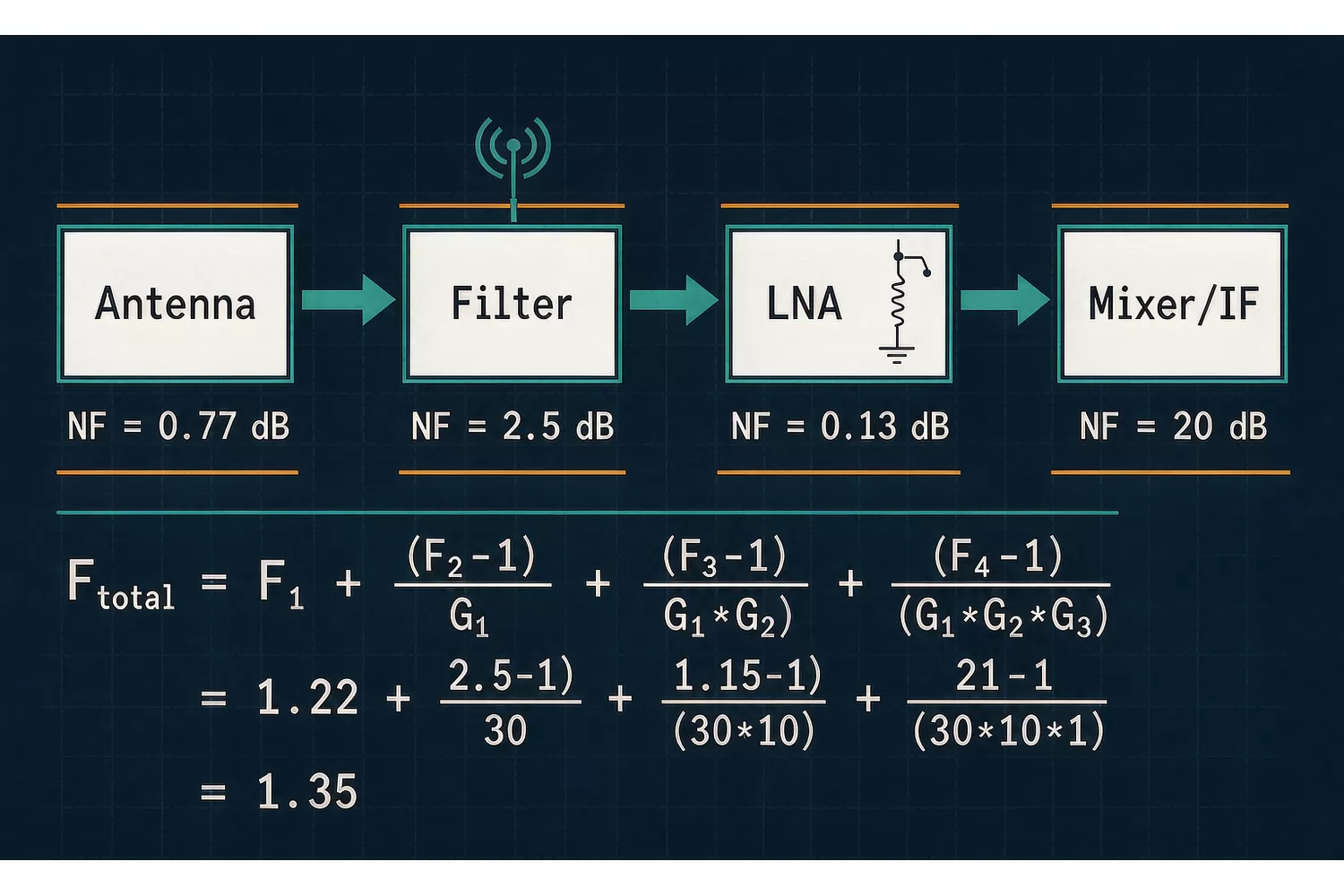
Why single-part noise figures mislead
A low noise figure on a datasheet says one thing: this part adds little noise when you measure it alone. Your receiver adds the contributions of the filter, the switch, the board losses and the LNA on top of the noise of everything that follows. Cascaded noise figures are additive in linear terms, which means a mediocre LNA dominated by all the blocks behind it gets averaged away. A mediocre LNA in a chain whose first stage is well protected will not help you.

Doing the cascade quickly
Convert each noise figure to a linear factor, divide the contribution of the following stages by the gain of the stage in front of them, and add everything up. In practice that means the block after your LNA barely matters, and the block before it dominates. This is why a 0.8 dB LNA followed by 2 dB of filter and switch loss performs worse than the datasheet of the LNA alone suggests.
What the numbers mean for sensitivity
Sensitivity is the point where signal equals noise plus a required signal-to-noise ratio. Roughly, doubling the total noise costs about 3 dB of sensitivity, and every 1 dB of noise figure you carry is a 1 dB shorter range at a fixed link budget. For IoT systems where the transmitter power is fixed and licence-free, that directly turns into a shorter battery life or a fewer number of repeater nodes.
Typical budget for a 2.4 GHz receiver
| Stage | Typical NF | Comment |
|---|---|---|
| Antenna / trace loss | 0.5-1.5 dB | Cheap to cut, easy to double by accident |
| SAW or LC filter | 1.5-3.0 dB | Insertion loss is also noise |
| RF switch | 0.8-1.5 dB | Adds loss which is noise, not just attenuation |
| LNA | 0.6-1.2 dB | The dominant and worth-paying-for stage |
| Mixer and baseband | 8-14 dB | Divided by the LNA gain, so usually not the limit |
Where the budget usually gets wasted
In real designs the loss in front of the LNA is where the budget goes, not the LNA itself. A long antenna trace on a four-layer board, a filter that is two octaves wider than the signal, or a switch that was chosen for a different band can each cost more than the LNA. Fix the front of the chain before you upgrade the LNA.
If you are rebuilding a receiver front end, watch the insertion loss of everything in front of the low noise amplifier. On this site: Mini-Circuits LFCN-5000+ low-pass filter and Mini-Circuits HFCN-9700+ band-pass filter for the preselect stage, and Qorvo RFSA2023TR7 when the receive chain needs its own switch rather than a shared front-end part. Browse the RF parts category under Interface / RF Chips for the full list.
Questions & Answers
Is a 0.4 dB LNA always better than a 0.9 dB LNA?
Not necessarily. The noise figure of everything in front of the LNA adds on top of it. If the filter and switch loss in front of the LNA is 2 dB, a 0.4 dB versus 0.9 dB LNA changes the chain noise figure by a small fraction of a dB.
Does insertion loss count as noise?
Yes. Every passive loss in the receive path degrades the chain noise figure because the signal is reduced while the following stages keep adding their own noise.
How much does noise figure affect battery life?
Every dB of extra receiver noise shortens the range at a fixed transmit power, which forces higher transmit power or more repeaters. On battery-powered nodes the two options cost battery life directly.
Can I compute the real sensitivity without lab equipment?
You can compute the cascaded noise figure from datasheet values using the standard cascade formula. Product or system tests are still the only way to confirm antenna and board level losses, which datasheets never include.
Related RF Components & Articles
- Browse our full range of RF chips & RF components.
- Related Qorvo parts: Qorvo components.
- Related Mini-Circuits parts: Mini-Circuits components.
- Looking for LFCN-5000? Check stock and specs on the product page.
- Looking for HFCN-9700? Check stock and specs on the product page.
- Looking for RFSA2023TR7? Check stock and specs on the product page.
- Related article: Insertion Loss Budget: How Filter Loss Eats Your Link Margin.
- Related article: Why Your 50-Ohm RF Trace Is Not 50 Ohm.
- Need pricing or availability? Upload your BOM or contact our team.
Recommended next steps
If you are sourcing any of the parts mentioned in this guide, we can help you confirm stock, pricing, and lead times quickly.
- Upload your BOM — send your full parts list and receive a consolidated quote within 2 business hours.
- Browse related in-stock lines: Power Management ICs · Microcontrollers / MCUs · Memory / Logic Devices.
- Contact our team for hard-to-find or end-of-life components.
About us & trademarks: Jingteng Electronics (Shenzhen Jingteng Electronics Technology Co., Ltd.) is an independent distributor of electronic components. We are not an authorised distributor, agent or representative of any manufacturer named in this article. Manufacturer names, part numbers and trademarks are used for identification and technical compatibility only and belong to their respective owners.
