
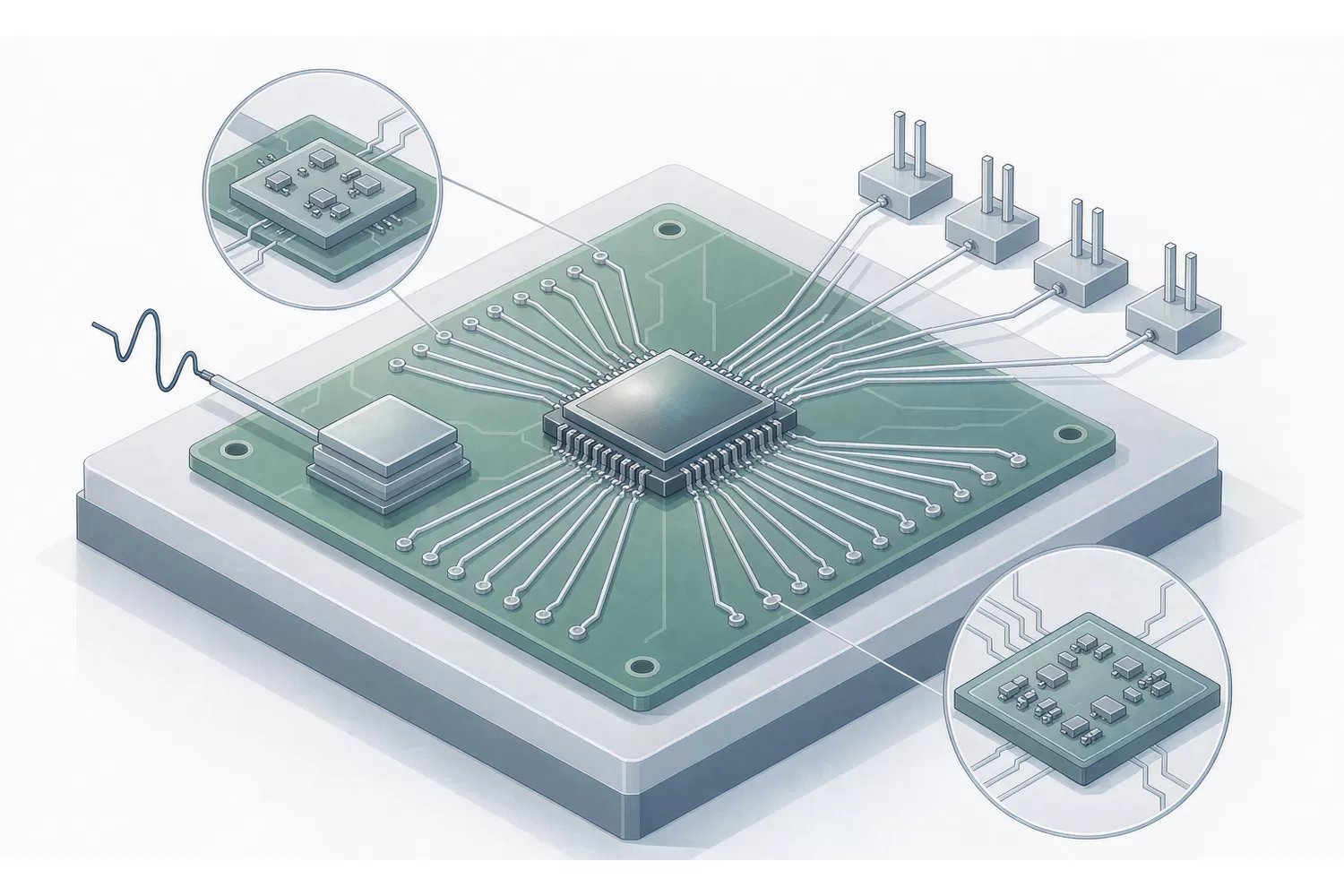
Every multi-antenna radio needs switches: to move one transceiver between antenna paths, to select bands through filter banks, to insert a bypass around a PA. The workhorse technology is RF-CMOS/SOI — and this is the category where domestically produced parts first earned mainstream trust, because a switch is compact enough to validate thoroughly yet impactful enough to matter in every BOM. This article covers the application logic, the technology frontier, and a structured cost comparison against the imported incumbents.

Application logic: what a design asks of an RF switch
The specification set is short but unforgiving: insertion loss (every dB is link budget), isolation (leakage between TX and RX paths corrupts receivers), linearity (harmonic and intermodulation products under high TX power), switching speed (TDD frame timing), control-logic interface (typically a GPIO-controlled truth table, sometimes MIPI RFFE in cellular front ends) and ruggedness (surviving a PA’s worst-case mismatch transient). Topologies range from SPDT through SP4T/SP8T antenna switches to complex antenna-tuning networks. For worked examples, see our RF switch selection guide and the product pages for the MACOM SW-456TR-3000 and Skyworks SE2595L-R.
New technology in RF switching
- High-harmonic-rejection switches for 5G NR coexistence, reducing external filtering.
- MIPI RFFE control in cellular front ends replacing parallel GPIO truth tables.
- Integration of tuning capacitors and switch functions into antenna-tuner ICs.
- SOI process nodes pushing to higher linearity and lower capacitance per shunt arm.
Domestic alternatives: analysis before switching
The methodology: (1) map the imported part’s topology (SPDT/SP4T, throw count, port ordering) and control truth table; (2) compare insertion loss and isolation at your exact band, not the datasheet’s headline band; (3) verify linearity under your TX power including mismatch; (4) check switching timing against your frame structure; (5) review control-interface polarity and any level-shifting; (6) confirm package footprint and bond-out compatibility — similar packages frequently hide different pin maps. Our SP4T selection guide and SPDT selection guide show the imported reference parts in detail.
Indicative cost comparison: imported originals vs domestic candidates
Price figures below are indicative public-market reference ranges for moderate volumes, compiled from publicly observable listings. They fluctuate with the spot market, package option, reel size and order quantity, and must not be read as a quotation. Ask us for a firm price on your exact part numbers and quantities.
| Device class | Common imported part (reference) | Indicative imported unit price | Domestic candidates (public sources) | Indicative domestic unit price |
|---|---|---|---|---|
| SPDT RF switch (SOI) | pSemi PE4259 class | USD 0.6–1.2 | Maxscend (Maxscend) SOI switch series | USD 0.15–0.40 |
| SP4T / multi-throw antenna switch | pSemi PE42441 class | USD 1.5–3.0 | Maxscend / Vanchip / Orimicro (Orimicro) multi-throw SOI series | USD 0.4–1.0 |
| Switch + LNA front-end module | Skyworks SE2595L class | USD 0.8–1.5 | Domestic FEM series combining SOI switch and LNA | USD 0.25–0.6 |
The switch category is where the domestic-vs-imported price ratio is most favourable, because the parts are single-die SOI and the domestic foundry access is mature. In volume, per-unit savings of 60–75 percent against imported equivalents are commonly reported — the caveat is engineering validation, which this article’s checklist structures.
Commonly referenced alternative models
| Imported original | Domestic candidate (public sources) | Notes |
|---|---|---|
| pSemi PE4259 — SPDT, DC–multi-GHz | Maxscend SOI SPDT series | Publicly referenced candidate direction for general-purpose SPDT switching; confirm frequency-range coverage for your top band. |
| pSemi PE42441 — SP4T switch (see guide) | Maxscend / Vanchip multi-throw SOI series | Series-level reference; port mapping and control truth table differ — budget a control-firmware change. |
| MACOM SW-456TR-3000 — RF switch (product page) | Domestic SOI SPDT/SP4T candidates | For industrial and instrumentation bands, verify ruggedness specification parity before substituting. |
Series-level references are given where that is what public sources support; specific ordering codes should be confirmed with the manufacturers’ current line cards, which our team tracks.
Validation checklist
- S-parameter comparison of insertion loss and isolation across your full band.
- Harmonic and intermodulation test at your maximum TX power with VSWR stress.
- Switching-time verification inside your frame timing, including glitch capture.
- Control-logic review and firmware update; verify truth table port by port.
- ESD and ruggedness margin review against your PA’s worst-case transients.
Related reading on our blog
Switch technologies compared · Switch specifications explained · Antenna tuning switches
Frequently asked questions
Why are SOI switches preferred over PIN-diode switches in phones and modules?
Ruggedness: RF-CMOS/SOI switches tolerate far higher RF input power without forward-bias damage, and they integrate control logic on the same die. PIN diodes still win at very high frequencies and power where the SOI roadmap does not reach.
How do domestic SOI switches compare with the pSemi parts?
No single domestic part is an automatic one-for-one swap, and we deliberately avoid that phrasing. Package similarities exist, but control logic, port mapping and RF parasitics differ. Treat the domestic parts as functionally comparable candidates that require layout and control-firmware review, then validate insertion loss and isolation on your board.
What is a high-harmonic switch and why does it matter?
In 5G NR designs, transmitter harmonics can desensitise co-located receivers. Switches engineered for high harmonic rejection reduce the filtering burden — it is one of the areas where newer domestic parts closely track the imported state of the art.
Do you stock the imported switch parts referenced here?
Yes. The MACOM SW-456TR-3000 and the pSemi PE42xxx families referenced in our guides are regularly quoted and shipped. We can also discuss domestic candidate series for your cost-down evaluations.
About us & trademarks: JTDZ Tech (Shenzhen Jingteng Electronics Technology Co., Ltd.) is an independent distributor of electronic components. We are not an authorised distributor or representative of any manufacturer named in this article. Manufacturer, brand and part names are used for identification purposes only; all trademarks remain the property of their respective owners. Cross-reference information in this article is based on publicly available sources, is subject to change, and is not a substitute for your own engineering validation. Always verify specifications against the manufacturer's datasheet before design-in or purchase.
