
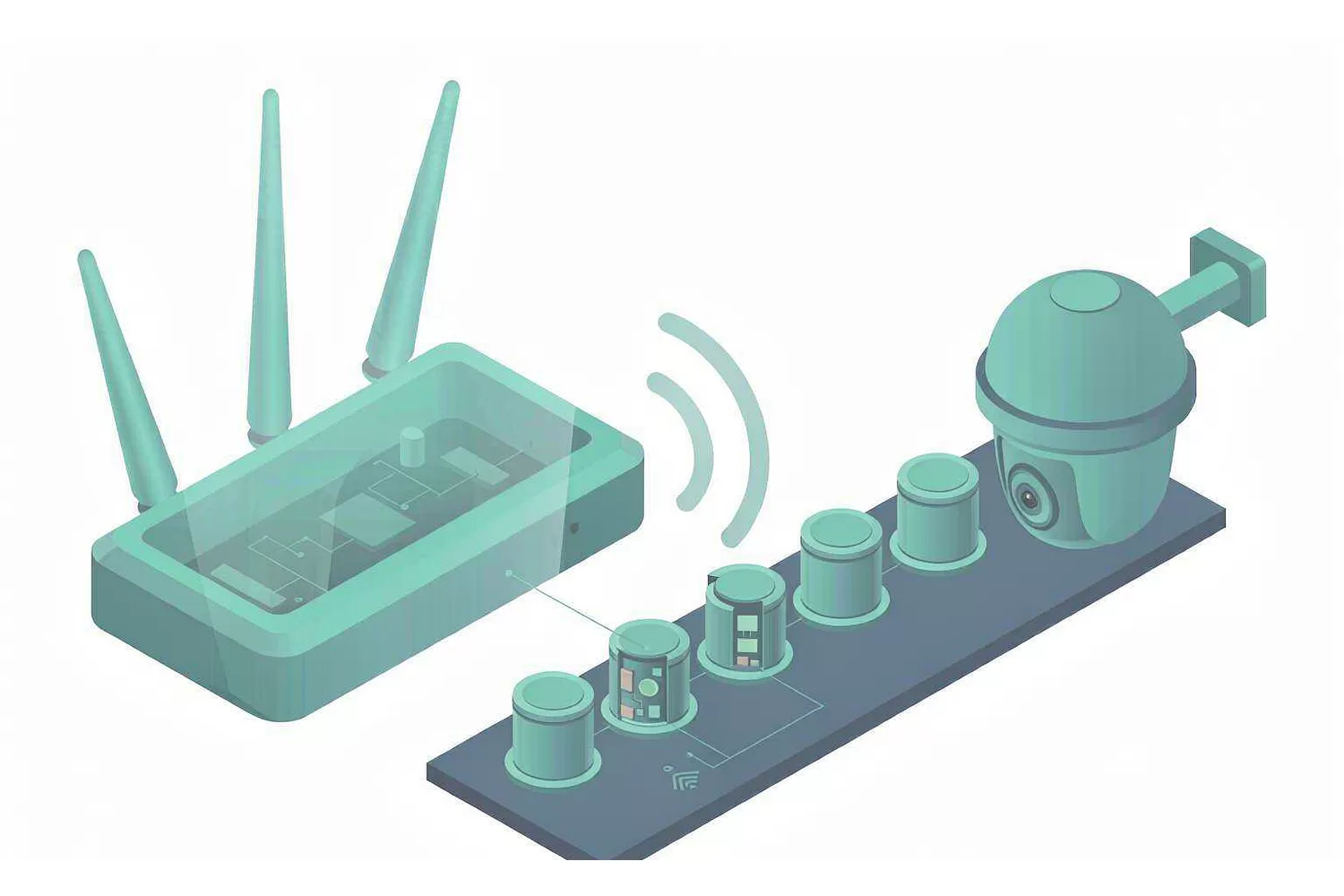
Every Wi-Fi 6 router, mesh node and IP camera has a row of small shielded modules beside its main SoC: the front-end modules (FEMs) that give each MIMO chain its transmit power and receive sensitivity. The category was historically dominated by imported parts — Qorvo, Skyworks and their peers — and it is now one of the most active segments for domestically produced alternatives. This article explains the application logic, the technology trajectory, and how to compare candidates with cost figures that reflect what distributors actually see.

Application logic: the FEM’s job in a radio chain
On transmit, the FEM’s power amplifier must deliver the OFDM waveform with enough linearity that the highest-order modulations (1024-QAM in Wi-Fi 6) still decode — EVM, not raw P1dB, is the binding constraint. On receive, its LNA sets the noise figure of the whole chain. Between the two, the TX/RX switch and its control logic must turn around fast enough for the frame structure. The integration win of a FEM is real: one 50-ohm-matched module replaces a PA, LNA, switch and their coupling/decoupling networks, shrinking layout effort and RF tuning cycles. Product-level considerations are thermal (duty-cycled but bursty dissipation), quiescent current (always-on idle drains router standby budgets), and regulatory spectral compliance across channels.
For a practical view of the imported catalog, see our product page for the Qorvo RFFM8209TR Wi-Fi front-end module and our Wi-Fi 6/7 front-end guide.
New technology in Wi-Fi front ends
- Wi-Fi 6E/7 extension into 6 GHz: wider bandwidths and 4096-QAM (Wi-Fi 7) tighten EVM requirements further.
- Higher integration: dual-band FEMs and FEMs with integrated couplers/power detectors for closed-loop power control.
- Process migration: SOI-CMOS output stages challenging the traditional GaAs PA in cost-sensitive segments.
- Volume shift eastward: router, mesh and smart-camera production concentrated in China pulls domestic FEM vendors into mainstream designs.
Domestic alternatives: analysis before switching
Compare on: EVM at your target MCS across channels (high/low edge), noise figure and RX gain, TX harmonic and spurious performance for your certification target, switch timing, thermal derating in your enclosure, and control-logic compatibility (some FEMs accept different TX/RX logic polarities). Then verify the supply side: the domestic vendors’ part-number matrices change quickly, so pin down the exact ordering code and its roadmap status. As a concrete imported reference point, the RFFM5765QTR7 class parts are commonly quoted against 5 GHz FEM candidates.
Indicative cost comparison: imported originals vs domestic candidates
Price figures below are indicative public-market reference ranges for moderate volumes, compiled from publicly observable listings. They fluctuate with the spot market, package option, reel size and order quantity, and must not be read as a quotation. Ask us for a firm price on your exact part numbers and quantities.
| Device class | Common imported part (reference) | Indicative imported unit price | Domestic candidates (public sources) | Indicative domestic unit price |
|---|---|---|---|---|
| 5 GHz Wi-Fi FEM (per chain) | Qorvo RFFM8209TR class | USD 0.8–1.5 | Kangxi Communications (Kangxi) 5 GHz FEM series; Vanchip (Vanchip) Wi-Fi FEM series | USD 0.25–0.6 |
| 2.4 GHz Wi-Fi FEM (per chain) | Skyworks SE2595L class (see product page) | USD 0.5–1.0 | Maxscend (Maxscend) and Vanchip 2.4 GHz FEM series | USD 0.15–0.45 |
| LNA-only front-end stage | Imported GaAs LNA families | USD 0.3–0.8 | Maxscend LNA series and peers | USD 0.08–0.25 |
Across a 4x4 router the FEM count multiplies the delta: replacing eight imported FEMs with domestic candidates at typical differentials funds weeks of engineering validation. That arithmetic explains how quickly the domestic share grew in this segment.
Commonly referenced alternative models
| Imported original | Domestic candidate (public sources) | Notes |
|---|---|---|
| Qorvo RFFM8209TR — integrated 5 GHz front-end module (product page: RFFM8209TR) | Kangxi Communications 5 GHz FEM series | Public materials position the series against integrated 5 GHz front ends for Wi-Fi 6 access points and CPE; exact cross-references depend on power class and band plan. |
| Skyworks SE2595L-R — RF switch / front-end module (product page: SE2595L) | Maxscend / Vanchip 2.4 GHz FEM families | Domestic families are widely used in smart-home and camera platforms; confirm control-logic polarity and pinout — packages are similar but not identical. |
| Imported GaAs LNA stages in receiver paths | Maxscend LNA series | Commonly referenced in IPC receivers; verify noise figure at your actual bias and band. |
For this category the honest framing is series-level, not part-number-level: the domestic vendors publish families with several power classes and package options, and the right cross-reference depends on your radio SoC, band plan and certification target. Our engineers can coordinate a candidate shortlist against your chain budget.
Validation checklist
- EVM sweep across channels and temperature at your target MCS.
- Conducted and radiated spurious-emission pre-scan for certification margin.
- RX sensitivity and blocker performance with your antenna environment.
- Thermal imaging at sustained TX duty cycle in the final enclosure.
- Control-logic and pinout delta review; adjust layout, do not force-fit.
Related reading on our blog
Wi-Fi 6/7 RF front end · FEM vs discrete front-end design · LNA, PA and switch building blocks
Frequently asked questions
What does a Wi-Fi FEM integrate?
Typically the 5 GHz (or 2.4 GHz) power amplifier, a low-noise amplifier for the receive path, and the TX/RX switch with its logic — sometimes with bypass paths and power-detector couplers — in one module matched to 50 ohms on the band of interest.
Why do routers and IPCs use one FEM per chain?
Each MIMO chain needs its own PA/LNA/switch set. A 2x2 5 GHz radio therefore uses two FEMs; a 4x4 system four. That multiplies the cost effect of the substitution decision per radio, which is why the domestic candidates attracted router and camera OEMs quickly.
What should I compare besides output power?
EVM at your modulation target (1024-QAM for Wi-Fi 6 is demanding), receive gain and noise figure, TX/RX switch transition time, harmonic and spectral-flatness compliance for regulatory certification, thermal behaviour at duty cycle, and quiescent current in idle.
Do you supply the imported FEMs referenced here?
Yes — for example the Qorvo RFFM8209TR and related front-end modules are regularly quoted by our team. Domestic candidate series can be discussed with our engineers and sourced through our supplier network.
About us & trademarks: JTDZ Tech (Shenzhen Jingteng Electronics Technology Co., Ltd.) is an independent distributor of electronic components. We are not an authorised distributor or representative of any manufacturer named in this article. Manufacturer, brand and part names are used for identification purposes only; all trademarks remain the property of their respective owners. Cross-reference information in this article is based on publicly available sources, is subject to change, and is not a substitute for your own engineering validation. Always verify specifications against the manufacturer's datasheet before design-in or purchase.
