
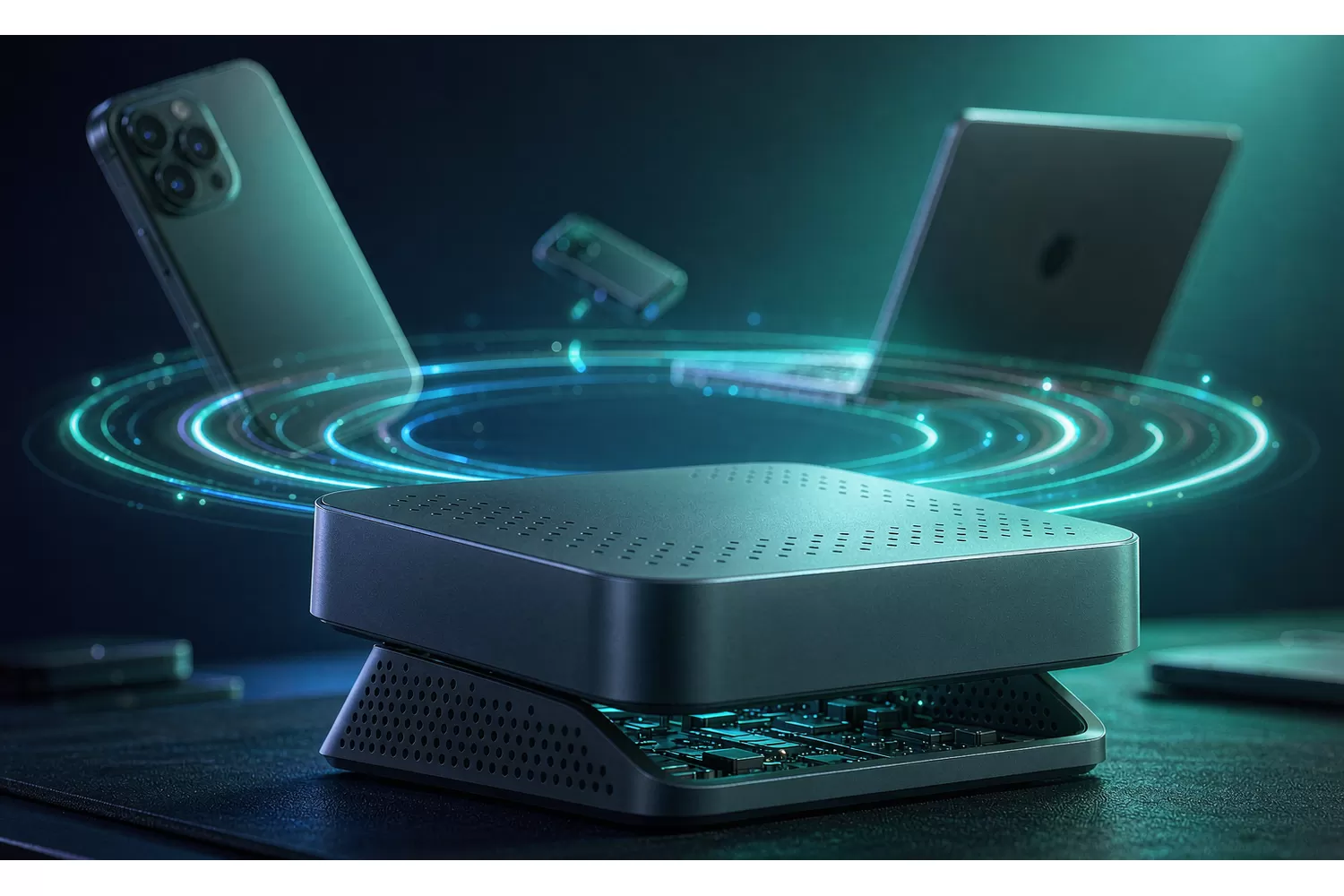
Wi-Fi is the radio most people touch every day, and behind every router, access point and mesh node is a compact, cost-sensitive RF front end doing the unglamorous work of turning a chip's modulated signal into something the antenna can radiate — and back again. As Wi-Fi evolved from 6 through 6E to 7, that front end got busier, not simpler.

The job of the WLAN front end
The Wi-Fi chipset handles modulation, but it cannot drive an antenna on its own. Between it and the antenna sit power amplifiers on transmit, low-noise amplifiers on receive, switches to select bands and antennas, and filters to keep each band clean. With 2.4, 5 and now 6 GHz in play, plus multi-link operation in Wi-Fi 7, the chain repeats across more paths than ever.
We stock transmit and driver amplifiers such as the RFPA3800TR13 and the SBB-3089Z, and small-signal gain blocks like the MGA-30889-TR1G that support driver stages.
Receive sensitivity wins range
A clean low-noise or gain-block amplifier in the receive path directly improves how far a weak packet can be heard. We stock the TQP3M9019, the SGA-6389Z, the ERA-1SM+ and the GALI-21+ for receive and driver roles.
Selecting and cleaning the bands
With three bands to manage, the antenna switch does constant work: low insertion loss preserves both battery (in clients) and receive sensitivity. We supply switches such as the SKY13575-639LF, the AS179-92LF SPDT switch and the QPC6044TR13. Filters keep the wanted band clean and reject neighbours; we stock the LFCN-3800+ low-pass and HFCN-5500+ high-pass families.
Level control
A step attenuator lets firmware trim path gain for calibration and receiver protection. We supply the PE4302-52 step attenuator for this role. For high-density APs where the power amplifier's heat is the real constraint, sourcing efficient, well-matched parts — and alternatives when a line is allocated — keeps a product on schedule. Browse the RF and interface chip range and the Skyworks and Qorvo collections.
Frequently asked questions
What does the RF front end of a Wi-Fi router or AP do?
It conditions the signal between the Wi-Fi chipset and the antennas. On transmit it amplifies the signal and filters the harmonics; on receive it recovers weak packets with a low-noise amplifier. As Wi-Fi moved to 6E and 7, more bands and wider channels meant more switches, filters and amplifiers packed around the wireless chip.
Why did Wi-Fi 6E and 7 increase RF part count?
Wi-Fi 6E opened the 6 GHz band on top of 2.4 and 5 GHz, and Wi-Fi 7 adds wider channels and multi-link operation. Each additional band and stream needs its own filtering and often its own front-end module, so the number of switches, filters and amplifiers around the chipset grows quickly.
What RF parts matter most in a WLAN design?
On the receive side it is the low-noise amplifier and the filter that rejects neighbouring bands; on transmit it is the power amplifier's efficiency and linearity. Low-loss switches route the right band to the right antenna. For high-density APs, thermal performance of the power amplifier is often the limiting factor.
Can you source the RF discretes used around Wi-Fi FEMs?
Yes. We supply power and driver amplifiers, low-noise and gain-block amplifiers, RF switches, filters and step attenuators commonly referenced in Wi-Fi and WLAN radio designs. Send the exact part numbers and quantity for a quote.
About us & trademarks: JTDZ Tech (Shenzhen Jingteng Electronics Technology Co., Ltd.) is an independent distributor of electronic components. We are not an authorised distributor or representative of the manufacturers named in this article. Manufacturer and part names are used for indicative purposes only, to help identify the components discussed; all trademarks remain the property of their respective owners. Always verify specifications against the manufacturer's datasheet before design-in or purchase.
