
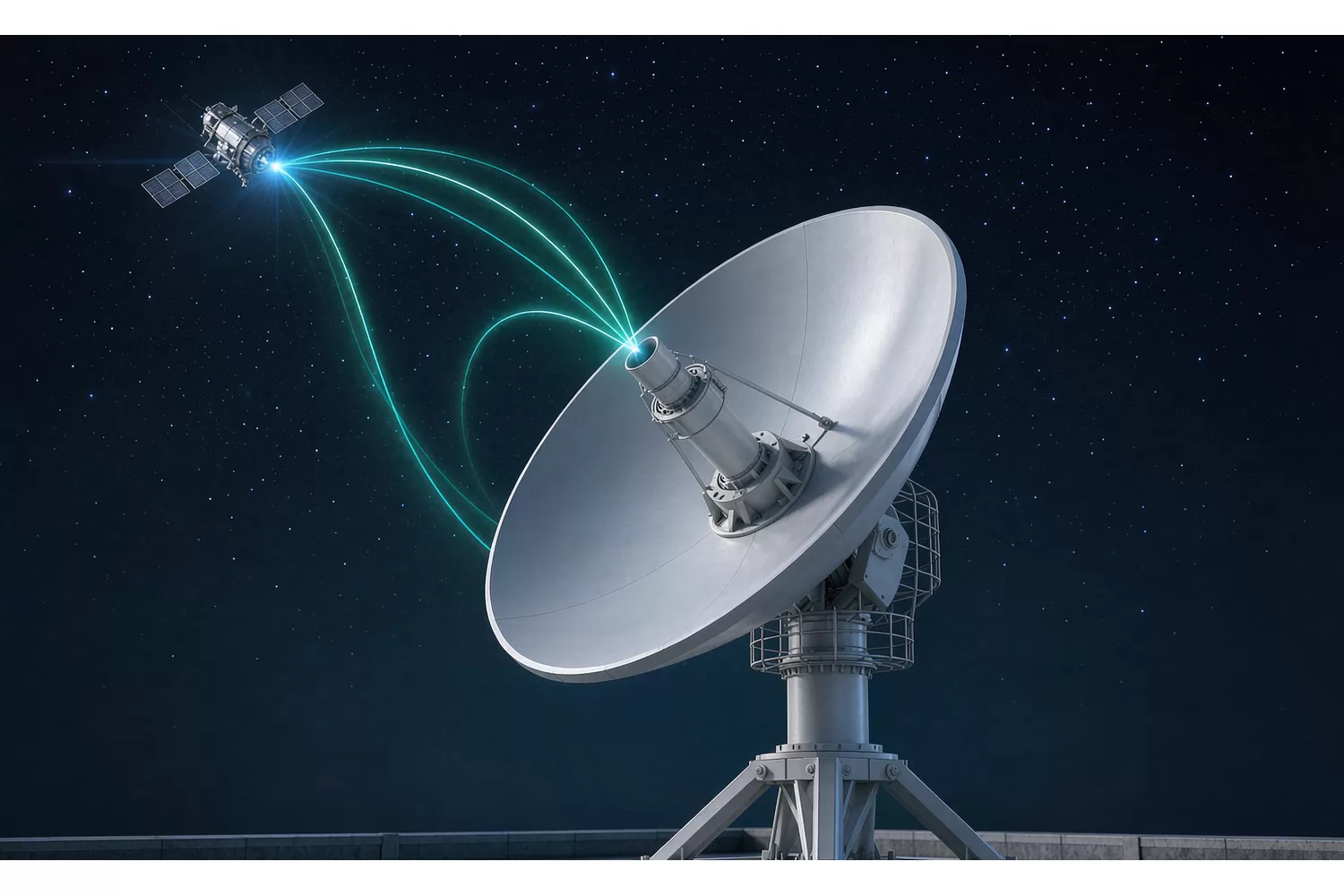
Satellite communication turns the entire planet into a single coverage area. Whether it is a maritime VSAT keeping a ship online, an L-band terminal on a remote site, or a phased-array user terminal on a vehicle, every one of these systems is fundamentally a radio with an unusually long range and an unusually weak signal. That makes the RF chain — and the parts in it — the difference between a working link and a dead one.

The receive path: fighting distance with gain
A signal reflected off a satellite 36,000 km away arrives at the antenna almost impossibly faint. The first active block it meets must add gain while adding almost no noise, because every decibel of noise it contributes is amplified by everything downstream. This is why low-noise and gain-block amplifiers sit at the heart of any SatCom receive chain. We stock devices such as the TQP3M9019, the SGA-6389Z, the ERA-1SM+ and the GALI-21+, which are commonly referenced where a clean receive or driver stage is needed.
The transmit path: pushing power to orbit
On the uplink the priorities reverse. The power amplifier must raise the signal to the level the satellite needs to hear, while staying linear enough that it does not spread energy into adjacent channels or violate the regulatory mask. Efficiency matters too, because a terminal may run from a limited power source. For transmit and driver amplification we supply parts such as the RFPA3800TR13 and the SBB-3089Z.
Routing and cleaning the signal
A switch selects the band or routes transmit versus receive, and filters reject the strong terrestrial interferers that sit near the satellite bands. We stock switches such as the QPC6044TR13, the SKY13575-639LF and the AS179-92LF SPDT switch, plus LC filter families such as the LFCN-3800+ low-pass and HFCN-5500+ high-pass filters. For level calibration, digital step attenuators like the PE4302-52 and fixed pads like the ATN3580-02 are used throughout.
Sourcing for a long-lived supply chain
SatCom programmes are often deployed for years in harsh, remote environments, and a single unavailable line can stall a build or a field upgrade. We help by supplying from traceable channels with date-code verification and inspection options (visual, X-ray, decapsulation, electrical test) so the parts feeding a link can be accounted for. Browse the full RF and interface chip range, or the Qorvo, Skyworks and Mini-Circuits collections.
Frequently asked questions
What RF components does a satellite communication terminal need?
A SatCom terminal - a VSAT, an L-band transceiver or a phased-array user terminal - repeats the same radio chain used on the ground, just at different frequencies. It needs a very low-noise receive amplifier (often a block downconverter with an LNA), switches for band or path selection, filters to reject terrestrial interferers, and a power amplifier on the uplink. The parts are chosen for low noise on receive and linearity on transmit.
Why is the LNA so critical in SatCom?
Satellite links operate over enormous distances, so the received signal is extremely weak. The first amplifier after the dish or antenna sets the noise floor of the entire receiver. A fraction of a dB saved in noise figure can mean a noticeably stronger, more reliable link, which is why low-noise and gain-block amplifiers matter so much here.
What frequencies does SatCom use and why does that matter?
L-band is used for mobile and maritime terminals because it penetrates weather and foliage well. Ku and Ka bands carry the high-throughput links but are more sensitive to rain. Each band needs its own filtering and, on the uplink, power amplifiers that stay linear at the band's output power.
Can you supply RF parts for SatCom and VSAT designs?
Yes. We stock low-noise and gain-block amplifiers, RF switches, power amplifiers, filters and step attenuators commonly referenced in satellite communication and VSAT radio designs. Send us the part numbers, package and quantity and we will quote availability and date code.
About us & trademarks: JTDZ Tech (Shenzhen Jingteng Electronics Technology Co., Ltd.) is an independent distributor of electronic components. We are not an authorised distributor or representative of the manufacturers named in this article. Manufacturer and part names are used for indicative purposes only, to help identify the components discussed; all trademarks remain the property of their respective owners. Always verify specifications against the manufacturer's datasheet before design-in or purchase.
