
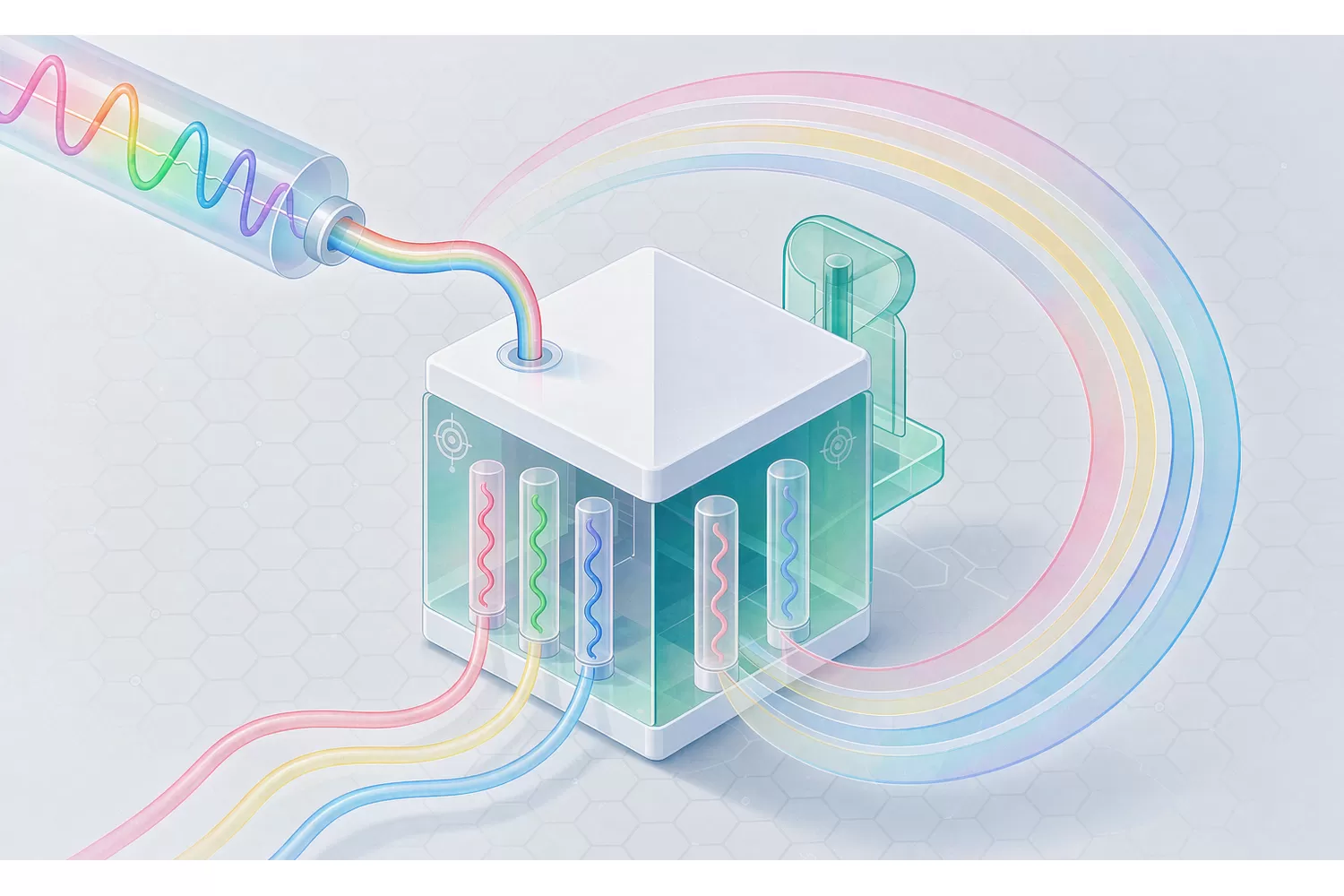
Radio spectrum is crowded, and it is only getting worse. A single device may transmit on cellular, shout on Wi-Fi, whisper on Bluetooth, and listen on GNSS — all at once, all in the same box. The component that lets all of this coexist without mutual destruction is the filter. This guide explains what RF filters do, the main types, and why they are the unsung guardians of spectrum coexistence.

What a filter passes and what it rejects
- Low-pass — passes below a cutoff, rejects harmonics. Essential after a power amplifier.
- High-pass — passes above a cutoff, blocks low-frequency content.
- Band-pass — selects a specific channel or band.
- Band-stop / notch — rejects a narrow interfering frequency.
We stock LC filter families such as the LFCN-3800+ low-pass and HFCN-5500+ high-pass filters, which are commonly referenced for general front-end conditioning.
The main filter technologies
SAW and BAW filters give very sharp skirts in tiny packages and dominate handsets, where space and selectivity are at a premium. LC filters (inductor-capacitor networks, such as the Mini-Circuits LFCN and HFCN families) are broadband, robust and easy to drop into a board. Ceramic filters sit between the two. The right choice balances sharpness, bandwidth, power handling and size.
Why coexistence is a filter problem
A cellular transmitter a few centimetres from a GNSS receiver will overwhelm it unless something rejects the cellular energy at the GNSS band. A Wi-Fi radio next to a Bluetooth one needs the same separation. Filters, together with careful channel planning and antenna isolation, are what make modern coexistence possible. Skimp on filtering and the device fails intermittently in the field, which is the worst kind of bug.
The chain around the filter
A filter usually sits between a switch and an amplifier, or after a power amplifier to clean up harmonics. We supply the switches (such as the QPC6044TR13), amplifiers (such as the SGA-6389Z) and step attenuators (such as the PE4302-52) that condition the signal on either side of the filter.
Sourcing filters and front-end parts
Filters are small, numerous and often allocated when a radio programme ramps. We supply from traceable sources with date-code verification and inspection options. Browse the RF and interface chip range and the Mini-Circuits collection for related devices.
Frequently asked questions
What does an RF filter do?
It passes the frequencies you want and rejects the ones you do not. Low-pass filters remove harmonics generated by a power amplifier; high-pass filters block low-frequency content; band-pass filters select a specific channel. Filters are what keep one radio from drowning out another.
What types of RF filters are commonly used?
SAW and BAW filters offer very sharp skirts in tiny footprints and dominate handsets. LC filters (such as the Mini-Circuits LFCN and HFCN families) are broadband workhorses for general conditioning. Ceramic filters sit between the two. The choice is a trade between sharpness, bandwidth, power and size.
Why does coexistence depend on filtering?
Phones, Wi-Fi, Bluetooth, GNSS and cellular all share the air. Without filtering, a strong transmitter leaks into a weak receiver and the link fails. Good filtering and channel planning are what let all of these coexist in one device and one neighbourhood.
Can you supply RF filters and the parts around them?
Yes. We stock LC filter families such as the LFCN-3800+ low-pass and HFCN-5500+ high-pass filters, plus the switches, amplifiers and attenuators that condition the signal around them. Send your part list and quantity for a quote.
About us & trademarks: JTDZ Tech (Shenzhen Jingteng Electronics Technology Co., Ltd.) is an independent distributor of electronic components. We are not an authorised distributor or representative of the manufacturers named in this article. Manufacturer and part names are used for indicative purposes only, to help identify the components discussed; all trademarks remain the property of their respective owners. Always verify specifications against the manufacturer's datasheet before design-in or purchase.
