
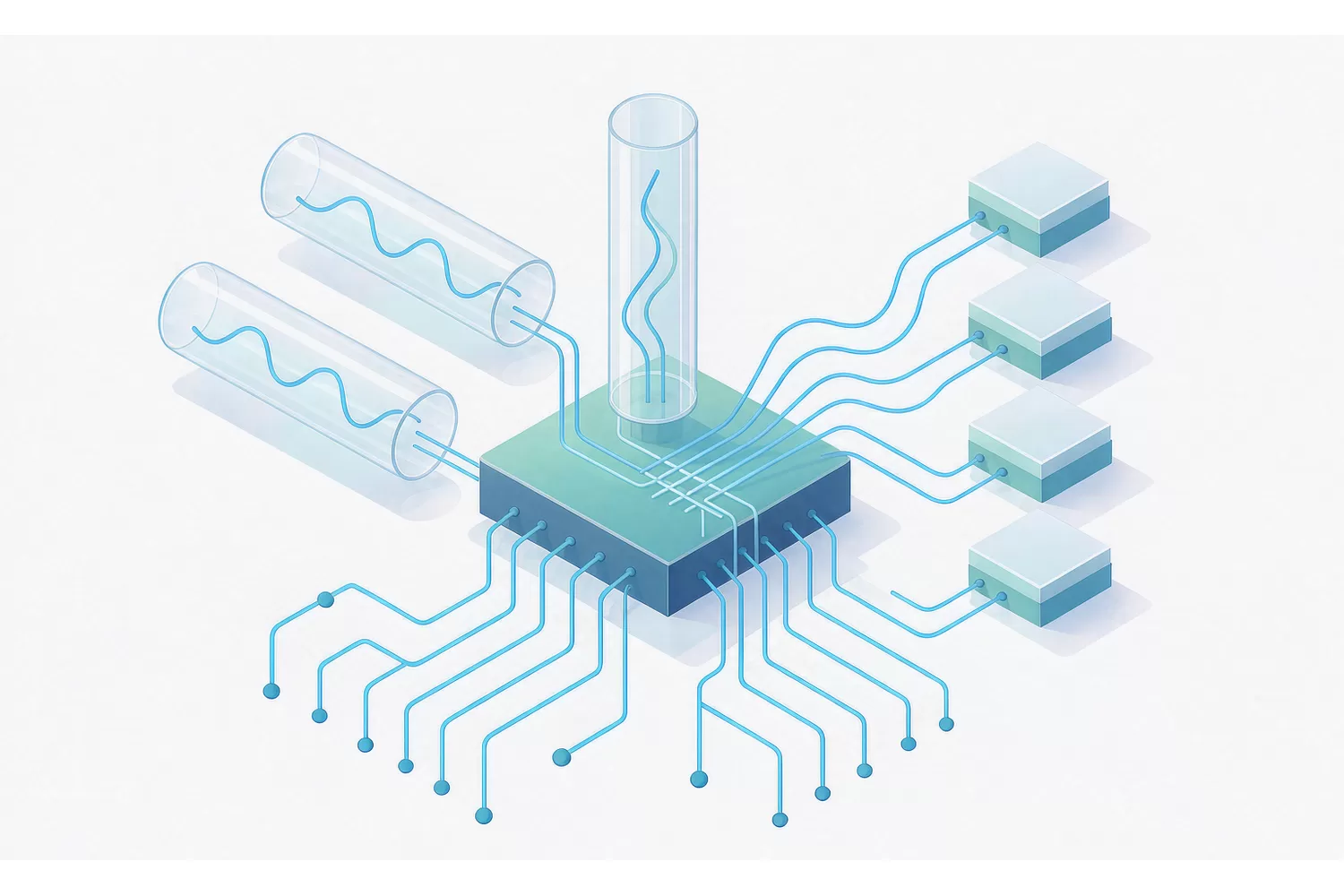
The RF switch is the quiet workhorse of every radio. It rarely gets the headline, but without it a single antenna could not serve dozens of bands, a phone could not switch between transmit and receive, and a IoT node could not pick the stronger of two antennas. This guide covers what switches and antenna tuners do, and how to think about selecting them.

What a switch actually routes
Modern radios multiplex one antenna system across many functions. A switch selects which band is active, which antenna is used, or whether the path is transmitting or receiving. In a massive-MIMO base station the same idea repeats across dozens of paths.
We stock switches such as the QPC6044TR13, the SKY13575-639LF and the AS179-92LF SPDT switch, used for band selection, diversity and TR routing.
The four numbers that matter
- Insertion loss — signal lost in the on-state. On receive this adds straight to the noise figure; keep it low.
- Isolation — how well the off-path is rejected. Poor isolation lets one band leak into another.
- Power handling (P1dB) — the switch must survive the transmit level without compressing or distorting.
- Switching speed — how fast it can change paths, which matters for time-division systems.
Antenna tuning: getting the last few dB back
An antenna's impedance shifts with frequency, with how the user holds the device, and with nearby objects. An antenna tuner — typically a switched capacitor or varactor network — re-matches the antenna across bands so transmit power reaches the air and receive sensitivity is preserved. A few dB recovered here can mean the difference between a dropped call and a clean one.
Level control alongside switching
Digital step attenuators let firmware trim signal level for receiver protection or calibration, and they are often paired with switches in a tuning or conditioning path. We supply the PE4302-52 step attenuator and fixed pads such as the ATN3580-02.
Sourcing switches
RF switches are small, numerous and frequently allocated when a radio build ramps. We supply from traceable sources with date-code verification. Browse the RF and interface chip range and the Skyworks and Qorvo collections.
Frequently asked questions
What does an RF switch do in a radio?
It routes the signal between paths: selecting a band, choosing between antennas for diversity, or switching between transmit and receive. The specifications that matter are insertion loss (keep it low), isolation (keep paths separate), power handling (P1dB) and switching speed.
What is antenna tuning and why is it needed?
A phone or IoT antenna's impedance changes with frequency, grip and environment. An antenna tuner (often a switched or varactor network) matches the antenna to the radio across bands so you keep efficiency and range. Good tuning can recover several dB of lost performance.
Why is insertion loss so important in a switch?
On the receive path, every dB the switch loses is paid for directly in receiver noise figure and therefore range. On transmit, it is paid for in wasted power and heat. So a low-loss switch is worth more than its datasheet price suggests.
Can you supply RF switches and tuning-related parts?
Yes. We stock RF switches such as the QPC6044TR13, SKY13575-639LF and AS179-92LF, plus step attenuators like the PE4302-52 used in tuning and level control. Send the part numbers and quantity for a quote.
About us & trademarks: JTDZ Tech (Shenzhen Jingteng Electronics Technology Co., Ltd.) is an independent distributor of electronic components. We are not an authorised distributor or representative of the manufacturers named in this article. Manufacturer and part names are used for indicative purposes only, to help identify the components discussed; all trademarks remain the property of their respective owners. Always verify specifications against the manufacturer's datasheet before design-in or purchase.
