
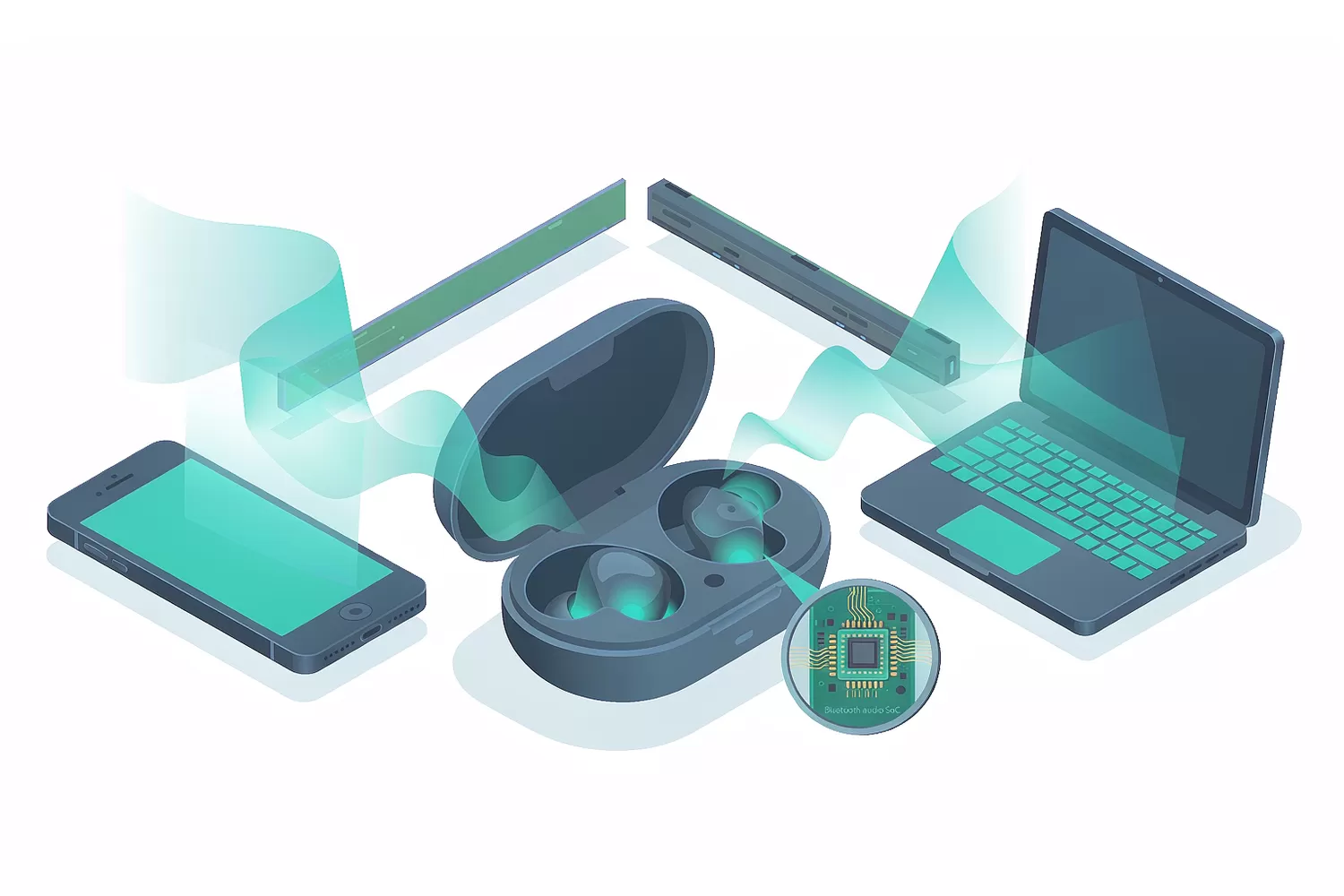
Twochip families defined the Bluetooth audio market: the imported Qualcomm CSR86xx series, which set the benchmark for TWS earbuds and headsets, and — over the last five years — a wave of domestically produced audio SoCs led by JieLi (Zhuhai JieLi, the AC69xx family) and Bluetrum (Zhongke Bluetrum, the AB53xx family) that reset the price floor of the entire category. This article explains the application logic of Bluetooth audio SoCs, the technology shift now under way, and what a substitution decision looks like with real numbers.

Application logic: what an audio SoC integrates
A Bluetooth audio SoC packs the 2.4 GHz radio, baseband and link controller, an audio DSP, codec (ADC/DAC), power management, battery charger interface and often embedded flash into one die or package. Around it, a design needs only a crystal, antenna matching, flash (on some SKUs), charging components and the acoustic front end. The engineering questions that decide success: RF coexistence with Wi-Fi in the phone it pairs to; power consumption across playback, standby and pairing; THD and SNR of the DAC/amp chain at your speaker impedance; and the firmware SDK’s maturity for your feature set (buttons, voice prompts, multipoint, EQ).
New technology in Bluetooth audio
- LE Audio and LC3 codec: better audio at lower bitrates; domestically announced roadmaps now include it, imported parts already ship it.
- Hybrid ANC: feed-forward plus feedback microphones, once exclusive to premium imported platforms, now appears in domestic mid-range parts.
- TWS pairing robustness: true wireless stereo link management is a differentiator — test in crowded RF environments, not on the bench.
- Integration squeeze: flash, charger and haptic-driver functions are being absorbed into the SoC, cutting external BOM further.
Domestic alternatives: analysis before switching
The comparison items that matter: audio quality on your actual transducer (datasheet THD numbers are measured in the vendor’s reference design, not yours); RF range and pairing robustness in the field; SDK licensing model and documentation language; encryption and voice-assistant requirements if you ship into regulated ecosystems; and the certification evidence chain (BQB, FCC/CE) the vendor can provide. Legacy CSR parts also raise a sourcing-risk question — much of the market supply is now reclaimed or aftermarket, which is why we recommend reading our counterfeit-recycled IC guide before buying older imported audio SoCs.
Indicative cost comparison: imported originals vs domestic candidates
Price figures below are indicative public-market reference ranges for moderate volumes, compiled from publicly observable listings. They fluctuate with the spot market, package option, reel size and order quantity, and must not be read as a quotation. Ask us for a firm price on your exact part numbers and quantities.
| Device class | Common imported part (reference) | Indicative imported unit price | Commonly referenced domestic candidate | Indicative domestic unit price |
|---|---|---|---|---|
| Classic Bluetooth stereo audio SoC | Qualcomm CSR8635 / CSR8645 class | USD 2.5–5.0 | JieLi AC69xx family (e.g. AC6926 class) | USD 0.4–0.9 |
| Entry Bluetooth mono audio SoC | Qualcomm CSR8615 class | USD 1.5–3.0 | Bluetrum AB53xx family (e.g. AB5301A class) | USD 0.25–0.6 |
| TWS earbud SoC (per-bud) | Qualcomm QCC30xx class | USD 3.0–6.0 | JieLi / Bluetrum TWS-class parts | USD 0.5–1.2 |
This category produced the most dramatic substitution story in consumer RF: the domestic candidates did not merely undercut the imported parts, they redefined the entry price of an entire product segment. The saving per board is one to four dollars — decisive in products that retail under twenty.
Commonly referenced alternative models
| Imported original | Domestic candidate (public sources) | Why it is referenced |
|---|---|---|
| Qualcomm CSR8635 — stereo Bluetooth audio SoC | JieLi AC69xx family | Extremely widely deployed in speakers and headsets; mature (though informal) firmware ecosystem; verify SDK access and certification evidence for branded projects. |
| Qualcomm CSR8615 — entry mono audio SoC | Bluetrum AB53xx family | Dominant in entry headsets and call-focused products; series includes flash-integrated variants; match the exact ordering code to your power and audio requirements. |
| Qualcomm QCC30xx / QCC51xx — TWS platforms | JieLi and Bluetrum TWS-class SoCs | Active TWS development across both domestic vendors; ANC and LE Audio support varies by part — evaluate on your acoustic hardware. |
Exact ordering codes and firmware builds matter enormously in this category; two parts from the same family can differ in flash size, DAC performance and supported profiles. Quote by the full part number, and ask for the vendor’s datasheet and errata before layout sign-off.
Validation checklist
- Listening test on your transducers and enclosure, both candidates, same content.
- Range and pairing-robustness test in a crowded environment (mall, train).
- Battery-life measurement across playback, idle and standby states.
- SDK due diligence: documentation quality, update cadence, engineering support.
- Certification evidence: BQB listing, FCC/CE test reports for the exact part.
Related reading on our blog
CSR8811 Bluetooth SoC integration guide · BC417143B Bluetooth SoC product page · ESP32-S3 Wi-Fi/BT module overview
Frequently asked questions
Are JieLi and Bluetrum chips suitable for branded products?
They are widely used in consumer audio products across all price tiers. The historical gap was in tooling and documentation polish, and in certification support packages; both have improved substantially. Evaluate firmware SDK access, reference designs and your certification workflow as part of the decision.
What did CSR chips cost compared with domestic audio SoCs?
At the peak, imported Bluetooth audio SoCs commonly traded in the low single-digit dollars, while the mainstream domestic candidates settled in the sub-dollar range. The indicative figures in the table below reflect public-market observations; actual pricing depends on package, flash option and volume.
Does the domestic route support ANC and LE Audio?
Newer generations of domestic audio SoCs advertise hybrid ANC and LE Audio direction support. Treat these as evaluation items in your own bench tests rather than assumptions, and confirm the exact feature set of the specific part number you are quoting.
Can you quote the imported originals and the domestic candidates?
Yes. We can supply the common imported Bluetooth audio SoCs and the domestic candidates referenced here, and quote them side by side for your BOM review.
About us & trademarks: JTDZ Tech (Shenzhen Jingteng Electronics Technology Co., Ltd.) is an independent distributor of electronic components. We are not an authorised distributor or representative of any manufacturer named in this article. Manufacturer, brand and part names are used for identification purposes only; all trademarks remain the property of their respective owners. Cross-reference information in this article is based on publicly available sources, is subject to change, and is not a substitute for your own engineering validation. Always verify specifications against the manufacturer's datasheet before design-in or purchase.
