
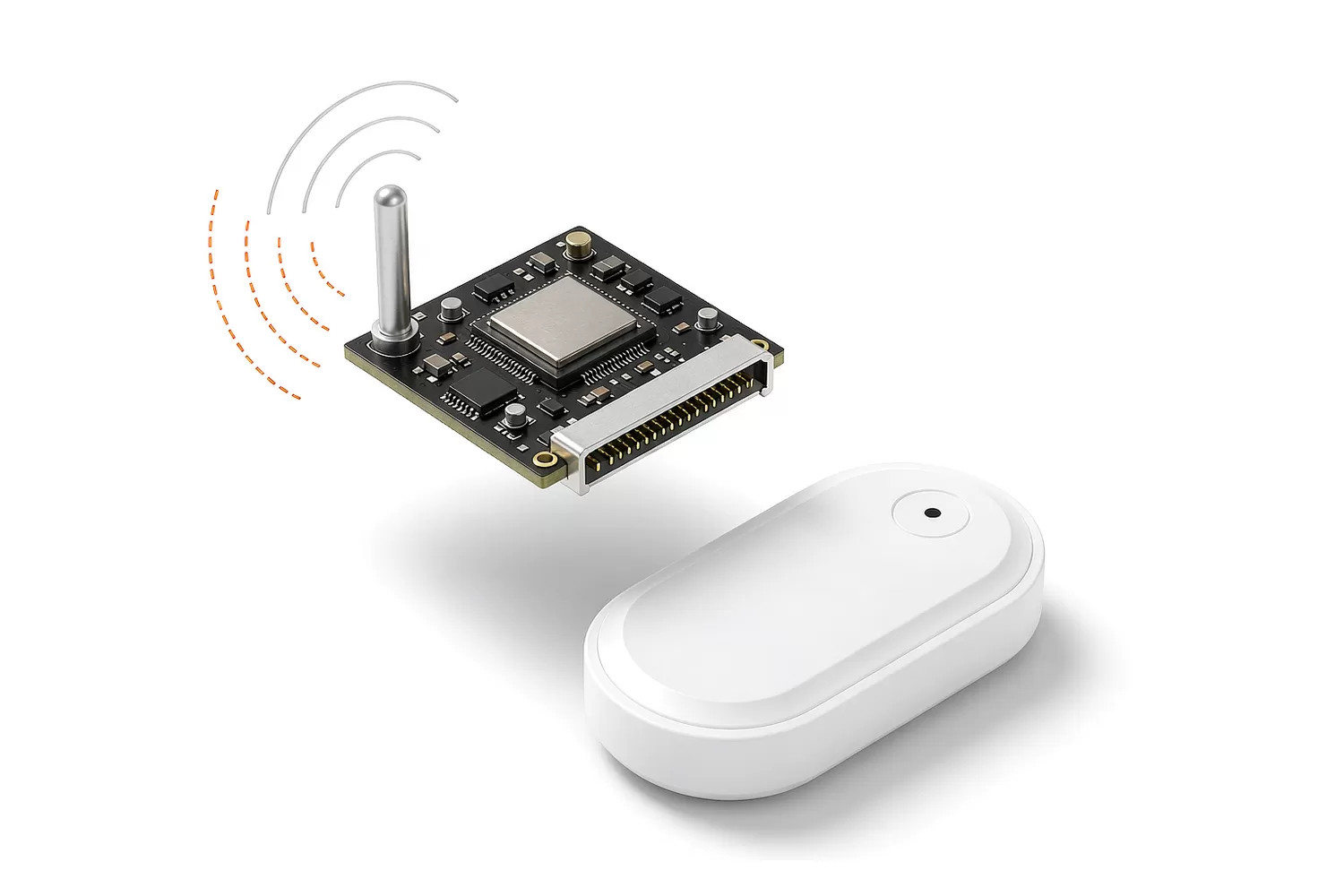
When a product needs to talk to the network, the fastest route is usually a wireless module rather than a chip-plus-discretes board. The ESP32-S3-WROOM-1-N16R8 packs a dual-core Xtensa LX7 microcontroller, Wi-Fi 4 and Bluetooth Low Energy 5, plus 16 MB flash and 8 MB PSRAM, onto one small module. This guide covers what it is for, the module-vs-chip trade-off, and what to check.

What the module gives you
The ESP32-S3 is a capable MCU in its own right — dual cores, plenty of GPIO, and rich peripheral sets — and the WROOM-1 module wraps it with the radio front end, the antenna footprint, flash and PSRAM, and the high-frequency layout already done. For Wi-Fi and BLE products, that removes the hardest RF work from your board.
Module vs bare chip
- Module — faster development, easier certification, fewer RF headaches; slightly larger and costlier than a bare chip.
- Bare chip — smallest and cheapest at very high volume, but you own the RF layout, antenna and certification.
What to verify before design-in
- Memory — confirm the flash and PSRAM your firmware and OTA need; variants differ.
- Antenna — on-board PCB antenna vs external connector changes your enclosure and certification.
- Power — budget for the transmit-current peak and decouple well.
- Provisioning & OTA — plan how devices join Wi-Fi and receive updates.
Always confirm the exact specifications against the manufacturer's datasheet before committing to volume.
Wireless MCUs we stock
| Part | Wireless | Typical use | Link |
|---|---|---|---|
| ESP32-S3-WROOM-1-N16R8 | Wi-Fi 4 + BLE 5, 16 MB Flash / 8 MB PSRAM | IoT, smart-home, gateways | ESP32-S3-WROOM-1 |
| ESP32-D0WDQ6 | ESP32 chip, Wi-Fi + BLE | Custom module bases | ESP32-D0WDQ6 |
| nRF52840-QIAA-R | Bluetooth 5 SoC | Low-power BLE nodes | nRF52840-QIAA-R |
See the full microcontroller range. Send your memory, wireless and quantity requirements for a quote.
Frequently asked questions
What is on the ESP32-S3-WROOM-1 module?
It is a self-contained wireless module built around the ESP32-S3 chip: a dual-core Xtensa LX7 microcontroller with Wi-Fi 4 and Bluetooth Low Energy 5, plus on-module flash and PSRAM. You get the radio, the MCU and the memory on one small footprint, which is why it accelerates connected-product development.
Why choose a module instead of a bare chip?
A module bundles the RF front end, the antenna or antenna footprint, the flash and the PSRAM, and carries the difficult high-frequency layout work. For most teams that means a faster path to a stable wireless product and an easier time with radio certification than spinning a chip-plus-discretes board.
What should I check before designing with it?
Confirm the flash and PSRAM size your firmware needs, the antenna option (on-board vs external), the power budget (Wi-Fi transmit peaks draw real current), and how you will handle provisioning and updates. Validate on the actual module variant you will buy, because flash and PSRAM configurations differ.
Do you stock ESP32-S3 and wireless MCUs?
Yes. We stock the ESP32-S3-WROOM-1 and related wireless modules and can quote by quantity with date codes so you can validate before committing to volume.
Recommended next steps
If you are sourcing any of the parts mentioned in this guide, we can help you confirm stock, pricing, and lead times quickly.
- Upload your BOM — send your full parts list and receive a consolidated quote within 2 business hours.
- Browse related in-stock lines: Microcontrollers / MCUs.
- Contact our team for hard-to-find or end-of-life components.
About us & trademarks: JTDZ Tech (Shenzhen Jingteng Electronics Technology Co., Ltd.) is an independent distributor of electronic components. We are not an authorised distributor or representative of the manufacturers named in this article. Manufacturer and part names are used for indicative purposes only, to help identify the components discussed; all trademarks remain the property of their respective owners. Always verify specifications against the manufacturer's datasheet before design-in or purchase.
