
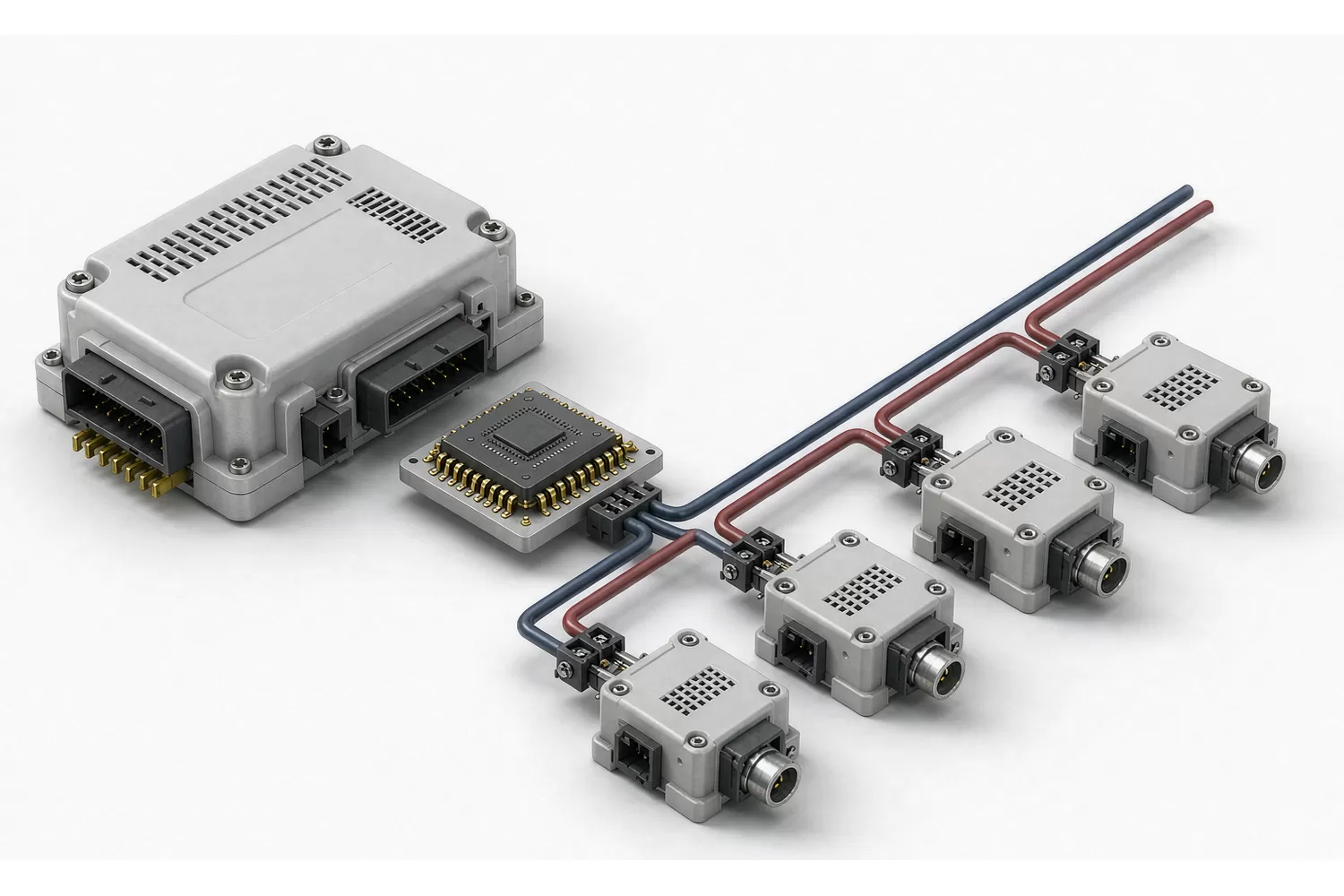
CAN bus is the backbone of automotive and industrial control networks, and every node needs a transceiver between the MCU and the wires. The COS1042T is a high-speed CAN transceiver offered as an alternative to the TJA1042T, with 3.3 V / 5 V logic compatibility and a standby mode. This guide covers what it does and what to check.

From MCU to the bus
The MCU runs the CAN controller and produces a single-ended TX/RX. The transceiver turns that into the differential CANH / CANL pair, driving dominant and recessive states and withstanding the electrical noise of a vehicle harness. Without it, the MCU cannot physically speak CAN.
Classical CAN vs CAN FD
If your network is CAN FD, the transceiver must support the faster data phase and the changed bit timing; a classical-only part will not keep up. Confirm which your bus uses before choosing. The COS1042T family covers the high-speed class used in most current designs.
What to verify
- Bit rate — classical up to 1 Mbit/s; FD needs the higher data-phase rate.
- Standby / silent — useful for sleep-capable or listen-only nodes.
- Common-mode and ESD — rated for the vehicle or factory floor.
- Logic level — 3.3 V vs 5 V I/O must match your MCU.
Always confirm the exact ratings against the manufacturer's datasheet before design-in.
CAN transceivers we stock
| Part | Maker | Position | Link |
|---|---|---|---|
| COS1042T | COSINE | TJA1042T-class alternative | COS1042T |
| COS1042T/3 | COSINE | TJA1042T/3-class (3.3 V I/O) | COS1042T/3 |
Explore the interface and RF range. Send your bit rate, I/O level and quantity for a quote.
Frequently asked questions
What does a CAN transceiver do?
The MCU handles the CAN protocol in firmware, but the physical bus is differential (CANH / CANL). The transceiver converts between the MCU's single-ended TX/RX and that differential pair, driving dominant and recessive states and tolerating the harsh electrical environment of a vehicle or machine.
What is the difference between CAN and CAN FD?
Classical CAN runs up to 1 Mbit/s with a fixed frame. CAN FD raises the data-phase bit rate (often to 5 Mbit/s and beyond) and allows larger data frames, so you move more payload per message. A transceiver must support the faster data phase and the changed bit timing to be used on an FD bus.
Why might a part sit in standby?
A standby or silent mode lets the MCU mute the transmitter while still listening, which saves power and prevents a dead node from blocking the bus. For battery-powered or sleep-capable nodes, a transceiver with a controlled standby state is worth having.
Do you stock COS1042T and CAN parts?
Yes. We stock the COS1042T and compatible TJA1042-class transceivers and can quote by quantity with date codes so you can validate before committing to volume.
Recommended next steps
If you are sourcing any of the parts mentioned in this guide, we can help you confirm stock, pricing, and lead times quickly.
- Upload your BOM — send your full parts list and receive a consolidated quote within 2 business hours.
- Browse related in-stock lines: Interface / RF Chips.
- Contact our team for hard-to-find or end-of-life components.
About us & trademarks: JTDZ Tech (Shenzhen Jingteng Electronics Technology Co., Ltd.) is an independent distributor of electronic components. We are not an authorised distributor or representative of the manufacturers named in this article. Manufacturer and part names are used for indicative purposes only, to help identify the components discussed; all trademarks remain the property of their respective owners. Always verify specifications against the manufacturer's datasheet before design-in or purchase.
