
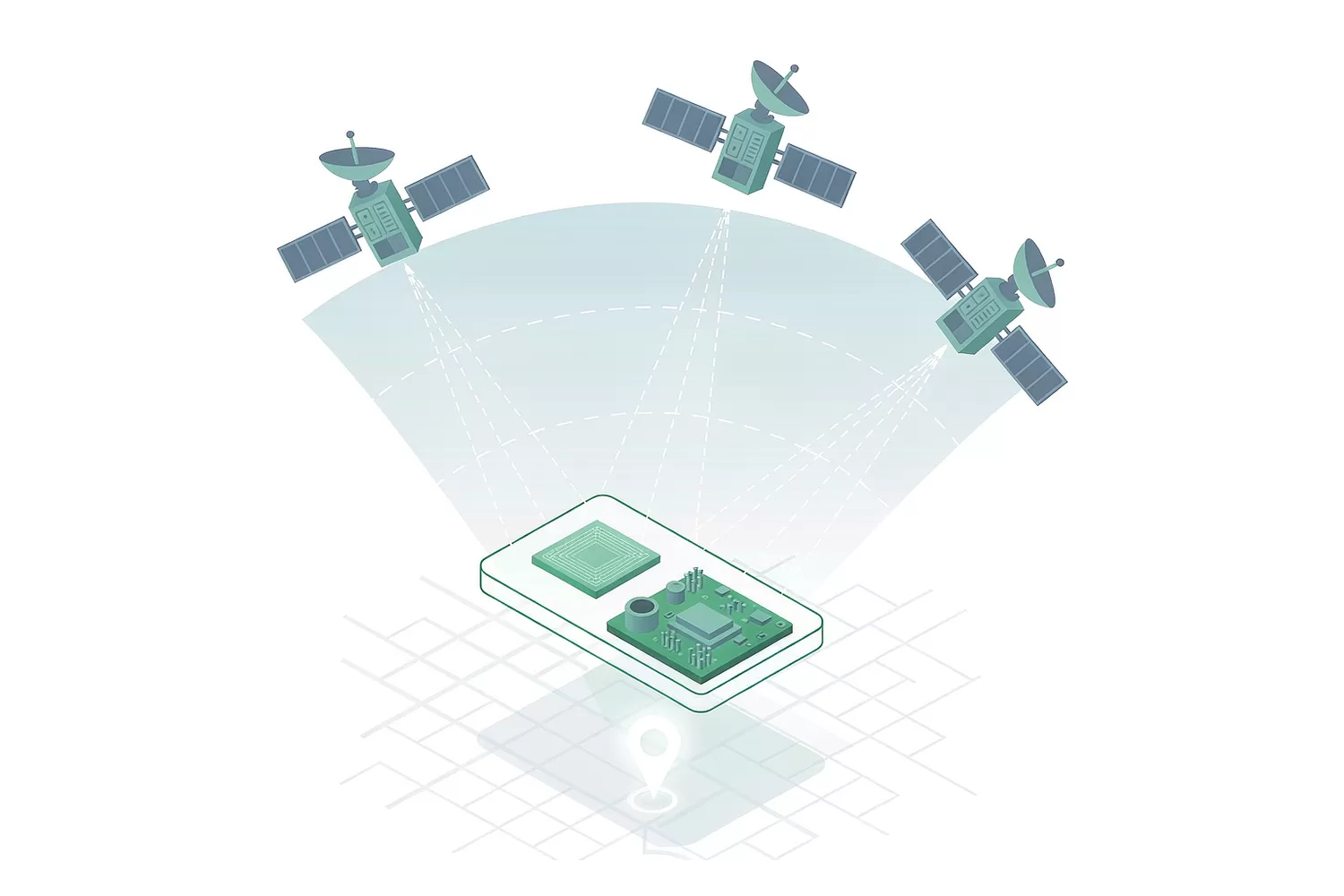
Positioning has quietly become a standard input of embedded products: dashcams, asset trackers, e-bikes, pet trackers, weather stations and timing receivers for base stations all need to answer “where am I, and at what time?”. The imported reference in this field is u-blox — the NEO and ZED module families in particular. In recent years, domestically produced GNSS receiver chips have reached the point where they are the default answer for many cost-driven designs. This article walks through the application logic, what is new in the category, and a candid comparison including concrete candidate models.

Application logic: what a GNSS receiver must get right
A GNSS receiver performs three jobs continuously: acquire visible satellites, track them, and solve position and time. The engineering trade-offs show up as time-to-first-fix (TTFF) — driven by aiding data (AGNSS) and crystal stability — tracking sensitivity (can it hold a fix indoors or in urban canyons), and power consumption per fix. Around the chip, the antenna is decisive: patch vs chip antenna, ground-plane size, LNA gain and pre-filtering against cellular interference are where most field problems originate. Our GNSS receiver design guide covers the RF-side detail.
For timing applications the PPS output and its jitter matter more than position accuracy; for trackers it is the energy per fix that sets battery life. Match the specification you optimise to the product you ship.
New technology in GNSS receivers
- Multi-constellation by default: GPS, BeiDou, GLONASS and Galileo processed together improve availability in urban canyons.
- Dual-band (L1+L5) receivers moving from geodesy into consumer products, cutting multipath error substantially.
- High-precision RTK: centimetre-level correction services over IP/NTRIP, once exotic, are now standard in agricultural and robotics platforms.
- BeiDou-native design: domestic chips are built around BeiDou first-class support, which benefits projects serving the Chinese market.
Domestic alternatives: analysis before you switch
The comparison sequence: (1) constellation and band support for your markets; (2) TTFF hot/warm/cold with the same AGNSS infrastructure; (3) tracking and re-acquisition sensitivity at your antenna size; (4) power per fix in your duty cycle; (5) NMEA/proprietary protocol compatibility — most domestic parts speak NMEA-0183, which simplifies firmware migration; (6) module vs chip packaging and certification evidence for your target markets.
Indicative cost comparison: imported originals vs domestic candidates
Price figures below are indicative public-market reference ranges for moderate volumes, compiled from publicly observable listings. They fluctuate with the spot market, package option, reel size and order quantity, and must not be read as a quotation. Ask us for a firm price on your exact part numbers and quantities.
| Device class | Common imported part (reference) | Indicative imported unit price | Commonly referenced domestic candidate | Indicative domestic unit price |
|---|---|---|---|---|
| Standard-precision GNSS module | u-blox NEO-6M / NEO-M8 class | USD 7–15 | Zhongke Micro (ATGM) modules based on AT6558R | USD 1.5–3.5 |
| GNSS receiver chip (multi-constellation) | u-blox UBX-M8030 class ICs | USD 4–8 | Zhongke Micro AT6558R; Taidou Micro TD3020C | USD 0.8–1.6 |
| High-precision RTK module | u-blox ZED-F9P class | USD 180–230 | Unisense (Simage Starcom) UM980 class | USD 30–55 |
The standard-precision segment is the clearest cost story: the domestic candidates deliver comparable practical accuracy for trackers and dashcams at a fraction of the price. In high precision, imported parts retain advantages in documentation, correction-service integrations and certification packages — but the domestic candidates are often 5–10x cheaper, which funds a lot of engineering validation.
Commonly referenced alternative models
| Imported original | Domestic candidate (public sources) | Why it is referenced |
|---|---|---|
| u-blox NEO-M8 — multi-constellation GNSS module | Zhongke Micro AT6558R (module family ATGM336H etc.) | Multi-constellation support including BeiDou; NMEA interface eases firmware migration; widely deployed in trackers and IoT devices. |
| u-blox NEO-6 — legacy single-band receiver | Taidou Micro TD3020C | Commonly referenced candidate for legacy-cost designs; confirm band plan and protocol support for your region. |
| u-blox ZED-F9P — dual-band RTK module | Unisense UM980 | All-constellation, multi-frequency RTK; publicly documented centimetre-level performance class; evaluate correction-service workflow compatibility. |
Candidate models here are starting points drawn from public sources — order codes, package options and firmware variants differ, and the responsible engineering step is a side-by-side bench comparison on your own antenna.
Validation checklist
- TTFF measurement hot/warm/cold with identical AGNSS data on both candidates.
- Urban-canyon and indoor-tracking drive test against your accuracy targets.
- Power-per-fix profile at your reporting duty cycle.
- Antenna review: ground plane, LNA, out-of-band filtering against cellular transmitters.
- Certification and RoHS/reach documentation for destination markets.
Related reading on our blog
GNSS / GPS positioning receiver guide · Satellite communications RF chain · Sourcing original RF components from China
Frequently asked questions
What is the difference between a GNSS chip and a GNSS module?
The chip is the receiver die or package-level IC; the module is the chip plus crystal, LNA, passives and shielding, tuned and tested. Many of the price figures quoted publicly compare modules with modules and chips with chips — mixing them is a common purchasing mistake.
Do domestic receivers really match u-blox performance?
In basic single-band positioning, the commonly referenced domestic candidates have closed most of the practical gap for consumer and light-industrial use. Where imported parts still lead or differ is in mature documentation, tooling, certification packages, and high-precision RTK variants — evaluate your own accuracy and convergence requirements.
Is multi-band (L1+L5) worth the extra cost?
For products sold into dense urban environments or beside reflective glass facades, yes: L5 signals are less prone to multipath, so time-to-first-fix and accuracy hold up better. For a tracker sold into open rural areas, a single-band part remains the cost-effective choice.
Can you supply u-blox parts and the domestic alternatives?
Yes. We quote the common imported GNSS receivers and modules as well as the domestic candidates referenced here, and we can supply both side by side during your evaluation phase.
About us & trademarks: JTDZ Tech (Shenzhen Jingteng Electronics Technology Co., Ltd.) is an independent distributor of electronic components. We are not an authorised distributor or representative of any manufacturer named in this article. Manufacturer, brand and part names are used for identification purposes only; all trademarks remain the property of their respective owners. Cross-reference information in this article is based on publicly available sources, is subject to change, and is not a substitute for your own engineering validation. Always verify specifications against the manufacturer's datasheet before design-in or purchase.
