
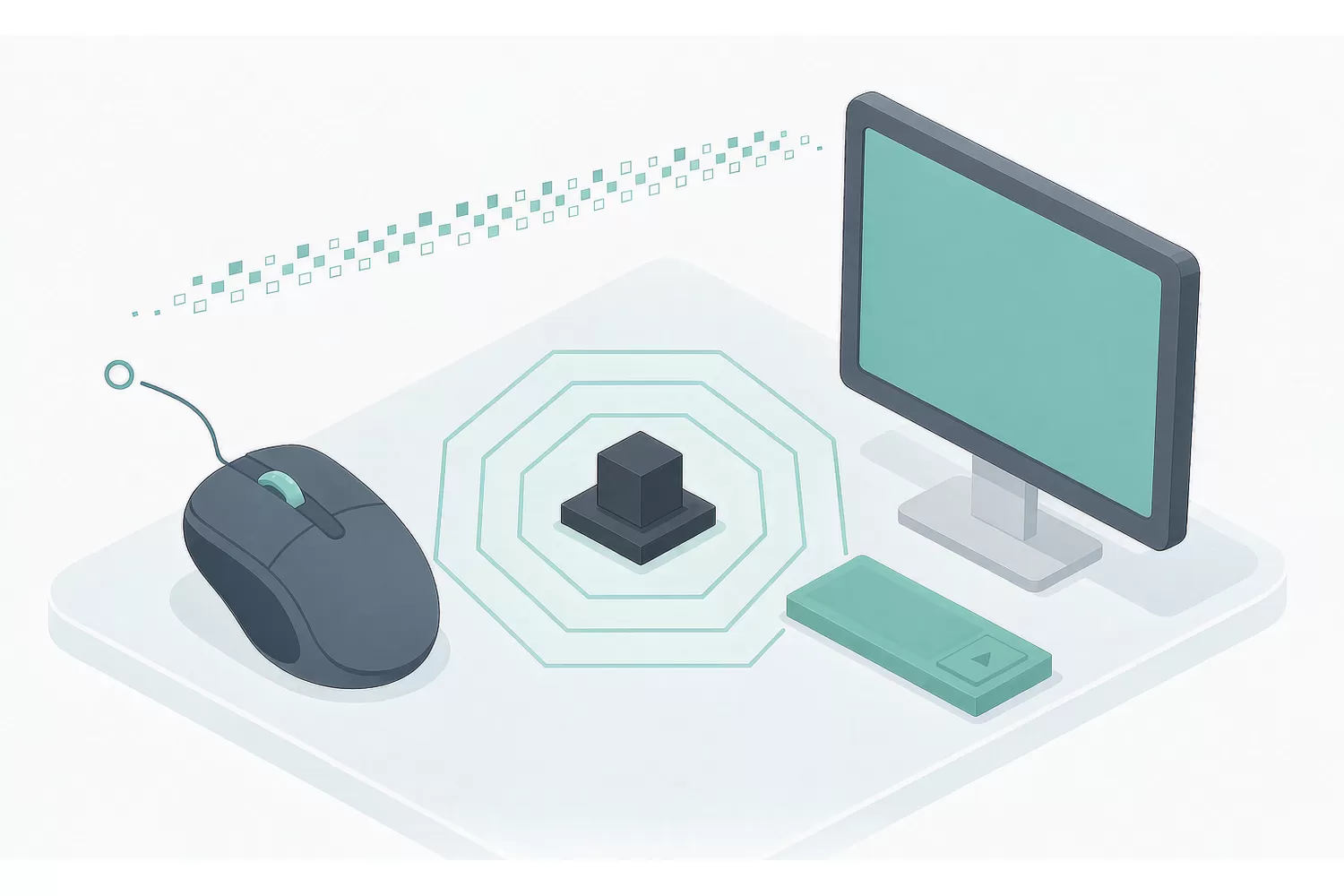
For every gaming mouse, drone, toy and industrial remote control that talks on a proprietary 2.4 GHz link, there is a small transceiver doing the work. The reference design for a generation of engineers has been the Nordic nRF24L01+, and its ecosystem of application notes is still the de-facto textbook. This article explains the application logic of 2.4 GHz private-protocol radios, what is changing in the category, and how the domestically produced alternatives — most prominently the Nanjing Zhongke Micro (Nanjing Zhongke Microelectronics) XN297 family — fit into a modern bill of materials.

Application logic: what a private-protocol 2.4 GHz link must do
A private-protocol radio has one job: move small payloads at low latency with minimal power, on a band shared with Wi-Fi, Bluetooth and microwaves. The design levers are: channel plan (frequency hopping across a subset of the 2.4 GHz band), packet format (short address + payload + CRC), and acknowledgement policy (auto-ACK plus retransmission, as the nRF24L01+ popularised). Latency is the reason these links survive next to BLE: a mouse report every 8 ms with a fixed 3-byte payload is exactly what a private protocol does well and what a connection-oriented stack handles awkwardly.
Power is the second lever. Duty-cycling the radio (sleep between reports), power-down states between packets, and output-power scaling by link quality typically dominate battery life — more than the headline receive current of the chip itself.
New technology and market direction
- Low-latency gaming peripherals: 1000 Hz report rates over private 2.4 GHz links are now a selling point, pushing tighter radio-turnaround timing.
- BLE-aware coexistence: newer designs hop adaptively around Wi-Fi access points detected at runtime.
- Single-chip 2.4 GHz SoCs with MCU and USB transceiver integrated, removing external components from dongles.
- LE Audio and multi-protocol stacks pressuring pure private protocols at the high end — while the cost-driven end stays private by choice.
Domestic alternatives: the analysis that matters
When evaluating the XN297 family or comparable parts against an nRF24L01+ based design, work through: air-data-rate and modulation settings; packet format and CRC length; the Enhanced-ShockBurst-style auto-acknowledgement behaviour and its timing; register interface differences (SPI commands differ); current consumption in your actual duty cycle; and the availability of reference firmware for your MCU platform. Also plan for manufacturing: the domestic parts are typically offered in SOP/QFN packages with similar footprints, but layout reuse should be verified with the manufacturer's reference design.
Indicative cost comparison: imported originals vs domestic candidates
Price figures below are indicative public-market reference ranges for moderate volumes, compiled from publicly observable listings. They fluctuate with the spot market, package option, reel size and order quantity, and must not be read as a quotation. Ask us for a firm price on your exact part numbers and quantities.
| Device class | Common imported part (reference) | Indicative imported unit price | Commonly referenced domestic candidate | Indicative domestic unit price |
|---|---|---|---|---|
| 2.4 GHz GFSK transceiver | Nordic nRF24L01+ | USD 0.8–1.6 | Nanjing Zhongke Micro XN297 / XN297L | USD 0.12–0.35 |
| 2.4 GHz transceiver with MCU integration | Nordic nRF5x family (BLE-capable) | USD 1.5–3.5 | XN297-class SoC variants; 2.4 GHz SoCs from Broadchip and other domestic vendors | USD 0.3–0.8 |
The per-unit saving looks small until you multiply it across a high-volume peripheral. For a mouse dongle or toy radio, the radio chip is frequently the largest active-line item after the MCU, so the substitution decision is usually a straightforward cost case — provided the firmware port is budgeted honestly.
Commonly referenced alternative models
| Imported original | Domestic candidate (public sources) | Why it is referenced |
|---|---|---|
| Nordic nRF24L01+ — 2.4 GHz GFSK transceiver, SPI, auto-ACK | Nanjing Zhongke Micro XN297 / XN297L | Publicly documented as a candidate alternative in the same frequency band and use cases; widely used in cost-driven peripherals and toys; verify packet-format interworking in firmware. |
| Nordic nRF51822 / nRF52832 class wireless MCUs (BLE + 2.4 GHz) | Domestic BLE/2.4 GHz SoCs (e.g. Broadchip, Awinic-family devices) | For designs that need BLE alongside private modes; ecosystem and SDK maturity vary — evaluate tooling before committing. |
Note that the XN297 family ships in several variants (supply voltage, output power, package). Match the variant against your power budget and antenna design, and confirm the exact ordering code with the supplier before layout.
Validation checklist
- Latency measurement at your report rate, including retry behaviour under interference.
- Range test in an office environment saturated with Wi-Fi (the realistic worst case).
- Current-profile capture of your duty cycle, not just the datasheet receive current.
- Interoperability matrix if any legacy nRF24 endpoints must still communicate.
- Second-source plan: agree a fallback part and footprint before you commit volumes.
Related reading on our blog
Si4455 sub-GHz transceiver design guide · RF chips in IoT sensor nodes · ESP32-S3 module overview
Frequently asked questions
Is the XN297 compatible with nRF24L01+ packets?
The XN297 is commonly referenced in public sources as a candidate alternative for nRF24L01+ style designs, and some firmware approaches exist to interoperate with nRF24 air packets. But compatibility is a firmware-and-configuration question, not a guarantee. Treat interoperability as a project task with its own test matrix, and check the manufacturer's documentation for the exact part.
Where do 2.4 GHz private-protocol radios still make sense versus BLE?
When you control both ends of the link and want minimum latency, minimum cost and no phone pairing: gaming mice and keyboards, drones and toys, sensor chains and industrial remote controls. BLE wins when you must talk to phones or benefit from its ecosystem of profiles.
What about coexistence with Wi-Fi?
Both share the 2.4 GHz band. Design in adaptive channel hopping, keep duty cycles low, and place the antennas with separation or orthogonal polarisation. On dense products a pre-scan of the channel environment during development avoids most field complaints.
Can you quote nRF24L01+ and the domestic alternatives together?
Yes. We regularly quote the imported originals and the domestically produced candidates referenced here side by side so that purchasing can compare landed cost with the engineering findings.
About us & trademarks: JTDZ Tech (Shenzhen Jingteng Electronics Technology Co., Ltd.) is an independent distributor of electronic components. We are not an authorised distributor or representative of any manufacturer named in this article. Manufacturer, brand and part names are used for identification purposes only; all trademarks remain the property of their respective owners. Cross-reference information in this article is based on publicly available sources, is subject to change, and is not a substitute for your own engineering validation. Always verify specifications against the manufacturer's datasheet before design-in or purchase.
