
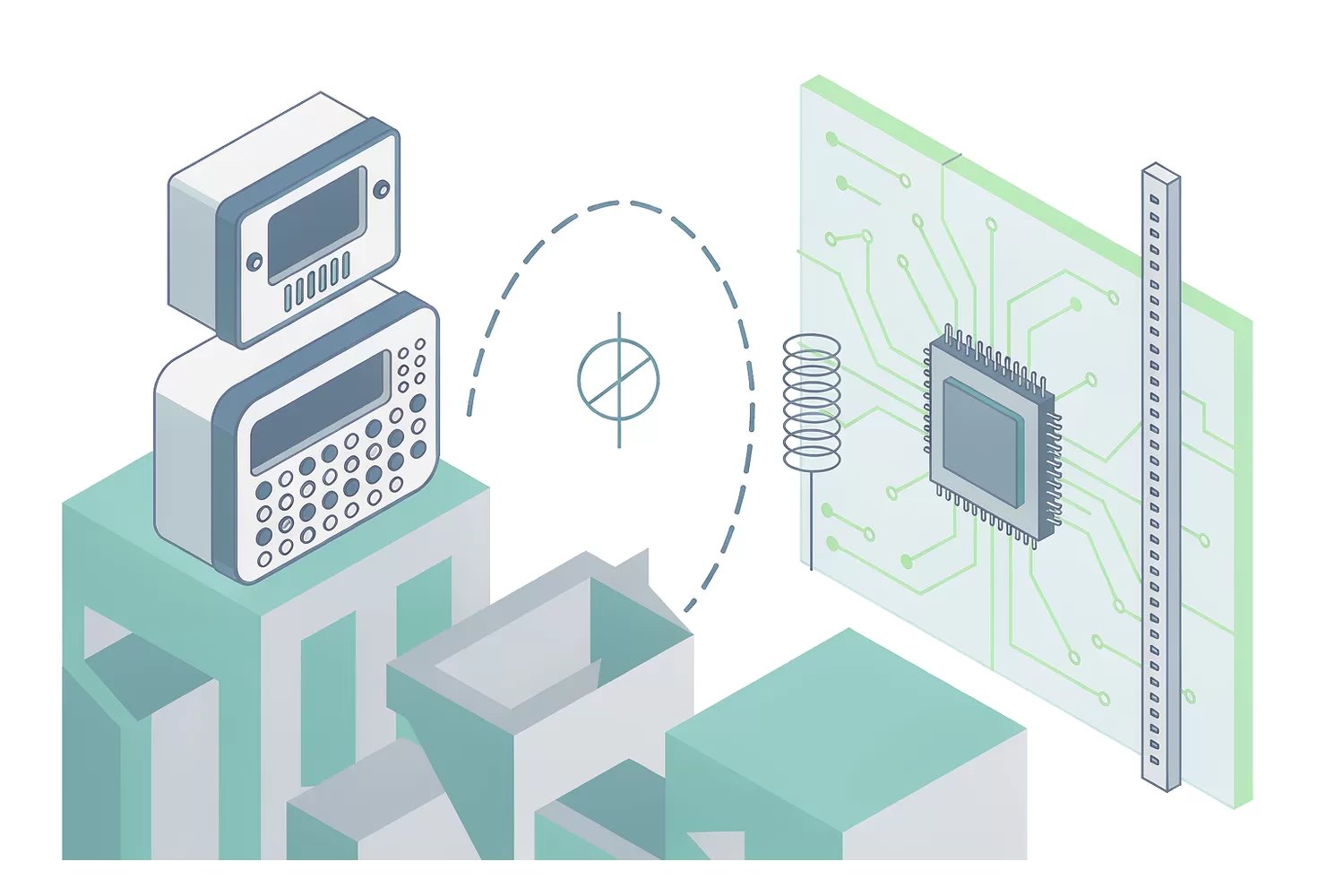
In smart meters, alarm systems, industrial remote controls and agricultural sensors, the radio link is usually a quiet, low-power workhorse in the sub-1 GHz ISM bands. For years the default choice was an imported transceiver such as the TI CC1101 or a Semtech SX-series part. Those chips are excellent — and they are also the category where domestically produced alternatives have advanced fastest, which is why this article looks at both the application logic and the substitution decision in one place.

Application logic: how a sub-1 GHz link is actually built
A sub-1 GHz design trades data rate for range and penetration. The receiver chain (LNA, mixer, IF filters, demodulator) is specified by sensitivity — how small a signal it can still decode — while the transmitter is specified by output power and current consumption. Around the chip, the engineer decides on the antenna ( PCB loop, helical or whip), the matching network, and the frequency plan that matches the local band plan (315/433 MHz in some markets, 868 MHz in Europe, 915 MHz in North America).
Two system choices dominate the outcome in practice. First, the packet protocol: most designs use the chip's built-in packet engine with CRC, address filtering and optional forward-error correction, so a wrong FIFO or sync-word configuration silently costs range. Second, the link budget: every dB of mismatch loss or a cheap antenna costs range directly, which is why layouts for these radios are reviewed like RF layouts, not like digital ones. If you are refreshing the basics, our sub-GHz transceiver guide walks through a concrete design example.
New technology in this category
- Higher integration: transceiver-plus-MCU SoCs (for example parts integrating a Cortex-M core with the radio) now let a whole sensor node run on one chip plus a crystal.
- Better receivers at lower current: modern candidates quote comparable sensitivity with noticeably lower receive current, which matters for battery metering products.
- Software-defined flexibility: wider frequency coverage and programmable modulations let one SKU serve 433 and 868/915 MHz markets with a firmware change.
- Regulatory pressure: region-specific duty-cycle and channel-access rules are pushing designs toward chips with built-in hopping and LBT support.
Domestic alternatives: what to analyse before switching
The analysis sequence we recommend: (1) confirm band and modulation parity against your regional band plan; (2) compare sensitivity and output power at the same supply voltage; (3) check the packet engine features you actually use (address filtering, FEC, auto-acknowledgement); (4) review register-map and driver effort — the SPI protocol is similar but never identical; (5) confirm crystal tolerance, matching-network reuse and layout changes; (6) validate range in your real deployment, not on the bench.
Indicative cost comparison: imported originals vs domestic candidates
Price figures below are indicative public-market reference ranges for moderate volumes, compiled from publicly observable listings. They fluctuate with the spot market, package option, reel size and order quantity, and must not be read as a quotation. Ask us for a firm price on your exact part numbers and quantities.
| Device class | Common imported part (reference) | Indicative imported unit price | Commonly referenced domestic candidate | Indicative domestic unit price |
|---|---|---|---|---|
| Sub-1 GHz FSK transceiver | TI CC1101 (QFN-20 class) | USD 1.2–2.5 | CMOSTEK CMT2300A | USD 0.15–0.40 |
| Sub-1 GHz transceiver (multi-mode) | Semtech SX1262 | USD 2.5–4.5 | CMOSTEK CMT2300A family members | USD 0.15–0.40 |
| LoRa-class SoC (radio + MCU) | Semtech SX1262 + external MCU | USD 3.5–6.0 (combined) | ASR Microelectronics ASR6501 | USD 1.0–2.0 |
Two observations from real bills of materials. First, the per-unit saving on the radio itself is the headline, but the larger saving is often the removal of a separate MCU when moving to a SoC candidate. Second, imported parts in allocation or at end-of-life can be far above these ranges on the spot market — see our EOL RF parts guide for that situation.
Commonly referenced alternative models
| Imported original | Domestic candidate (public sources) | Why it is referenced |
|---|---|---|
| TI CC1101 — sub-1 GHz FSK/GFSK transceiver, SPI, packet engine | CMOSTEK CMT2300A | Same ISM bands and FSK/GFSK family; widely cited as a candidate for cost-driven meter and alarm designs; register map differs, driver rewrite required. |
| Semtech SX1262 — long-range LoRa/FSK transceiver | ASR Microelectronics ASR6501 | SoC integrating the radio function with an MCU; commonly referenced for LoRa-style long-range nodes where a single-chip solution is preferred. |
| TI CC1310 — sub-1 GHz wireless MCU | ASR Microelectronics ASR6601 class SoCs | Radio-plus-Cortex-M integration direction; check SDK maturity for your application before design-in. |
We list candidates here as engineering starting points, not as certified equivalents. The responsible step is a short benchmark: port the driver, run your packet-loss matrix, and compare current consumption on your own board.
Validation checklist
- Range test at maximum packet size and minimum data rate your product allows.
- Coexistence check alongside Wi-Fi and Bluetooth devices in the same enclosure.
- Crystal and matching-network review; re-tune rather than assume reuse.
- Register-level review of packet engine settings (sync word, CRC, whitening).
- Supply-chain check: confirm the domestic candidate is on the manufacturer's active roadmap, not a legacy derivative.
Related reading on our blog
RF chips in IoT wireless sensor nodes · Antenna selection and matching · Sourcing original RF components from China
Frequently asked questions
How close are domestic sub-1 GHz transceivers to the CC1101?
They are commonly referenced as a candidate alternative because they cover the same ISM bands and offer similar FSK/GFSK modulation, but register maps, packet engines and SPI timing differ. Treat it as a redesign of the driver layer and re-run your range and interference tests rather than assuming a one-for-one swap.
Which frequencies do these parts cover?
The parts discussed target the licence-free sub-1 GHz ISM bands, typically 315/433/868/915 MHz depending on the regional band plan. Actual support for a specific band and channel spacing must be confirmed from the manufacturer's datasheet for the exact part number.
Is a SoC with an integrated MCU a good idea for new designs?
For many nodes, yes: a transceiver-plus-MCU SoC removes a chip, saves board area and usually lowers total BOM cost. The trade-off is that you adopt the vendor's SDK and toolchain, so check the development ecosystem and long-term supply before committing.
Can you quote both the imported originals and domestic alternatives?
Yes. We can quote the common imported sub-1 GHz transceivers as well as the domestically produced candidates referenced in this article. Send the exact part numbers, package and quantity, and we will reply with availability, date codes and pricing.
About us & trademarks: JTDZ Tech (Shenzhen Jingteng Electronics Technology Co., Ltd.) is an independent distributor of electronic components. We are not an authorised distributor or representative of any manufacturer named in this article. Manufacturer, brand and part names are used for identification purposes only; all trademarks remain the property of their respective owners. Cross-reference information in this article is based on publicly available sources, is subject to change, and is not a substitute for your own engineering validation. Always verify specifications against the manufacturer's datasheet before design-in or purchase.
