
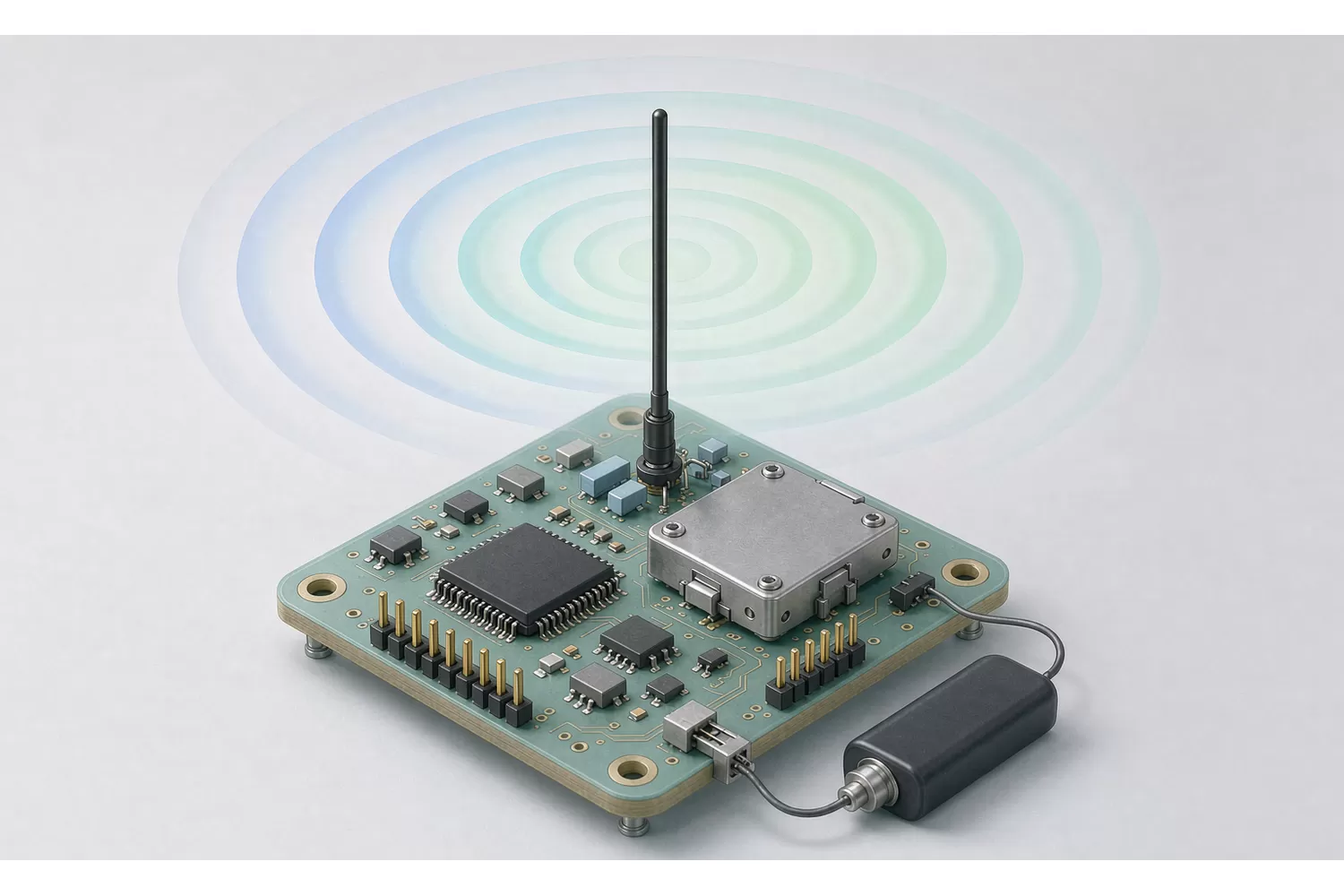
Long-range, low-power wireless almost never means 2.4 GHz. For remote sensors, meters, controls and asset tags, the link that survives a building or a field is usually a sub-GHz one. The Si4455-B1A-FMR from Silicon Labs is a member of the EZRadioPRO family — a sub-GHz transceiver built for exactly that job.

Sub-GHz versus 2.4 GHz
The physics is straightforward: at equal transmit power, a lower frequency travels farther and bends around obstacles better. A 433 MHz or 868/915 MHz link therefore reaches sensors that a 2.4 GHz link would never see, at the cost of lower throughput. For a water meter or a door sensor that sends a few bytes an hour, that trade is an easy one.
What the Si4455 does
- Broad frequency coverage. A single device spans roughly 142 to 1050 MHz, so one bill of materials can serve several regional bands.
- Flexible modulation. 2/4(G)FSK and OOK cover most license-free sensor and control schemes.
- Integrated packet handler. Preamble, sync word, CRC and FIFO management are handled on-chip, which shrinks the host firmware.
- Low current, configurable power. Short, infrequent transmit/receive bursts let the node sleep most of the time.
Building the link
The transceiver talks to a host over SPI and expects the MCU to own the network and sleep logic. Pair it with a small MCU such as the C8051F366 or a Bluetooth SoC like the QCC-3007 when audio or a 2.4 GHz bridge is also needed. The antenna and matching network decide the real range, so treat them as part of the radio, not an afterthought.
Where sub-GHz fits in the range
| Band | Strength | Typical use | Part |
|---|---|---|---|
| Sub-GHz | Range + penetration | Meters, sensors, controls | Si4455 |
| 2.4 GHz | Throughput + ubiquity | Audio, HID, phones | QCC-3007 |
| Host MCU | Link + app logic | Node controller | C8051F366 |
We stock the Si4455-B1A-FMR and related RF parts; see the interface and RF chip range or ask us for a quote on the band and package you need.
Recommended next steps
If you are sourcing any of the parts mentioned in this guide, we can help you confirm stock, pricing, and lead times quickly.
- Upload your BOM — send your full parts list and receive a consolidated quote within 2 business hours.
- Browse related in-stock lines: Sensors / Optoelectronic Devices · Interface Chips / RF Chips.
- Contact our team for hard-to-find or end-of-life components.
About us & trademarks: JTDZ Tech (Shenzhen Jingteng Electronics Technology Co., Ltd.) is an independent distributor of electronic components. We are not an authorised distributor or representative of the manufacturers named in this article. Manufacturer and part names are used for indicative purposes only, to help identify the components discussed; all trademarks remain the property of their respective owners. Always verify specifications against the manufacturer's datasheet before design-in or purchase.
