
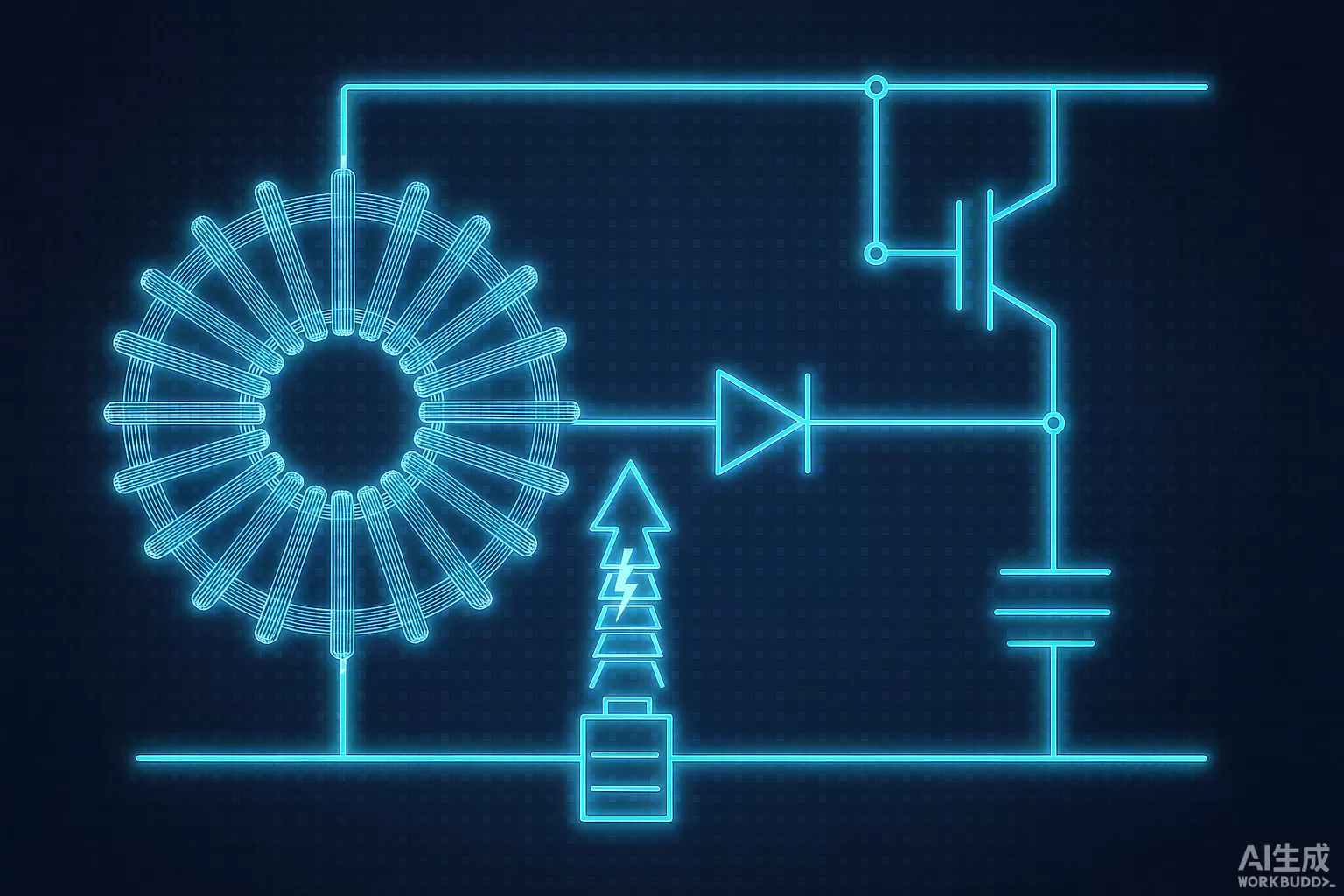
Boost Converter ICs: Synchronous vs Asynchronous Topologies Compared
Boost converters step a lower input voltage up — 3.7 V from a Li-ion cell to 5 V USB, 12 V rails for displays and audio, LED string supplies. Within the boost family there is one fork that shapes cost, efficiency and part count: synchronous vs asynchronous rectification, and integrated vs external MOSFET. Feeling Technology's lineup covers all four corners, and we stock the popular part numbers as an independent distributor.
Synchronous boost: integrated MOSFETs, best efficiency
Synchronous parts replace the rectifier Schottky with an internal second MOSFET, cutting conduction losses — the difference is largest at low output voltage and high duty cycle. Feeling's synchronous boost ICs such as FP6276BXR-G1 and FP6277XR-G1 (both SOP-8(EP) with exposed pad for thermal performance) suit 5 V/9 V/12 V boost rails from single-cell and multi-cell inputs where every point of efficiency matters.
Asynchronous boost: fewer internals, lower cost
Asynchronous parts keep the internal power switch but let the external Schottky do rectification. That trims die area and cost, and the Schottky's low forward drop is competitive at moderate currents. The family spans FP6291LR-G12 and FP6291CLR-G1 in SOT23-6 for compact designs, FP6293XR-G1, FP6295XR-G1, FP6296XR-G1 and FP6298XR-G1 in SOP-8(EP) for mid-range power, and the TSSOP-14 FP5217MR-G1 when more pin-out is needed for features and thermal spreading.
External-MOSFET boost controllers: when power leaves the die
Above a few amps the power switch no longer fits economically in the IC. Boost controllers integrate the control loop and gate driver while the external MOSFET handles the current — FP5207XR-G1 (SOP-8) and FP5207BDR-G1 (DFN-12L) are Feeling's asynchronous controllers in this mould. The trade-offs: you pick the FET's RDS(on), current rating and thermal budget, gaining flexibility at the cost of one more component and a harder layout review.
Choosing between them
| Criterion | Synchronous (e.g. FP6276/6277) | Asynchronous (e.g. FP629x / FP5217) | Controller (e.g. FP5207) |
|---|---|---|---|
| Efficiency at low VOUT / high IOUT | Best | Moderate (Schottky loss) | Depends on external FET |
| Cost | Higher IC cost | Lower IC cost + Schottky | Lowest IC cost + FET + Schottky |
| Max power | Limited by internal switches | Limited by internal switch | Highest (external FET) |
| BOM count | Fewest | One more (Schottky) | Most (FET, gate components) |
Layout notes that apply to all three
- Keep the input loop (Cin → inductor → switch) tight; boost converters stress the input capacitor's ESR.
- For SOP-8(EP) parts, solder the exposed pad to a real copper pour — it is the main heat path.
- Schottky selection for asynchronous parts: low forward drop and adequate reverse voltage with margin.
Where to go next
- All listed parts are in stock under Power Management Chips.
- Also stepping down? Read our guide to buck converters, or upload your BOM and we will quote the full power tree.
- For date codes and volume pricing, contact us.
Questions & Answers
What is the practical difference between synchronous and asynchronous boost ICs?
Synchronous parts integrate a second MOSFET that replaces the Schottky rectifier, cutting conduction losses and improving efficiency, especially at low output voltages. Asynchronous parts use an external Schottky, which lowers IC cost at moderate efficiency.
When should I use a boost controller with an external MOSFET?
When output current or power exceeds what an integrated solution supports, or when you want to pick the switch's on-resistance and thermal characteristics yourself. The FP5207 is a typical external-MOSFET boost controller.
Why do many boost ICs come in SOP-8(EP) packages?
The exposed pad conducts heat from the die into the PCB copper, which is essential for boost converters because all output power flows through the switch and inductor.
Does Jingteng Electronics stock these Feeling Technology boost ICs?
Yes — we are an independent distributor holding spot stock of the FP6276/6277, FP629x, FP5217 and FP5207 families. Quantities and date codes are listed on each product page.
Trademark & Disclaimer
MST, Feeling Technology and all part numbers are trademarks or registered trademarks of their respective owners. Jingteng Electronics is an independent distributor and is not affiliated with, endorsed by, or authorized by Feeling Technology. Brand names and part numbers on this page are used solely for identification and cross-reference. Electrical specifications must be confirmed against the original manufacturer datasheet before use. See our Legal Notice / Trademark Disclaimer.
Recommended next steps
If you are sourcing any of the parts mentioned in this guide, we can help you confirm stock, pricing, and lead times quickly.
- Upload your BOM — send your full parts list and receive a consolidated quote within 2 business hours.
- Browse related in-stock lines: Power Management ICs.
- Contact our team for hard-to-find or end-of-life components.
