
Linear Hall Sensors: Ratiometric Output for Current Sensing and Position
Where switches give you a yes/no answer, linear Hall sensors give you the whole curve: an analog output voltage proportional to the magnetic flux density passing through the die. That proportional ("ratiometric") behaviour is what makes them useful for measuring current without contact, reading throttle or joystick angles, and closing position loops. This guide explains the principle and the MST linear parts we carry — MH254EUA / MH254EST, the MH481 generation (MH481IST, MH481IUA, MH481ISQ, MH481ISD) and the MH491 family (MH491ISO-A, MH491ISO-A-T, MH491IUA-A, MH491IUA-A-T).
How ratiometric output works
A linear Hall IC outputs VOUT = VQ + S × B, where VQ is the quiescent output (half supply in a typical ratiometric design) and S is sensitivity in mV/mT. Because both VQ and S scale with the supply rail, an ADC that uses the same rail as its reference cancels supply error automatically — a significant accuracy win in cost-sensitive boards. The trade-off is that the output is only as clean as your magnetic circuit and supply decoupling.
Application 1: contactless current sensing
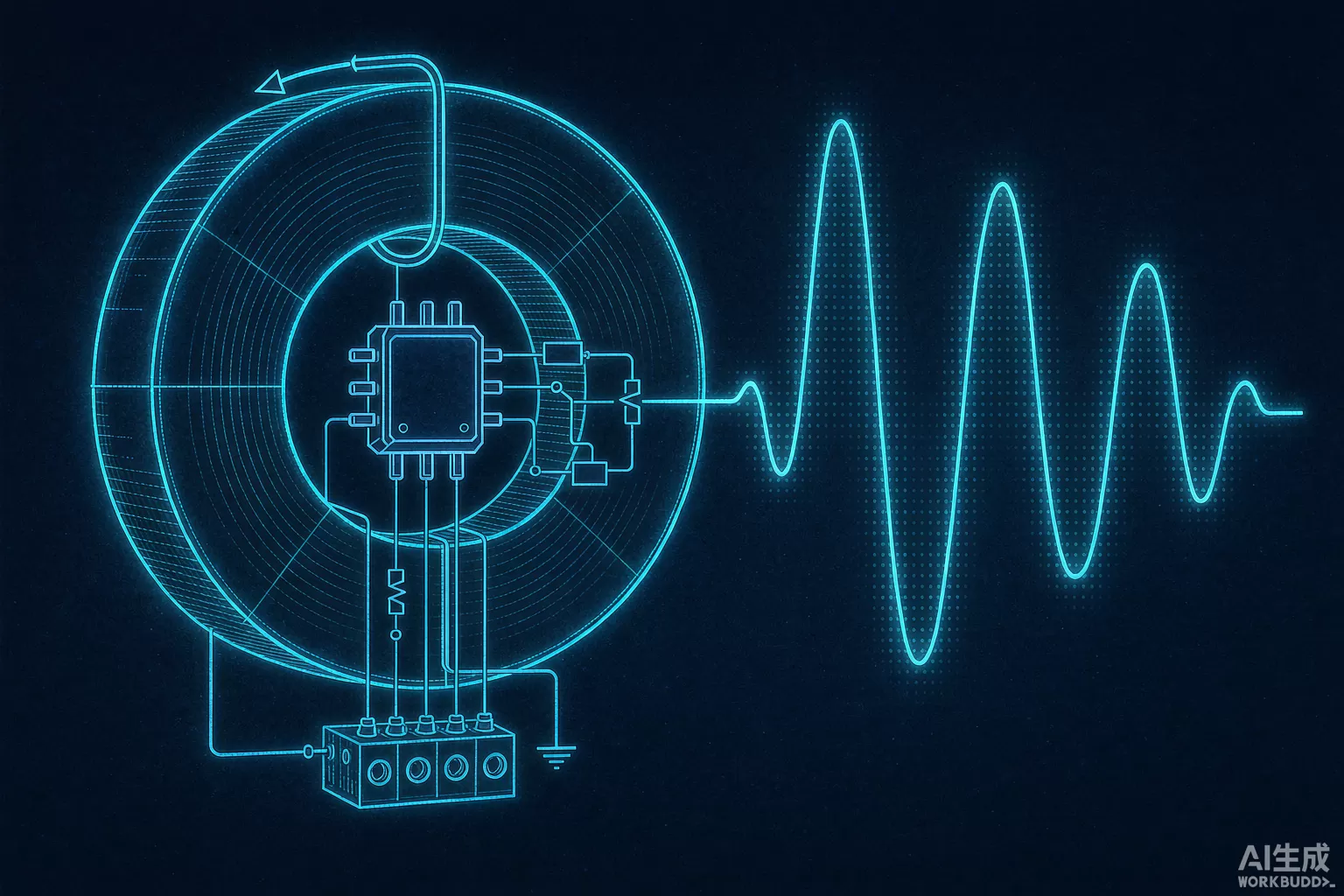
Pass the conductor through a ferrite core with an air gap and place the linear sensor in the gap: the current's field appears as a proportional voltage. This isolates the measurement electronics from the power circuit with no shunt loss. Gain and offset calibration in firmware (two-point calibration against a known load) brings residual core non-linearity down. For compact, board-level versions, QFN-packaged parts like MH481ISQ and MH481ISD minimise the sensing footprint.
Application 2: angle and position measurement
A diametrically magnetised magnet rotating above a linear Hall die produces a sinusoidal output; two dies at 90° give sin/cos from which any angle is computed with an arctangent. The same trick reads suspension height, throttle pedals, gas valves and joystick positions. TO-92S parts such as MH491IUA-A suit potted probe assemblies, while SOT23 versions like MH491ISO-A drop onto the main PCB. The -T suffix variants (MH491ISO-A-T, MH491IUA-A-T) are tape-and-reel packaging options for automated lines.
Application 3: magnetic level and proximity scaling
Because the output is continuous, a linear sensor can report "how far" rather than just "whether" — float magnets in tanks, dampers, and slide potentiometer replacement. The classic MH254EUA (TO-92S) and MH254EST (TSOT-23-3L) cover these general-purpose roles economically.
Design checklist
- Decouple the supply — ratiometric output inherits supply noise directly.
- Shield or distance from motors/transformers — stray DC fields shift the quiescent point.
- Calibrate offset and gain in firmware — two-point calibration absorbs mechanical tolerance stack-up.
- Verify linearity across temperature — sensitivity drifts; check the datasheet curve at your range endpoints.
Sourcing
- All listed parts are in stock under our Sensors & Optoelectronic Devices category.
- Need the whole signal chain? Upload your BOM for a one-shot quote including amplifiers and MCUs.
- Or contact us for date codes and volume pricing.
Questions & Answers
What does 'ratiometric output' mean on a linear Hall sensor?
The output voltage scales with the supply rail: both the quiescent point and sensitivity track VCC. Using VCC as the ADC reference cancels supply drift from the measurement.
Can a linear Hall sensor measure DC current?
Yes. With a magnetic core and air gap, the sensor reads the DC field produced by the conductor, giving isolated current measurement without a shunt resistor.
What is the difference between MH491ISO-A and MH491ISO-A-T?
They are the same sensor die; the -T suffix denotes tape-and-reel packaging for automated SMD assembly versus tray/bulk handling.
Does Jingteng Electronics sell these MST linear sensors?
Yes — we are an independent distributor with spot stock of the MH254, MH481 and MH491 families. Each product page lists quantity and date code; contact us for a quote.
Trademark & Disclaimer
MST, Feeling Technology and all part numbers are trademarks or registered trademarks of their respective owners. Jingteng Electronics is an independent distributor and is not affiliated with, endorsed by, or authorized by MST. Brand names and part numbers on this page are used solely for identification and cross-reference. Electrical specifications must be confirmed against the original manufacturer datasheet before use. See our Legal Notice / Trademark Disclaimer.
Recommended next steps
If you are sourcing any of the parts mentioned in this guide, we can help you confirm stock, pricing, and lead times quickly.
- Upload your BOM — send your full parts list and receive a consolidated quote within 2 business hours.
- Browse related in-stock lines: Amplifiers / Data Conversion · Sensors / Optoelectronic Devices.
- Contact our team for hard-to-find or end-of-life components.
