
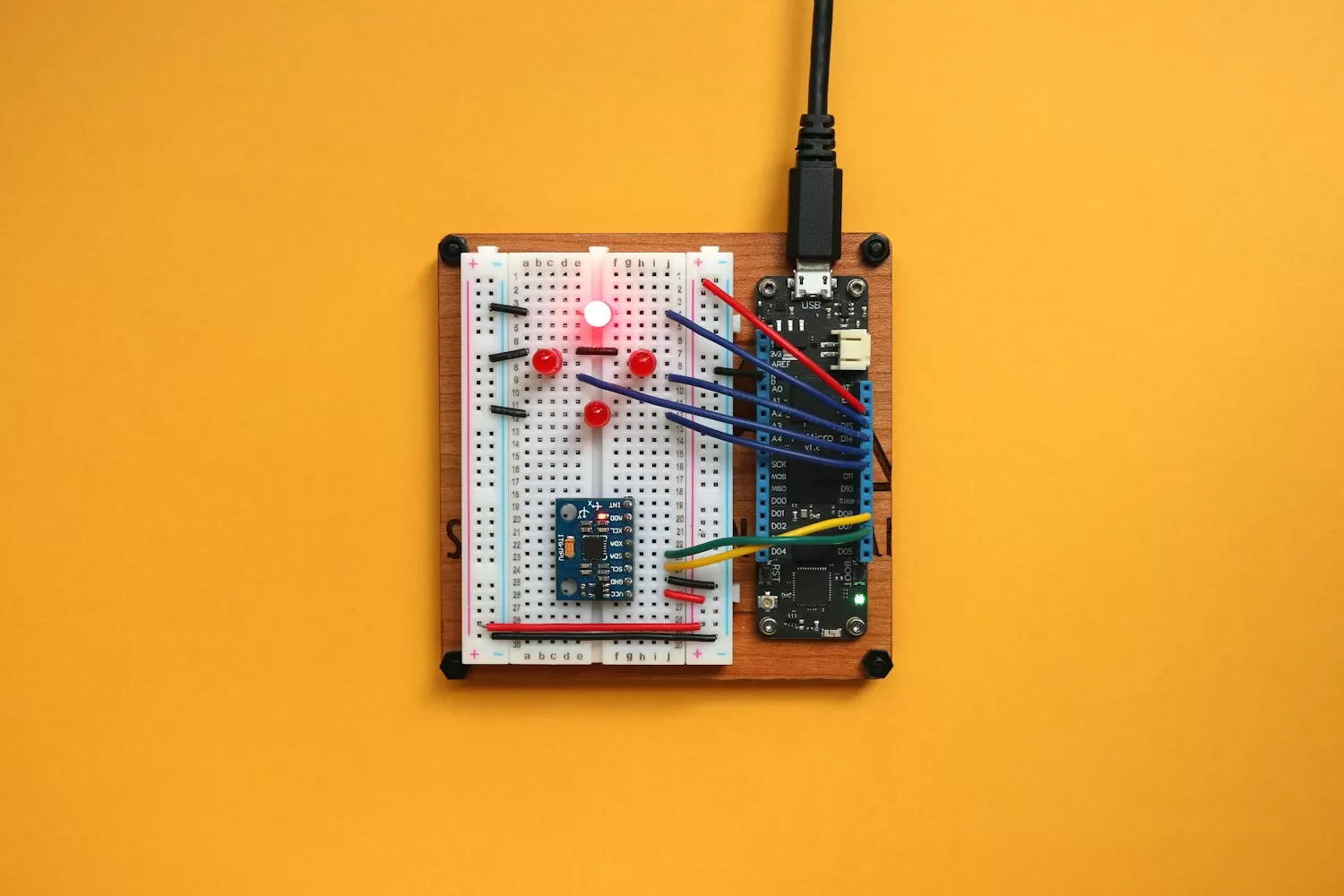
The 32-bit MCU market has split into clear tiers — mainstream, high-performance, and value — and in 2026 the interesting action is in all three at once. Choosing correctly is less about core marketing than about matching peripherals, memory, and ecosystem to the product. Here is a working framework.
Core Choice: M4F vs M0+ Is a Cost/Performance Decision
- Cortex-M0+ (48–72 MHz class) covers the enormous middle of the market: appliances, sensors, lighting, simple motor control, touch interfaces. It is cheap, low-power, and code-dense enough for most control loops.
- Cortex-M4F (200–288 MHz class) brings a hardware FPU, DSP instructions, and the memory to feed them. Motor FOC with position estimation, audio, TFT displays, and any control loop that benefits from floating-point math belong here.
- The real decision is usually memory and peripherals, not MHz: a 288 MHz part with 32 KB of flash solves nothing; a 72 MHz part with the right ADC, CAN, and op-amps on-chip can eliminate a whole board section.
Three Family Profiles Worth Knowing
| Family | Profile | Standout Features |
|---|---|---|
| Artery AT32F403A/F407 & F435/437 (雅特力) | Mainstream & high-performance M4F | 240–288 MHz on 55 nm; up to 4032 KB flash and 512 KB SRAM on F435; 3× 5.33 Msps ADCs; dual CAN; dual QSPI; Ethernet MAC on F407/F437; sLib code-protection zones |
| Puya PY32 (普冉) | Value M0+/M4, application-specialized | 24–144 MHz range; motor-control SoCs with integrated pre-drivers and op-amps; hardware-touch MCU variants; ultra-low-power NOR Flash pairs naturally with PY32 for code storage |
| Sinomcu SC32F (赛元) | Industrial-grade M0+, white-goods heritage | Up to 64 MHz, 2.0–5.5 V wide supply, −40 to +105 °C; strong ESD/EFT immunity ratings; up to 512 KB flash; ISP/ICP/IAP and OTA boot paths; deep 8-bit 8051 (SC92F) legacy for touch products |
Each family answers a different question. AT32 maximizes headroom — when your firmware keeps growing, 4 MB of on-chip flash and zero-wait execution end the argument. PY32 optimizes BOM cost and integration, especially in motor and touch applications where the SoC absorbs discrete parts. SC32F optimizes robustness: wide supply, wide temperature, and interference immunity tuned for appliances that live next to relay coils.
Migrating Off an 8-Bit Part
Thousands of shipping designs still run on 8051-class MCUs, and the migration calculus has improved every year as 32-bit value parts approach 8-bit pricing. Checklist:
- Pinout and supply: 5 V-tolerant I/O and 2.0–5.5 V operation (as on SC32F) let you migrate without redesigning the power tree or level-shifting the board.
- Peripherals you actually use: map timers/PWM, UART, and ADC channels one-for-one before committing; most 8-bit usages have direct 32-bit equivalents.
- Toolchain and code reuse: CMSIS-compliant parts work in Keil, IAR, and GCC; hardware divisor and multiply on M0+ remove the 8051's arithmetic quirks from your porting list.
- Flash endurance and OTA: modern 32-bit parts support in-application programming and dual-bank-style update paths — plan the bootloader early, not after certification.
- Supply durability: qualify at least two sources for the socket; the vendor-listed cross-reference tables (Artery publishes one explicitly) shorten that work.
Send us your current 8-bit part number and peripheral usage and we will map it to 32-bit alternatives across these families with sample-level lead times.
Related parts & collections
Browse the in-stock lines referenced in this guide:
Need a quote fast? Upload your BOM and we reply within 2 business hours. | Contact us
